
Floods in Himachal, Gujarat, drought in K'taka: What's behind the weather contrast?
The IMD recently said that the intense spell of rainfall in northern India resulted from the interaction between Western Disturbance (WD) and monsoonal winds.
- India News
- 6 min read

Days after much of Delhi went under water, the national capital is once again at risk of floods as the water level in the Yamuna River goes past the 205-metre danger mark. This comes after the water level went below the danger-mark on July 22. The water level in the Yamuna river is now at 206.26 metres. Impeding floods have put the Delhi government have been on high alert and large amounts of water have been discharged into the Hathinikund Barrage due to heavy rain in Himachal Pradesh and Uttarakhand.
For the last few weeks, scenes of floods have surfaced from across the northern states. On July 9, Delhi recorded its wettest day as it received 6 inches of rain, the highest since 1982, according to the India Meteorological Department (IMD).
States such as Himachal Pradesh, Uttarakhand, Punjab, Uttar Pradesh, Rajasthan and Jammu and Kashmir have also witnessed torrential rains causing damages worth Rs 10,000- Rs 15,000 crore. Add to this, the unaccounted damage in Gujarat which is also grappling with flash floods as of July 23.

(Inundated Yamuna Bazar in New Delhi; Image: PTI)
Advertisement

(Rescue teams bring villagers to safety in Punjab; Image: PTI)

(Locals swimming their way through a flooded road in Haryana's Faridabad; Image: PTI)
Advertisement
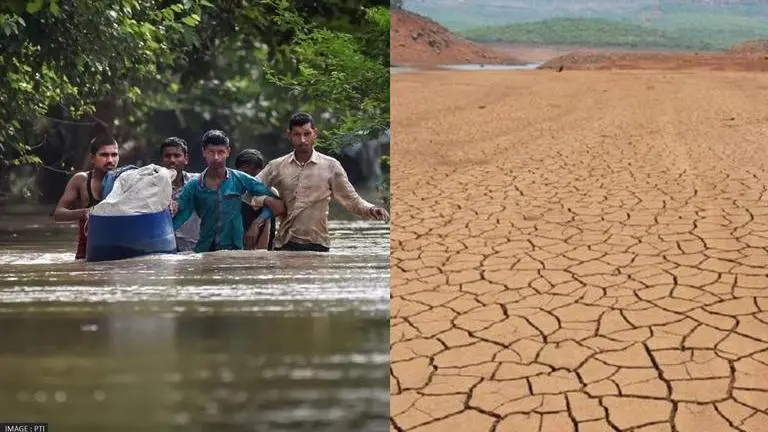
In Himachal alone, the state incurred an estimated loss of Rs 5,000 crore due to damages to roads, transformers, electricity stations and water supply sources. Dozens of deaths have also been reported across northern India due to the floods, all while southern and eastern India is facing a threat of drought. The scenario in the southern state of Bengaluru, along with Jharkhand and Bihar paint a completely different picture due to scarce rainfall. The crops of paddy are waiting to be sown in these states and the administration is anxious about declaring a drought.
Death and destruction in north and west India, potential drought in south and east
In northern India, Jammu and Kashmir has been reeling under heavy rains and the resulting flash floods and landslides. The torrential rains have caused the water levels to rise in the rivers Jhelum, Tawi and Chenab causing damage to properties in several districts. In Punjab and Haryana, more than 50 people have died and many have been left displaced. Officials revealed that a total of 1,457 villages in 19 districts of Punjab are still affected by floods.
Himachal and Delhi have witnessed similar scenes along with the western states of Rajasthan, Gujarat and Maharashtra. Gujarat is being pounded with rain again after just recovering from the severe cyclonic storm Biparjoy.
But southward, Karnataka is struggling to meet the target of sowing paddy crops despite the arrival of the monsoon. Agriculturist Venugopal Adiga told Republic that the state has set a target of sowing various agricultural crops in an area of 82.35 lakh hectares for the Kharif season 2023. However, only 26.82 lakh hectares, or 33% of the area had been sown till the first week of July.
Agriculture Minister Cheluvarayaswamy told Republic that the government will consider declaring a drought in a few districts of the state if the scarcity continues till the last week of July.

(Farmers planting paddy in the field; Image: PTI/File)
This rainfall deficiency has raised an alarm in the east as well. Bihar CM Nitish Kumar, during a meeting on Friday, alerted the officials and directed them to ensure the availability of drinking water and make preparations to assist the farmers in case of a drought. According to the India Meteorological Department (IMD), there has been a 41% deficiency in rainfall in Bihar this year.
From June 1 to July 21, the state received only 238 mm of rain instead of the ideal 406 mm. Notably, only four of the 38 districts in Bihar have received proper rainfall, according to official data. The state had set a target of planting paddy in 35 lakh hectares area but only 43% of it has been achieved.
The situation is grave in Bihar's neighbouring state Jharkhand as well which is facing a 45% rain deficit. Till July 21, Kharif crops were sown in only 4.15 lakh hectares against the target of 28.27 lakh hectares, which makes up only 14% of the arable land, officials revealed. Notably, the sowing of the main crop of the season, paddy, was even lesser at 11.20% of the target of 18 lakh hectares as compared to the previous year. In 2022, the figure was 11.76% around the same time.
What's with the simultaneous droughts and floods?
In early July, the India Meteorological Department (IMD) said that the intense spell of rainfall in Himachal Pradesh and Uttarakhand resulted from the interaction between the Western Disturbance (WD) and the monsoonal winds. The monsoon arrived in New Delhi in the last week of June and the rains were coupled with the WD which brings rainfall from the Mediterranean region.

(Diagram showing the mechanism of Monsoon; Image: NOAA)
Both the WD and the monsoon are basically a result of winds travelling from high-pressure (low temperature) to low-pressure (high pressure) areas. In the case of WD, the moisture-filled air in the upper atmosphere rushes across the Middle East from Iran, Afghanistan and Pakistan to finally enter the Indian subcontinent. The WD brings moderate to heavy rain in low-lying areas and a huge quantity of snow to mountainous areas including in the Indian subcontinent.
As for the mechanism of the monsoon, it works the same way except the air with moisture rushes from the Indian Ocean to the warm land (low pressure). When the moisture-filled winds reach land, they rise up and condense bringing rainfall (see picture above).
However, while the mechanism of WD and the moonsoon is the same, the major difference between the two is uniformity. The Western Disturbance is not seasonal. The IMD recently confirmed that the heavy spells of rain in northern India were due to the rare phenomenon of an amalgamation of the WD and monsoonal winds, doubling the amount of rainfall. Although scientists had predicted the Western Disturbance to subside soon, it seems to be lasting longer than expected.