
After Kashi, preparations on to build Ujjain Mahakal Corridor: Plan for its iconic revival
Touted to transform into ‘India's most technologically advanced religious site’, here are details of the Ujjain Mahakal Temple Corridor.
- India News
- 6 min read

;'%3e%3cpath%20d='m8,15.99c4.41,0,7.99-3.58,7.99-7.99S12.41,0,8,0,0,3.59,0,8s3.58,7.99,7.99,7.99Z'%20style='stroke:%23fff;%20stroke-miterlimit:10;%20stroke-width:.02px;'/%3e%3cpath%20d='m3.08,3.37l3.82,5.11-3.84,4.15h.87l3.37-3.64,2.72,3.64h2.94l-4.04-5.39,3.58-3.87h-.86l-3.1,3.35-2.5-3.35h-2.94Zm1.27.64h1.35l5.97,7.99h-1.35l-5.97-7.99Z'%20style='fill:%23fff;'/%3e%3c/g%3e%3c/svg%3e)


On December 12, Prime Minister Narendra Modi inaugurated his dream project - the Kashi Vishwanath Corridor - at his parliamentary constituency Varanasi. Conceptualised by the PM himself, the corridor located near the iconic Dashashwamedh Ghat, sought to clear the pathway to the ancient temple by removing properties clogging the corridor in a litigation-free manner, while preserving existing heritage sites.
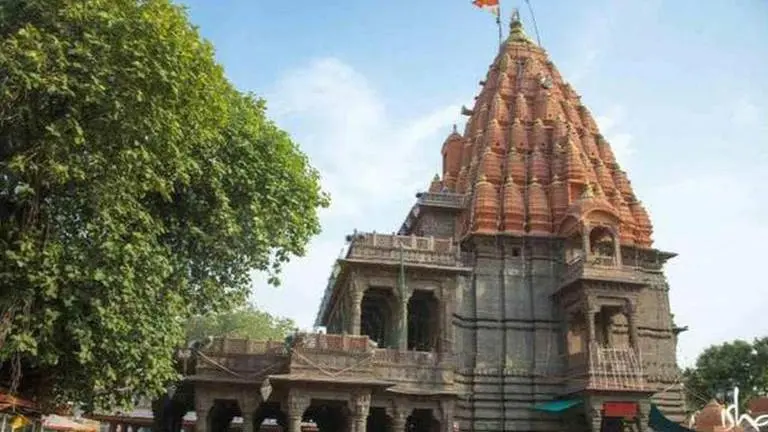
The Government has now envisioned a similar plan, in fact at a much larger scale, in the form of the Ujjain Mahakal Corridor leading up to the Mahakaleshwar Jyotirlinga. The ambitious project has been divided into a two-part plan to expand the temple complex by nearly eight times its present size from 2.82 hectares to 20.23 hectares by August 2023.
For taking the temple town back to its previous glory, the Madhya Pradesh Government has come up with an elaborate project, with CM Shivraj Singh Chouhan approving an initial fund of Rs 500 crore for the development of the corridor in January this year. Touted to transform into ‘India's most technologically advanced religious site’, the Ujjain Mahakal Temple Corridor would be developed to include a 900-metre long corridor filled with scores of installations, a theme park, a heritage mall, E-transport facilities, and most importantly, to connect the water from the holy Shipra river to Rudra Sagar lake.
Details of the Ujjain Mahakal Corridor
The monumental project is being developed under the MP government's larger plan to transform Ujjain into a 'Smart City'. Given the scale of the vision, the project will be undertaken in two parts. In the first part, the area near the Char Dham Mandir, Nutan school complex, Ganesh school complex, Mahakal's new entry door, 900-metre long corridor, theme park, Rudra Sagar Ghat, Midway June, a Food court, watchtower, mural walls, and other sections would be completed. Around 200 houses in Begum Bagh will be demolished and transformed into multi-storey buildings to beautify the region, as part of the initial development plan.
Advertisement
In the second part, the transformation of Maharajwada school Bhavan to a heritage Dharamshala, the linking of Rudra Sagar and Shipra river, beautification of the front lake area, construction of multi-level parking with a space to fit 350 cars, a railway underpass and the development of a 210-meter suspension bridge over Rudra Sagar, amongst others would be undertaken. Moreover, a dynamic light show will be given a spot near the iconic Ram Ghat. It is being stated that all these works will be completed by 2028.
Interestingly, earlier this year, a treasure trove of ancient remains had been found during the excavation work at the premises. Ancient pillars, temple walls and foundations of the 2,100-year-old temple structure, destroyed during the Muslim invasion were unearthed. All artefacts found during the construction process would be preserved by the State and Ministry of Culture.
Advertisement
Key features of the Mahakal Temple Corridor
The 900-metre Mahakal Corridor would be adorned with larger-than-life statues and idols of Hindu Gods and Goddesses. Traditional Rajasthan stone will be used to build approximately 108 pillars and 200 Shiva statues along the corridor. At least 200 more idols will be built along the corridor featuring Parvati, Ganesh, Nandi and other gods to lead up to the 12-metre high entryway to the Triveni Museum. A Ganesh pond will be built in front of the main entrance, with a nine-foot-tall idol. A 920-meter heritage mall from the entryway to the Mahakal temple is also being constructed.
Along the long corridor, several technological facilities such as smart ticket counters, restrooms, places to sit at intervals, will be developed. From Mahakal plaza, a path will be made to connect the Mahakal corridor and temple through two lanes of three metre-width each. One would be used for devotees who wish to undertake the journey on foot, and the other for e-rickshaws. A midway zone for a craft bazaar will also be created. Moreover, the state is also planning to develop a Mahakal Vatika with trees to make the journey of the devotees even more mesmerising. Along the walls, murals would narrate Lord Shiva's tales and devotees would be able to reach the Garbhagriha with ease. Inside, Shehnai Dwar will be expanded to have a waiting hall and the Nandi hall will be further developed.
विश्वनाथ कॉरिडोर के बाद अब महाकाल कॉरिडोर की तैयारी।
— Prashant Umrao (@ippatel) December 27, 2021
हर हर महादेव🚩 pic.twitter.com/hkLTcQ9Kas
Brief history of Mahakal Temple: Why the delay?
The present structure of the Mahakal Temple was built by the Maratha general Ranoji Shinde in 1734 CE after Baji Rao I appointed him to collect taxes in the Malwa region. The original temple structure, built thousands of years ago, was razed to the ground by Sultan Shams-ud-din Iltutmish during his raid of Ujjain in 1234-5. It is believed that the Jyotirlinga was dismantled and thrown into a nearby 'Kotiteerth with the Jaladhari stolen during the invasion.
Speaking exclusively to Republic TV, author and historian Uday Mahurkar underlined how Ujjain went into a decline during the medieval period, a time when both through the Sultanate and Mughal era, the temple was demolished a number of times, much like other Hindu temples across India.
"The Marathas finally restored the lost glory to Ujjain post the demise of Aurangzeb and downfall of the Mughal empire. Under Ranoji Scindia, the Marathas did the reconstruction of the Mahakaal and other temples in Ujjain in 1735. But much through the freedom struggle and for the greater part of the post-independence history, reclaiming lost Hindu prestige never became a mainstream political narrative," he shared.
The thinker further expounded on how the repression led to a sense of 'victimhood' among a great mass of Hindu communities in the country. It is only now in the last few years that a Hindu renaissance is taking shape under the present government, he detailed, adding that the delay in restoration is a direct result of the Congress policy of Muslim appeasement since independence, which is now getting corrected.
"So be it the Kedarnath redevelopment project or the Somnath temple beautification, or the more recent Kashi Vishwanath Corridor, the Modi government is spearheading that Hindu reassertion. It is a civilisational project to re-establish lost symbols of the Hindu faith. If the Ujjain Mahakaal temple is going to see similar redevelopment, it is in the fitness of things. It underscores the Hindu renaissance and correction of a centuries-old wrong," said Uday Mahurkar.
This will be a historic event in our 1,000 year history. Ujjain’s Mahakal temple was demolished by several Muslim invaders but was ultimately resurrected in 1730s by Maratha ruler Ranoji Scindia & his Diwan Ramchandra Baba who revived all the temples of Ujjain.
— Uday Mahurkar (@UdayMahurkar) December 28, 2021
We owe them a lot https://t.co/zh2e8V2L52