
India highlights its contribution to global food security amid COVID outbreak, Ukraine war
India on Thursday highlighted that the contribution of the nation to global food security is a 'basic minimum requirement', especially during the war
- India News
- 3 min read

;'%3e%3cpath%20d='m8,15.99c4.41,0,7.99-3.58,7.99-7.99S12.41,0,8,0,0,3.59,0,8s3.58,7.99,7.99,7.99Z'%20style='stroke:%23fff;%20stroke-miterlimit:10;%20stroke-width:.02px;'/%3e%3cpath%20d='m3.08,3.37l3.82,5.11-3.84,4.15h.87l3.37-3.64,2.72,3.64h2.94l-4.04-5.39,3.58-3.87h-.86l-3.1,3.35-2.5-3.35h-2.94Zm1.27.64h1.35l5.97,7.99h-1.35l-5.97-7.99Z'%20style='fill:%23fff;'/%3e%3c/g%3e%3c/svg%3e)


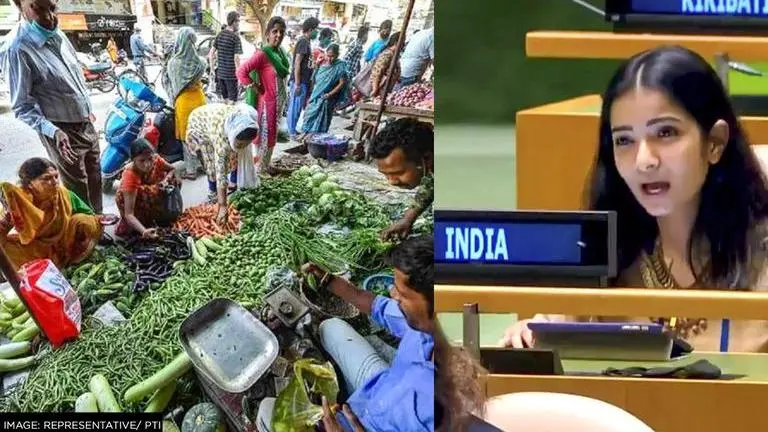
India on Thursday highlighted that the contribution of the nation to global food security is a 'basic minimum requirement', especially at the time when the globe grapples with the worldwide effects of the COVID-19 outbreak and ongoing wars. While, speaking at the United Nations Security Council ARRIA formula meeting on conflict and hunger, India's First Secretary Sneha Dubey said that New Delhi has delivered food assistance to several nations, which includes Myanmar, Afghanistan, Lebanon, Sudan, as well as South Sudan, ANI reported.
Indicating the contributions, Dubey said that India has chosen to provide 50,000 metric tons of wheat to Afghanistan due to the growing humanitarian crisis. It is worth noting that recently, Pakistan said that India has been given a two-month extension to transfer 50,000 metric tons (MTs) of wheat and life-saving medications to Afghanistan through the Attari-Wagah integrated checkpoint. The time restriction for transferring humanitarian supplies ended on March 21, 2022, according to a statement provided by Pakistan's Ministry of Foreign Affairs, and New Delhi has asked for a time extension to complete the aid shipment.
Further, India has also continued to provide humanitarian assistance to Myanmar, including a donation of 10,000 tons of rice and wheat, Dubey added.
India commits to promoting global food security, especially in conflict-affected areas
The First Secretary also reaffirmed India's commitment, by saying that the nation will continue to collaborate with all other member states along with international organisations, including the United Nations, to promote global food security, especially in conflict-affected areas.
Advertisement
According to Sneha Dubey, "Food security, in itself, is not a driver of armed violence and conflict. It may, at best, precipitate or exacerbate violence, depending upon a country's level of development and the strength of its political institutions," ANI reported.
Armed conflict as well as terrorism, she noted, when joined with the extreme weather conditions, food price fluctuations, political isolation, and economic shocks may devastate any weak state, further reducing economic development and raising the risk of famine.
Dubey further asserted during the ARRIA formula meeting, “We would like to underscore that "White Notes" on famine risk in conflict situations should be objective and factual, and need not become political tools.” she claimed that unfortunately, they are seeing an increase in the politicisation of humanitarian issues.
Advertisement
In addition to this, India emphasised that the food security issues which is arising from the Ukraine crisis need to respond effectively, embracing UN Secretary-General Antonio Guterres' request for immediate relief from food export restrictions. "The growing shortages can only be addressed by going beyond the constraints that bind us presently," Dubey noted.
Furthermore, India remains dedicated to global food security, having donated to the UN's Central Emergency Response Fund (CERF) and UN Office for the Coordination of Humanitarian Affairs (UNOCHA) in response to numerous humanitarian emergencies over the years.
(Image: Representative/ PTI)