
Updated 22 August 2018 at 22:18 IST
Kerala Floods 2018: Here's the background to why India may not accept the Rs 700 crore aid offered by the UAE
Government sources have provided reasons as to why India may not accept the around Rs 735 crore in aid that is being offered by the UAE, Qatar and the Maldives on account of the floods that have rocked Kerala over the last two weeks
- India News
- 0 min read

Update at 10:15 PM:
The Union Government issued an official statement on Wednesday responding to the denial of foreign aid towards rebuilding Kerala after its recent devastating floods.
The statement read:
“The Government of India deeply appreciates offers from several countries, including from foreign governments, to assist in relief and rehabilitation efforts after the tragic floods.
In line with the existing policy, the Government is committed to meeting the requirements for relief and rehabilitation through domestic efforts.
Contributions to the Prime Minister's Relief Fund and the Chief Minister's Relief Fund from NRIs, PIOs and international entities such as foundations would, however, be welcome."
Government sources have provided reasons as to why India may not accept the around Rs 735 crore in aid that is being offered by the UAE, Qatar and the Maldives on account of the floods that have rocked Kerala over the last two weeks.
Advertisement
In light of the UAE, which is home to a large diaspora from Kerala, offering Rs 700 crore in aid, a figure that exceeds the Rs 600 crore allocation by the Centre, sources have told Republic TV, that 'as a general policy in case of rescue and relief operations, India has followed the practice that we have adequate ability to respond to emergency requirements. For a variety of reasons we have not accepted offers of assistance for rescue and relief unless there are specific circumstances'.
The sources did add a rider, however, speaking about how such cataclysmic events have a longer-term impact:
'Beyond the rescue and relief there are other phases. These are rehabilitation, reconstruction and so on. If reconstruction and other measures are provided for those elements, we will examine how they fit into the broader plan in terms of rehabilitation and reconstruction in the region and take a call at that stage'
THE ORIGIN OF INDIA NOT ACCEPTING DISASTER AID:
Interestingly, the policy of not accepting relief aid in the case of such natural disasters is not new, but it's not old either. It came into force following the December 26, 2004, Indian Ocean Earthquake and Tsunami that caused enormous loss of life in a number of South-East Asian countries, and also, on India's East coast and in the Andaman and Nicobar islands. At that time, the Manmohan Singh-led UPA government, which was just over half a year-old, had declined offers of aid from foreign countries, backing India's propensity to manage by itself.
Advertisement
“We feel that we can cope up with the situation on our own and we will take their help if needed”, then PM Manmohan Singh had said.
Since then, for a number of calamities, including multiple floods in Jammu and Kashmir and in Uttarakhand, India has declined offers of aid, as per what appears to now have become an informal diplomatic protocol. Contributions can be made, however, via remittances by Indians staying abroad, or via NGOs, or through donations into disaster relief funds.
KERALA FLOODS | Here's How You Can Help
INDIA NOW A NET DONOR OF AID
Following the 'no foreign aid for disasters' policy coming into effect, which coincided with the fastest economic growth India had recorded till that point, India appears to have instead become one of the top donors. In fact, India had donated $25 million in aid to Sri Lanka following the very same 2004 Tsunami, and has regularly provided aid to a number of countries, including the US and Bangladesh (Hurricane Katrina and Cyclone Sidr), Pakistan and China (Earthquakes), and even Japan (Earthquake and subsequent Fukushima-Daichii nuclear accident). On the other hand, before the policy came into effect, India had accepted donations for a number of disasters, including earthquakes in Maharashtra's Latur and Gujarat's Bhuj, as well as the floods in Bihar in 2004.
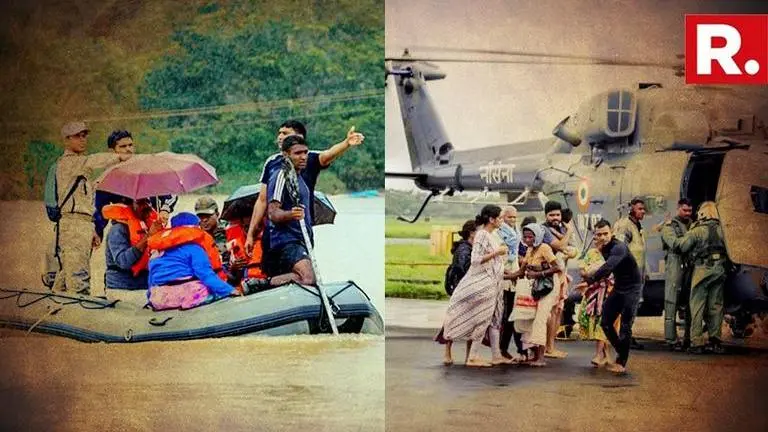
The Central government's allocation for Kerala was broken down into a number of buckets, tackling specific issues that the people of the state would face, including rescue and relief (for which the Army, Navy, Air Force and NDRF were deployed at a war footing), food medicines and essential supplies, insurance claims for property loss, quick rebuilding of infrastructure, provision for employment for those who have lost livelihoods, provision for housing for residents of villages who have lost kutcha housing, and others. The state, meanwhile, had pegged the loss caused due to the debilitating floods at almost Rs 2000 crore.
Unabating rainfall in Kerala and its subsequent effects have caused the deaths of over 350 people and the displacement of over 2 lakh others to various relief camps. Around 80 dams have had to be opened, many for the first time, to prevent overflow. Apart from the Centre, a number of states have sent aid, while corporates, citizens and others have done their bit.
Published By : Ankit Prasad
Published On: 22 August 2018 at 16:15 IST