
Yasin Malik sentenced to life imprisonment: All Charges, fines against terror convict here
Yasin Malik has been charged under 10 Sections of the IPC and UAPA and a total fine of Rs 10.75 lakhs has been imposed on him by the Special NIA Court.
- India News
- 5 min read

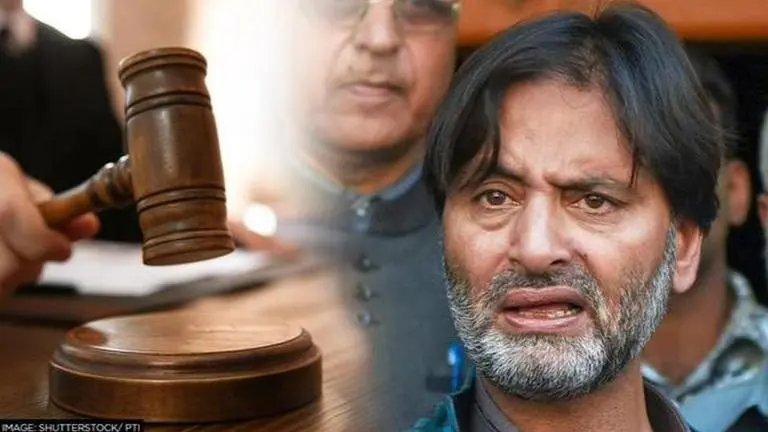
The National Investigation Agency (NIA) on May 25 sentenced convicted Kashmiri separatist Yasin Malik to rigorous life imprisonment. According to the details, Yasin Malik has been charged under 10 Sections of the Indian Penal Code (IPC) and Unlawful Activities (Prevention) Act (UAPA) and a total fine of Rs 10.75 lakhs has been imposed on him. It is under Section 17 of the UAPA and Section 121 of the IPC, that Malik has been sentenced to life imprisonment along with a 2.5-year and 6-year additional sentence respectively.
Here are details of the Charges & Fines imposed against him:
1. Charge: 120 B IPC
Sentence: 16 years
Fine: Rs 10,000
2. Charge: 121 IPC
Sentence: Life imprisonment + 6 years
Fine: Rs 10,000
3. Charge: 121 A IPC
Sentence: 16 years
Fine: Rs, 10,000
Advertisement
4. Charge 13 UAPA r/w 120B IPC
Sentence: 8 years
Fine: Rs 5,000
5. Charge: 15 UAPA r/w 120b IPC
Sentence: 16 years
Fine: Rs 10,000
Advertisement
6. Charge: 17 UAPA
Sentence: Life imprisonment + 2.5 years
Fine: Rs 10 lakhs
7. Charge: 18 UAPA
Sentence: 16 years
Fine: Rs 10,000
8.Charge: 38 UAPA
Sentence: 8 years
Fine: Rs 5,000
9. Charge: 39 UAPA
Sentence: 8 years
Fine: Rs 5,000
10. Charge: 20 UAPA
Sentence: 16 years
Fine: Rs 10,000
Charges & Fines against Yasin Malik

Sentence Yasin Malik by Republic World on Scribd
Yasin Malik sentenced to life imprisonment
Days after convicting Yasin Malik in a terror funding case, the Special NIA court sentenced the Kashmiri separatist and chief of the banned Jammu & Kashmir Liberation Front (JKLF) to Life Imprisonment with fine and rigorous Imprisonment on May 25. The sentencing by special judge Praveen Singh came after Malik stated that he is 'not going to beg' for anything, and left the quantum of sentence to the discretion of the court.
The quantum sentence came after the Special NIA Court on May 19 convicted Malik after he pleaded guilty to all the charges in cases related to terrorism and secessionist activities in 2017. The NIA highlighted that Malik had formed the Joint Resistance Leadership along with Syed Ali Shah Geelani and Mirwaiz Umer Farooq in 2016 to support the cause of J&K's secession from India.
It stated that the secessionists were mobilising from all possible sources including the Hawala network to fuel unrest and support the terrorist activities in Jammu and Kashmir. Maintaining that Malik had played a key role in orchestrating protests, it cited his Facebook chat to show that stone-pelting incidents were a part of a well-planned conspiracy.
Several others such as Geelani's son-in-law Altaf Ahmed Shah, his close aide Ayaz Akbar, businessman Zahoor Ahmed Watali, Peer Saifullah, Mehrajuddin Kalwal, Nayeem Khan, and Farooq Ahmed Dar have all been charged under Sections 120B, 121 and 121A of the IPC and Sections of the UAPA.
Key takeaways from Court's ruling
Yasin Malik engaged in violent terrorist activities
According to the order, Yasin Malik was engaged in violent terrorist activities prior to the year 1994. The convict claimed that he gave up the gun in the year 1994 and thereafter was solely recognised as a legitimate political leader. He verified the fact by stating that the government of India has been engaging with him and had been providing him with multiple platforms to express his opinions and represent India. The argument in itself will be very sound as it gives an impression that the convict has already reformed.
Yasin Malik may have given up the gun but never regretted his violence
There was no reformation of Yasin Malik. It might be true that the convict might have given up the gun in the year 1994, but he had never expressed any regret for the violence he had committed in his early years, stated the order.
Malik didn't desist from violence even after GOI gave him chances
The order noticed that after he claimed of giving up the path of violence post-1994. Taking it upon its face value, the government of India gave him an opportunity to reform in good faith, tried to engage him in meaningful dialogue and as admitted by him gave him every platform to express his opinion. However, the convict did not desist from the violence and rather betrayed the good intentions of the Government of India.
His motive was to secede J&K from India
The crimes for which Yasin Malik has been convicted are of a very serious nature. These crimes were intended to strike at the heart of the idea of India and intended to forcefully secede J&K from UOI, according to the order.
Crime becomes heinous if foreign help involved
The crime becomes more serious as it was committed with the assistance of foreign powers and designated terrorists (referring to Pakistan). The seriousness of the crime is further increased by the fact that it was committed behind the smokescreen of an alleged peaceful political movement.