
104 Years Jallianwala Bagh Massacre: Darkest episodes of British rule in India
The Jallianwala bagh massacre was one of the darkest episodes of the British rule in India, in which scores of people died after a mass shooting was ordered
- India News
- 3 min read

;'%3e%3cpath%20d='m8,15.99c4.41,0,7.99-3.58,7.99-7.99S12.41,0,8,0,0,3.59,0,8s3.58,7.99,7.99,7.99Z'%20style='stroke:%23fff;%20stroke-miterlimit:10;%20stroke-width:.02px;'/%3e%3cpath%20d='m3.08,3.37l3.82,5.11-3.84,4.15h.87l3.37-3.64,2.72,3.64h2.94l-4.04-5.39,3.58-3.87h-.86l-3.1,3.35-2.5-3.35h-2.94Zm1.27.64h1.35l5.97,7.99h-1.35l-5.97-7.99Z'%20style='fill:%23fff;'/%3e%3c/g%3e%3c/svg%3e)


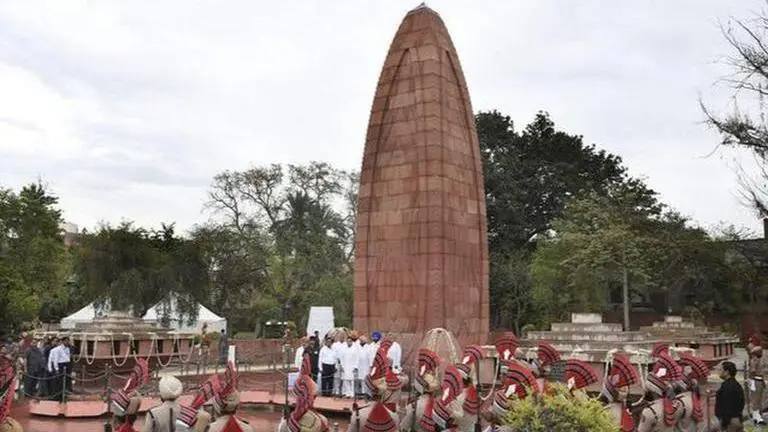
The Jallianwala Bagh massacre was one of the darkest episodes of the British rule in India, in which scores of people died after a mass shooting was ordered by Brigadier-General Reginald Dyer on the people gathered at the Jallianwala Bagh in Amritsar, Punjab on this day 1919. Today is the 104th anniversary of the mass killings. The peaceful crowd had congregated on the ground to protest against the Rowlatt Act and demand the release of two imprisoned freedom fighters.
In the ghastly mass murder, General Dyer ordered the closure of all exits to the Jallianwala Bagh ground in Amritsar and then asked the soldiers to fire indiscriminately on the peaceful gathering. What ensued was a brutal display of inhuman firing, during which even the children were not spared. To protect themselves the people even jumped into the well in the ground. The firing continued until the ammunition was over and according to various estimates 400 to 1500 people were killed in the massacre.
The shooting was followed by the imposition of Martial law in Punjab. Indian poet, and freedom fighter from Bengal Rabindranath Tagore relinquished the title of Knighthood given to him by the British government. Mahatma Gandhi also announced the nonviolent satyagraha campaign, the Non-Cooperation movement following the shooting as a mark of protest. A Hunter Commission was appointed to do an investigation into the massacre. The commission held Dyer responsible for the order to shoot and he was asked to step down from the military.
Revenge
The Indian freedom fighter and revolutionary Udham Singh took revenge for the brutal act and assassinated Michael O’Dwyer, Lieutenant Governor Punjab who was considered responsible for passing the order to depute the forces at the Jallianwala Bagh on the day of April 13, 1919. On March 13, 1940, Singh killed Dyer during a meeting between the East India Association and the Central Asian Society, moving towards the speaker platform shot O’Dwyer twice with a revolver.
Advertisement
Udham Singh's: Facts about man who avenged Jallianwala massacre
1. Udham Singh, while in custody following the assassination of Michael O'Dwyer used the used Ram Mohammad Singh Azad, representing three major religions of India at the time.
2. Udham Singh considered another revolutionary from Punjab Shaheed Bhagat Singh as his role model. Bhagat Singh was also hanged by the British government in 1931 on similar charges.
Advertisement
3. There is a district named after the revolutionary freedom fighter in the Indian state of Uttarakhand, known as Udham Singh Nagar.
4. Udham Singh and his elder brother were raised at an orphanage after the death of their father. Singh left the orphanage in 1919, a year after passing his matriculation examination.
5. Udham Singh after killing O'Dwyer did not run and waited for cops to come and take him under arrest. Singh went on a hunger strike for 42 days while in custody.
6. Udham Singh was represented in court by V.K Krishna Menon, the fifth Defence Minister of independent India from 1957 to 1962.