
AAP protests over CAG report on Dwarka Expressway, equates cost escalation to corruption
The CAG report revolves around the Dwarka Expressway construction project and the factors that led to a substantial increase in its cost.
- India News
- 4 min read

;'%3e%3cpath%20d='m8,15.99c4.41,0,7.99-3.58,7.99-7.99S12.41,0,8,0,0,3.59,0,8s3.58,7.99,7.99,7.99Z'%20style='stroke:%23fff;%20stroke-miterlimit:10;%20stroke-width:.02px;'/%3e%3cpath%20d='m3.08,3.37l3.82,5.11-3.84,4.15h.87l3.37-3.64,2.72,3.64h2.94l-4.04-5.39,3.58-3.87h-.86l-3.1,3.35-2.5-3.35h-2.94Zm1.27.64h1.35l5.97,7.99h-1.35l-5.97-7.99Z'%20style='fill:%23fff;'/%3e%3c/g%3e%3c/svg%3e)


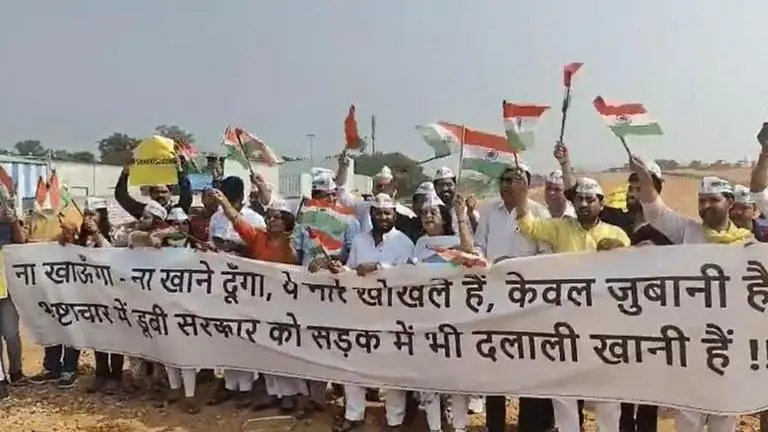
Aam Aadmi Party on Wednesday staged a protest over the Comptroller and Auditor General (CAG) of India's report on the ‘Bharatmala Pariyojana’ highway projects. The AAP workers were protesting over the CAG report which cited that the average cost of the Dwarka Expressway connecting Delhi and Gurugram has gone up to Rs 251 crore per kilometre from 18.2 crore per km.
Taking to 'X', AAP took a jibe at the Central government by calling under construction Dwarka Expressway "Sone ki Sadak" (Road of gold). "There is neither shine nor lustre. Look, this is a road of gold. AAP leaders and workers along with AAP Chief Spokesperson Priyanka Kakkar arrived to see Dwarka Expressway, to know what ₹ 251 crore/km road looks like," the party's official said. It further alleged that the CAG report exposed the corruption in the construction of the Expressway.
‼️ना चमक है ना दमक है, 🚧
— AAP (@AamAadmiParty) August 16, 2023
‼️देखो ये सोने की सड़क है 🛣️
AAP Chief Spokesperson @Pkakkar_ के साथ AAP के नेता और कार्यकर्ता देखने पहुंचे Dwarka Expressway, कि ₹251 करोड़/km की सड़क कैसी दिखती है
‼️ CAG Report ने Dwarka Expressway के निर्माण में Modi जी के भ्रष्टाचार का खुलासा… pic.twitter.com/OrlvX23V2z
CAG report on Dwarka Expressway
The Comptroller and Auditor General (CAG) report revolves around the Dwarka Expressway construction project and the factors that led to a substantial increase in its cost. The report examines the decisions made by the Ministry of Road Transport and Highways (MoRTH) and the National Highways Authority of India (NHAI) in prioritizing and executing the project, shedding light on the discrepancies and complexities that contributed to the elevated expenses.
Background:
Advertisement
MoRTH, in November 2018, opted to fast-track the construction of the Dwarka Expressway by dividing it into four separate projects. These projects were intended to de-congest NH-48, the highway between Delhi and Gurugram, and were allocated a civil cost of Rs 7,287.29 crore. The completion dates for these projects were projected to range between November 2020 and September 2022. By March 31, 2023, the physical progress of these projects had reached varying degrees, ranging from 60.50% to 99.25%
Cost Escalation:
Advertisement
The significant increase in the cost of the Dwarka Expressway construction is attributed to several factors, most notably the decision to construct elevated eight-lane sections instead of at-grade lanes. The elevated sections were initially planned by the Haryana Government under the Gurugram Manesar Urban Construction Plan 2031. The plan involved acquiring a right-of-way of 150 meters to construct a main carriageway of 25 meters, along with a seven-meter-wide median and a dedicated utility corridor for trunk services.
However, the project faced delays under the Haryana Government's jurisdiction. Subsequently, it was approved in BPP-I by the Cabinet Committee on Economic Affairs (CCEA), with NHAI receiving a right-of-way of 90 meters at no cost from the Haryana Government. Notably, this right-of-way was more than adequate to accommodate a 14-lane national highway at grade. Despite having sufficient space for an at-grade road, the project was designed as an elevated main carriageway and a six-lane at-grade road. This design choice led to the construction of massive structures and a significant increase in cost.
The project's length in the Haryana region extended for 19 km, yet it was constructed as an eight-lane elevated main carriageway with a civil construction cost of Rs 7,287.29 crore, amounting to Rs 250.77 crore per kilometre. This cost was substantially higher than the CCEA-approved per kilometre cost of Rs 18.20 crore for similar projects under the National Corridors/National Corridors Efficiency Improvements Program.
Traffic Allocation and Discrepancies:
The CAG feasibility study revealed that the average daily traffic on NH-48 consisted of 3,11,041 vehicles, primarily passenger vehicles (92.72%). Of these, 80.78% represented inter-city traffic that did not cross the Kherki Daula Toll on NH-48. Despite this, the project involved constructing elevated eight-lane sections for average daily traffic of 55,432 passenger vehicles and freight vehicles, while only six-lane at-grade lanes were planned for average annual daily traffic of 2,32,959 passenger vehicles and freight vehicles.
MoRTH's Response
According to the report, in 2022, the MoRTH stated that the elevated corridor was designed to facilitate the smooth movement of inter-state traffic and to meet technical standards and road safety requirements. They emphasized that the 90-meter right-of-way provided by the Haryana Government was essential for ensuring technical standards.
The CAG report critiqued MoRTH's response, suggesting that constructing underpasses or flyovers at intersections could have presented a more cost-effective solution than building the entire stretch as elevated sections. The report also noted that constructing a 14-lane national highway at grade within the available 90-meter right-of-way could have been a feasible option.