
Updated 3 September 2022 at 22:08 IST
As India gets INS Vikrant, here's why 1st Aatmanirbhar aircraft carrier changes everything
An 'exceptional symbol of reliance and aspirational India', INS Vikrant was commissioned into the Navy in a ceremony at the Cochin Shipyard on Friday.
- India News
- 3 min read
Follow :

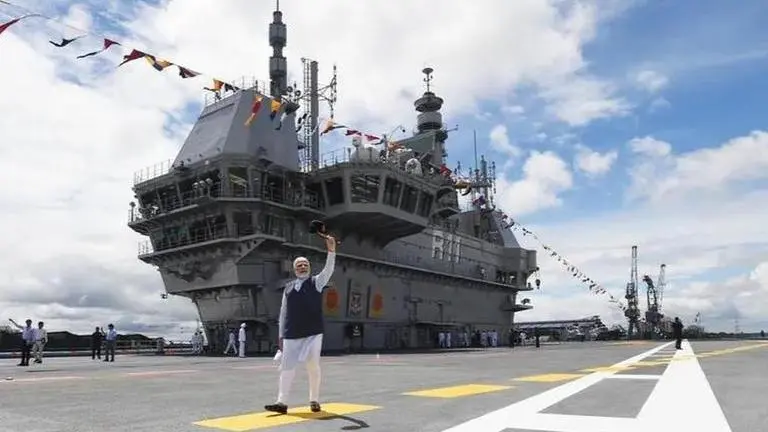
Image: Twitter/@narendramodi | Image:
self
An 'exceptional symbol of reliance and aspirational India', INS Vikrant was commissioned into the Navy in a ceremony at the Cochin Shipyard on Friday, September 2. The commissioning ceremony of the aircraft carrier had in attendance Prime Minister Narendra Modi, and Defence Minister Rajnath Singh among others. The induction of reincarnated Vikrant is a major step towards strengthening the defence preparedness, here's how:-
What INS Vikrant means for India?
- Designed by the Indian Navy's Warship Design Bureau (WDB) and constructed by Cochin Shipyard Limited, a Public Sector shipyard under the Ministry of Ports, Shipping and Waterways, INS Vikrant is India's first indigenous aircraft.
- With INS Vikrant, India joins the elite group of nations like--the US, Russia, France, the UK and China -- who are capable of producing their own aircraft carriers. While the first aircraft carrier, INS Vikramaditya was procured from Russia and commissioned in 2013, INS Vikrant, the second aircraft carrier is indigenously built. There is also a proposal for the third, likely to be named INS Vishal.
- When fully loaded, INS Vikrant is set to be the seventh largest among the carriers or carrier classes in the world. The largest is USS Gerald R Ford Class (CVN-78), followed by Nimitz Class, USA, Queen Elizabeth Class, UK, Liaoning and Shandong, China and Admiral Kuznetsov, Russia.

- The ship is powered by four Gas Turbines totalling 88 MW power to cut through choppy seas.
- It has a displacement of 43,000 tonnes and can hit a maximum speed of 28 knots. It has an operation range of 7500 Nautical Miles. This is far better than INS Vikramaditya, which has a capacity of over 8,000 tonnes of LSHSD and capable of operations up to a range of over 7,000 nautical miles or 13,000 kms.
- With 14 floors and 24 compartments, it is designed to house 1600 crew members. It has a specialised kitchen. Also, a medical wing, with 16 operational beds, modular emergency operation theatre, physiotherapy clinic, Intensive Care Unit, pathology set up, radiology wing with a CT scanner and X-Ray machines, a dental complex, isolation ward and telemedicine facilities that will catalyse the members' easy recuperation during adverse situations.
- With its ski-jump ramp technology with two take-off runways and a landing strip with three arrester wires, INS Vikrant can operate Short Take-Off but Arrested Landing (STOBAR) craft. The carrier will have an air wing consisting of 30 aircraft comprising of Russian-origin, carrier-capable MiG-29K fighter jets and airborne early warning control helicopter Kamov-31 helicopters, US origin MH-60R multi-role helicopters, in addition to homegrown Advanced Light Helicopters (ALH) and Light Combat Aircraft (LCA) (Navy).

- A Rs 20,000 crore worth aircraft carrier, INS Vikrant's 80-85 per cent of the cost has been ploughed back into the Indian economy with complete indigenous construction, 76% indigenous content and with employment given to 2,000 CSL personnel.
- When fully operational the mighty aircraft carrier will not just be a strong deterrent but also act as a floating airbase on blue waters and will be a sovereign territory of India in the middle of the ocean.
- INS Vikrant's addition will help India compete with China, which already has about two aircraft carriers and one in the making.
Published By : Sudeshna Singh
Published On: 2 September 2022 at 19:11 IST