
Updated 23 January 2022 at 23:25 IST
Beating Retreat Ceremony: Timeline of changes inflicted in the centuries-old tradition
A new row erupted on Saturday after the Beating Retreat Ceremony's concluding piece 'Abide With Me' was replaced with Mangeshkar's 'Aey Mere Watan ke Logon'.
- India News
- 4 min read

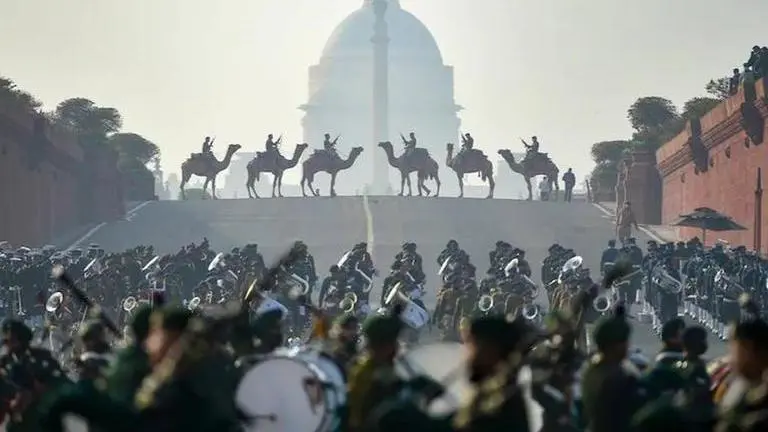
Republic Day 2022 has been enveloped in several controversies. From the dispute regarding the selection of parade tableaux to the merging of Amar Jawan Jyoti with the National War Memorial Flame, a heated discourse has surrounded several of the Centre's decisions for the January 26 ceremony.
Amidst this, a new row erupted on Saturday after the Beating Retreat Ceremony's concluding piece 'Abide With Me' was replaced with legendary singer Lata Mangeshkar's 'Aey Mere Watan ke Logon'. While changes made in the Beating Retreat ceremony this year, have riled up the Opposition, historically, change has always been a constant in the ceremony. Here is a brief history of the Beating Retreat Ceremony and how it has evolved over the decades.
Started with only British Tunes
The Beating Retreat Ceremony evolved from a centuries-old military tradition where the sounding of drums after the day's battle indicated a halt in fighting and withdrawal of the forces. As soon as the buglers sounded the Retreat, the troops ceased fighting, sheathed their arms, and withdrew from the battlefield. The British trace this practice to 1694 A.D. when King William III ordered his drummers to march down the streets of various towns post a battle. The Indian present tradition of Beating Retreat after Republic Day Parade was choreographed and adapted from the British pattern in 1952. Since the beginning of the Beating Retreat ceremony, British tunes have been played.
First major change: 1955
In Beating Retreat of 1955, mass singing of ‘Trahi Pahi Bharat Mata’ was an unusual innovation. The drums beating by mass drummers gave a spectacular climax to the program. The retreat ceremony took a sharper change in 1961 when Queen Elizabeth II and Prince Philip visited India. The then Prime Minister wanted to make it a special occasion and gave Major GA Roberts, Advisor Military Music, to make it a spectacular ceremony.
Advertisement
A total of 27 Military Bands took part in the fanfare which was organised on January 27, since Queen Elizabeth was not available in Delhi on January 29. Newspapers report and testimonies assert that some tunes such as ‘Colonel Bogey’, ‘Bell Figure’, ‘Trom bone King’, were played for decades following the ceremony's inception.
How Indian compositions assumed greater place: 1979
In 1979, the ceremony took one of its first major steps towards nationalism after all instruments played ‘Sare Jahan Se Achcha.’ Air and Navy also played ‘Jai Bharati’ during the ceremony. In 1984, the bands played ‘Swagatham’ composed by Pt Ravi Shanker for Asiad games. This was followed by the induction of other Indian music compositions such as ‘Deshon ka sartaz Bharat' in 1993 and some indigenous songs composed by Indian Military Musicians such as ‘Nidar Yodha’, ‘Tiranga Senani, ‘Ladaku’, ‘Swadeshi’ in the years that followed.
Advertisement
Addition of Indian musical instruments: 2015
In 2015, the Beating Retreat saw some major changes. Indian musical instruments sitar, santoor, and tabla were added for the first time. The retreat was thus infused with an Indian flavour. In 2016, besides bands of Army, Navy, and Air Force, the Central Police Forces, and Delhi Police bands were also added with the retreat ceremony. Thus an ensemble of traditional Indian musical instruments, such as sitar and table, performing in tandem with military bands made a spectacular show. The army symphony orchestra was also included in the retreat ceremony. Thus, there started an increased focus on more and more Indian tunes.
Recent changes
In the 2020 Beating Retreat, the other songs performed at the ceremony included ‘Ae mere Pyaare Watan’ from Kabuliwala, ‘Nritya Sarita,’ ‘Abhiyan’ and title song of film Lakshya, amongst others. In 2021, the ceremony played four tunes-- ‘Kadam Kadam Badhaye Ja,’ ‘Drummers Call,’ ‘Ae mere Watan ke logon’ and ‘Abide With Me'. This year, the Massed Bands would play only three tunes ‘Kadam Kadam Badhaye Ja,’ ‘Drummers Call,’ and ‘Ae mere Watan ke logon.’
Even as controversy erupts surrounding the exclusion of 'Mahatma Gandhi's favourite hymn', there are no credible sources that confirm that ‘Abide with me’ was part of the Beating Retreat Ceremony since its conception. It could have perhaps been added somewhere in the early 1960s (unverified). While the traditional Christian tune is believed to have been a favourite of Mahatma Gandhi, there is no old source confirming this either.
The infamous hymn was written by Henry Francis Lyte, a Scottish poet, and hymnologist, in 1847 and gained popularity in the trenches during World War I. It is believed that Gandhi first heard it being played by the Mysore Palace Band. The hymn continues to remain a part of the ‘Ashram Bhajanavali’ at the Sabarmati Ashram in Ahmedabad.
Published By : Ananya Varma
Published On: 23 January 2022 at 17:25 IST