
Dark chapter of India's Emergency: Here's list of prominent leaders that were arrested
At the anniversary of the Emergency imposition in India, here's a comprehensive list of political leaders who were arrested during 1975-77.
- India News
- 4 min read

;'%3e%3cpath%20d='m8,15.99c4.41,0,7.99-3.58,7.99-7.99S12.41,0,8,0,0,3.59,0,8s3.58,7.99,7.99,7.99Z'%20style='stroke:%23fff;%20stroke-miterlimit:10;%20stroke-width:.02px;'/%3e%3cpath%20d='m3.08,3.37l3.82,5.11-3.84,4.15h.87l3.37-3.64,2.72,3.64h2.94l-4.04-5.39,3.58-3.87h-.86l-3.1,3.35-2.5-3.35h-2.94Zm1.27.64h1.35l5.97,7.99h-1.35l-5.97-7.99Z'%20style='fill:%23fff;'/%3e%3c/g%3e%3c/svg%3e)


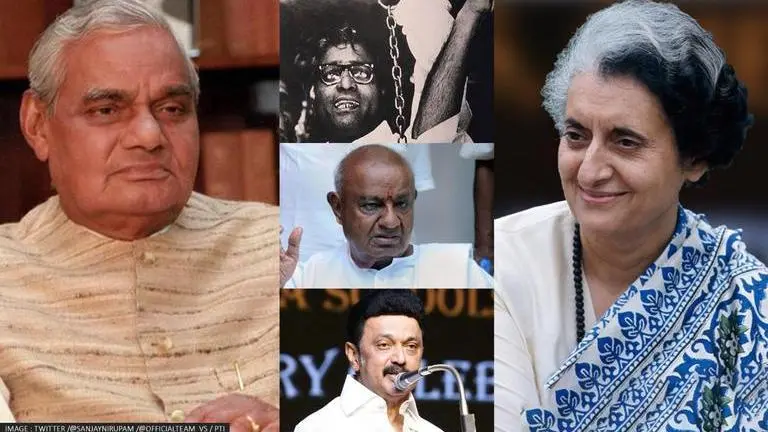
June 25 holds a significant place in the history of Indian democracy as it marks the anniversary of the imposition of the Emergency in 1975. This fateful day serves as a stark reminder of a period characterised by curtailed civil liberties, censorship, and the arrest of numerous political leaders. At the anniversary of the Emergency imposition in India, here's a comprehensive list of political leaders who were arrested during 1975-77, regarded as the darkest phase of India's democracy.
Political Leaders Arrested During the Emergency:
- Morarji Desai: Janata Party leader and former Prime Minister who became the first non-Congress PM of the country.
- Acharya Kripalani: Freedom fighter and first Congress president of Independent India.
- Atal Bihari Vajpayee: First non-Congress Prime Minister who served a full term as the PM. He was the co-founder of the Bharatiya Janata.
- Lal Krishna Advani: Former Deputy Prime Minister, Home Minister and co-founder of the BJP.
- Jayaprakash Narayan: Social and Political leader who called for a "total revolution" against Indira Gandhi.
- Charan Singh: Home Minister in the Morarji Desai government. He later became the PM after Morarji Desai's resignation.
- George Fernandes: Former Defence Minister in the Vajpayee government.
- Raj Narain: Janata Party leader who won in a famous electoral malpractice case against then PM Indira Gandhi, which led to her disqualification and later imposition of Emergency in 1975.
- Devi Lal: Former Deputy PM and farmer leader from Haryana. He was the founder of the Indian National Lok Dal.
- Bhairon Singh Shekhawat: BJP leader and former Vice President. He remains the only non-Congress politician who became CM of Rajasthan three-time.
- Jyotirmoy Bosu: CPIM leader and Trade Unionist.
- Arun Jaitley: BJP leader and former Finance Minister. Jaitley was arrested at the age of 22.
- EMS Namboodiripad: CPI leader and first non-Congress CM of India. He served as the CM of Kerala twice in 1957–1959 and then again in 1967–1969.
- HD Deve Gowda: JD(S) chief who served as the 11th prime minister of India from 1 June 1996 to 21 April 1997.
- Parkash Singh Badal: Former Union Minister and Punjab CM. He served as the CM of Punjab 5 times.
- Lalu Prasad Yadav: Former Bihar CM and Railway Minister. He is currently chief of RJD which is in alliance with Congress and JD(U) in Bihar.
- Mulayam Singh Yadav: Samajwadi Party leader and former Uttar Pradesh CM.
- M Karunanidhi: DMK leader and former Tamil Nadu CM. He served as the CM for almost two decades over 5 terms.
- MK Stalin: DMK supremo and Tamil Nadu CM was arrested in 1976. He claimed that he was beaten up in jail and was brutally tortured. DMK leader C Chittibabu allegedly died trying to save Stalin in prison.
- Nanaji Deshmukh: Social activist and RSS leader. He was posthumously awarded Bharat Ratna, India's highest civilian award.
Other prominent political arrests were of Karpoori Thakur, Madhu Limaye, Biju Patnaik, BJP leaders such as BS Yediyurappa, Prakash Javadekar, Bhagat Singh Koshyari, Pramod Mahajan, Gopinath Munde, Mukhtar Abbas Naqvi. Notably, according to Shah Commission, appointed to inquire into all the excesses committed in the Indian Emergency (1975 - 77), estimated that nearly 1,11,000 people were arrested under preventive detention laws.
The Imposition of Emergency
The Emergency was imposed by then Prime Minister Indira Gandhi on June 25, 1975, under Article 352 of the Constitution, citing "internal disturbances" as the justification. The political climate leading up to the Emergency was marked by intense political polarisation, economic challenges, and social unrest.
Indira Gandhi's government faced significant opposition, particularly from Jayaprakash Narayan, who led the "Total Revolution" movement against corruption and authoritarianism. As public unrest grew, Gandhi declared a state of Emergency, effectively suspending civil liberties, imposing press censorship, and granting sweeping powers to the government.
Advertisement
During the Emergency period, fundamental rights, such as freedom of speech, expression, and assembly, were curtailed, and dissenting voices were suppressed. Opposition leaders, activists, journalists, and individuals critical of the government were arrested, leading to a climate of fear and intimidation.
The Dark Days
The Emergency period witnessed a range of repressive measures, including the forced sterilisation campaign, where the government implemented a controversial policy to control population growth. The media faced severe censorship, with newspapers and publications being censored or shut down for criticising the government. Journalists and activists were arrested, and the freedom of the press was severely curtailed.
Advertisement
The arrests of political leaders aimed to weaken the opposition and consolidate power in the hands of the ruling party. The Emergency also witnessed instances of abuse of power and allegations of human rights violations. According to Shah Commission, around 7 lakh people were displaced after a demolition drive was conducted in Delhi during the Emergency. Notably, the suspension of democratic institutions and the erosion of civil liberties deeply impacted the fabric of Indian society.