
Updated 16 July 2023 at 05:51 IST
Delhi floods: How Hathnikund Barrage works, AAP's allegation falls flat
AAP-led govt in Delhi has sparked a controversy alleging that floods in Delhi are the result of planned conspiracy of the BJP-led govt in Haryana & at Centre.
- India News
- 6 min read

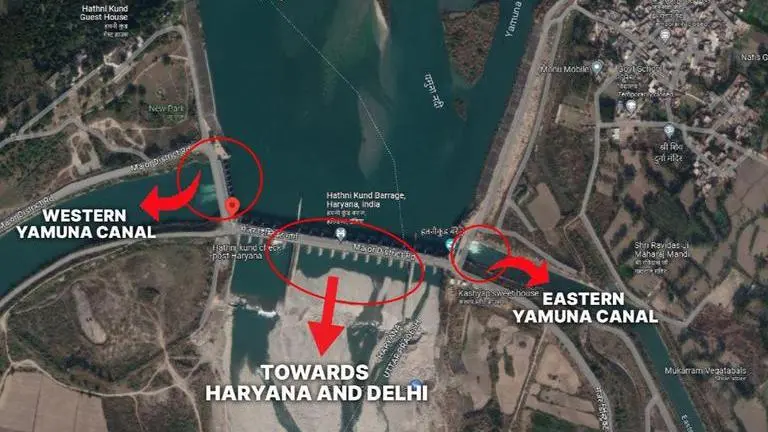
The political blame-game between the ruling Aam Aadmi Party (AAP) and the Bharatiya Janata Party (BJP) in the national capital is at its peak over the flood water in Delhi. Both the parties have come face to face and are helding each other responsible for the flood. Meanwhile, the AAP-led government in Delhi has sparked a controversy alleging that the floods in Delhi are the result of planned conspiracy of the BJP-led government in Haryana and at the Centre. The AAP party has stated that the BJP-led government under serious conspiracy, discharged heavy amounts of water through the HathniKund barrage located in Haryana towards Delhi, which led to the submersion of several residential areas in the national capital.
In order to prove the allegation right, the ruling party in Delhi also shared a video, wherein a man appeared to be explaining how the floods in Delhi is actually a conspiracy by the Haryana government. In the video, a man is being seen claiming that all the water from the barrage is being released towards Delhi and not into the canal, which leads to Uttar Pradesh.
Analysis on political blame-game over the video
Sharing the video, the Aam Aadmi Party started making serious allegations against the BJP and termed the entire flood situation in Delhi as a planned conspiracy. The party also alleged that the Haryana government is deliberately discharging water into the Yamuna River from the barrage. Responding to the allegations, the BJP said that the HathniKund is a barrage, which has limited capacity to hold water and at a certain level, the water needs to be released.
Amid all the ongoing political ruckus in the national capital, let us understand the functioning of the HathniKund barrage and let us analyse how the claims being made by the AAP-led government don’t hold a base.
Advertisement
What is HathniKund Barrage?
The Hathni Kund is a concrete barrage, which is located on the Yamuna River in the state of Haryana. The barrage lies in the Yamuna Nagar district of Haryana. As per information, it took over 2.5 years to construct this barrage, which was constructed between October 1996 and June 1999 to replace the Tajewala Barrage, which was 3 Km downstream and was constructed in 1873. However, it became operational after March 2002. The substantial purpose for the construction of this barrage was irrigation.
With the help of this barrage, the water of the Yamuna River is diverted into two different canals mostly for the purpose of irrigation. These two canals are known as the Western Yamuna Canal and the Eastern Yamuna Canal. While the Western canal leads the Yamuna water to parts of Haryana and a few outer parts of Delhi, the Eastern canal leads water to Uttar Pradesh. Apart from this, the small reservoir created by the barrage also serves as a wetland for 31 species of waterbirds.
Advertisement
The barrage is around 360 Meter long and its spillway is composed of ten main floodgates. Apart from this, there are five under sluices on its Western canal and three on the Eastern canal.
Eastern and Western Yamuna Canal
Experts say the two canals, which are known as Western Yamuna Canal and Eastern Yamuna Canal were constructed for irrigation facilities in Uttar Pradesh, Haryana and outer parts of Delhi. The capacity of the Eastern Yamuna Canal is around 7000 cusecs of water and that of the Western Yamuna Canal is around 18000 cusecs. As per experts, the Eastern canal normally doesn’t hold more than 5000 cusecs of water. This means both the canals collectively cannot release more than 25000 cusecs of water.
What is the rule to release water in canals?
In the viral video shared by the AAP, a man said that the water wasn’t released in the Eastern Yamuna Canal, which leads to Uttar Pradesh, while Delhi is submerged in Yamuna’s flood water. To know about this fact, we talked to one expert, who has done a broad research on the Yamuna River.
As per an expert, there are certain guidelines of the Central Water Commission (CWC), which need to be followed while releasing water in both canals. It is being said that a report was presented by the CWC on the Yamuna River, wherein it was said that during the heavy water flow in the river, vast amounts of silt with heavy boulders also come along with the water. In such a condition, if the water will be released into both canals, then it may lead to damaging the gates of the canal and also can clog the canal.
In order to minimize this apprehension, the CWC has issued a guideline that if the flow of water in Yamuna raises above 1 lakh cusecs of water, which is the threshold mark, then the gates of two canals should be closed. As per reports, in order to ensure that the guidelines should be strictly followed, a system has been installed at the barrage, which allows the gates of the canals to get automatically closed when the water level rises above the threshold mark.
6 districts of Haryana come before Delhi
- The AAP government in Delhi is screaming and making serious allegations against the BJP-led government in Haryana and at the Centre saying that the flood in Delhi is a conspiracy by the Bharatiya Janata Party governments. Here are some facts to understand this.
- The HathniKund barrage has only released little above 3.65 lakh cusecs of water till now, while in 2019 a record 8.28 lakh cusecs of water was discharged, followed by around 8 lakh cusecs of water in 2013.
- Around 7 lakh cusecs of water were released from the barrage in Haryana before HathniKund came into existence, which had flooded Delhi almost the way it has flooded in 2013.
- Notably, the barrage has a capacity of releasing 995,874 cusecs of water into the river and it was fixed after years of research and studies by experts. The amount of water can be understood from the fact that 1 cusec of water is equivalent to discharging around 28.32 litres of water per second.
- As per experts, a low-flood hits Delhi, when the level rises above 1 lakh cusec of water and it is considered as a high flood situation when the watermark crosses above 2.5 lakh cusecs.
- The expert says that this year over 3.65 lakh cusecs of water has been discharged from the HathniKund barrage in the river and if in any way as per capacity, 5000 cusecs of water could be discharged in the Eastern Yamuna Canal towards Uttar Pradesh, then too, it won’t make any difference to the flooding situation in Delhi.
- The expert further asserts that before the water of the Yamuna River enters Delhi, it passes through six major districts of Haryana after getting released from the HathniKund barrage. So, if it is a conspiracy by the BJP government to submerge Delhi, how is it possible to submerge the national capital without submerging the six major districts of Haryana?
Published By : Abhishek Tiwari
Published On: 16 July 2023 at 05:51 IST