
ESO shares 'blood red' image of Super Flower Blood Moon spotted during Lunar eclipse
The super flower blood Moon's photograph was taken by the European Southern Observatory's Paranal Observatory in Chile on the night of May 15.
- India News
- 2 min read

;'%3e%3cpath%20d='m8,15.99c4.41,0,7.99-3.58,7.99-7.99S12.41,0,8,0,0,3.59,0,8s3.58,7.99,7.99,7.99Z'%20style='stroke:%23fff;%20stroke-miterlimit:10;%20stroke-width:.02px;'/%3e%3cpath%20d='m3.08,3.37l3.82,5.11-3.84,4.15h.87l3.37-3.64,2.72,3.64h2.94l-4.04-5.39,3.58-3.87h-.86l-3.1,3.35-2.5-3.35h-2.94Zm1.27.64h1.35l5.97,7.99h-1.35l-5.97-7.99Z'%20style='fill:%23fff;'/%3e%3c/g%3e%3c/svg%3e)


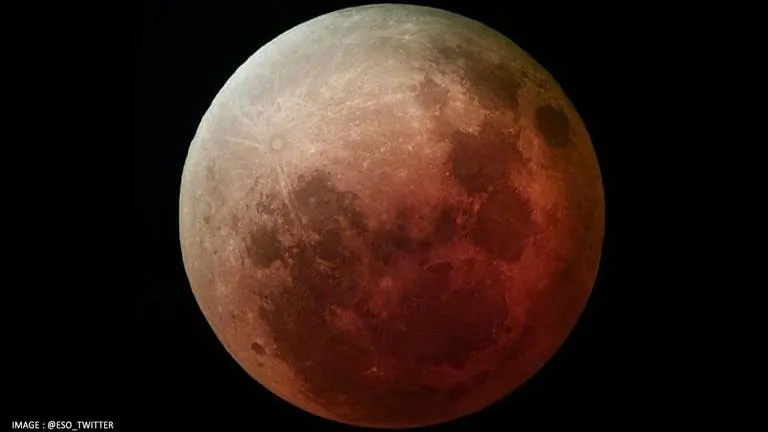
The European Southern Observatory (ESO), which unveiled the first image of the Milky Way galaxy’s supermassive black hole earlier this month, has shared a new picture. This time, it shared the image of the Moon which recently turned blood red during the lunar eclipse. According to ESO, this photo of the 'super flower blood Moon' was taken from its Paranal Observatory in Chile on the night of May 15.
This ominous Picture of the Week shows our very own Moon undergoing a total lunar eclipse. The image was taken on the night of May 15 2022 from our Paranal Observatory in Chile.
— ESO (@ESO) May 23, 2022
🔗 https://t.co/wA4gGSa76y
Credit: F. Aedo, F. Durán/ @ESO pic.twitter.com/0BU1btu80I
A lunar eclipse, as we know it, occurs when the Earth is positioned directly between the Sun and the Moon, blocking some of the Sun’s light. This phenomenon causes the Earth to cast its shadow across the Moon’s surface.
During the recent eclipse, which occurred on May 15-16 (depending on different time zones), the lunar surface turned red as the Earth obscured the sunlight falling on the Moon. When the Moon entered the totality phase, meaning it was completely under the Earth’s shadow, the sunlight passed through the atmosphere at our planet’s edges and the red wavelength light escaped.
"Blue light is dispersed by the atmosphere through a process called Rayleigh scattering (which makes the sky blue) while red light can pass through the atmosphere more easily, becoming slightly deflected. This red light then reaches the Moon’s surface, giving rise to its dramatic crimson hue," ESO explained in its statement.
Advertisement
The image above was taken during the totality by two ESO colleagues at Paranal Observatory using an amateur telescope nicknamed “UT5”, ESO said.
Lunar eclipse spotted from deep space
NASA's Lucy spacecraft, which is on its way to studying Jupiter's trojan asteroid, spotted the lunar eclipse from a distance of 100 million km. Using its high-resolution panchromatic camera, L'LORRI, Lucy was able to watch as the Earth cast its shadow on the Moon.
Advertisement
In the visual shared by NASA, the moon can be seen blinking, which actually was sunlight being obstructed from falling on the lunar surface. The agency shared a short timelapse of the video which covered a period of almost three hours, which is from 7:10 a.m. (IST) to 10 a.m.
See a total lunar eclipse from 64 million miles away.
— NASA (@NASA) May 20, 2022
Our @NASASolarSystem Lucy spacecraft is on a journey to Jupiter’s Trojan asteroids. On the way, it saw Earth (left) cast its shadow on the Moon (right) during an eclipse on May 15-16, 2022. https://t.co/qnynNetbTr pic.twitter.com/OY24GQs7bi