
Hearing of same-sex marriage pleas: Here's how the arguments went down in Supreme Court
On Tuesday, a 5-judge constitutional bench of the SC led by CJI DY commenced a hearing on the bunch of pleas seeking legal recognition of same-sex marriage.
- India News
- 4 min read

;'%3e%3cpath%20d='m8,15.99c4.41,0,7.99-3.58,7.99-7.99S12.41,0,8,0,0,3.59,0,8s3.58,7.99,7.99,7.99Z'%20style='stroke:%23fff;%20stroke-miterlimit:10;%20stroke-width:.02px;'/%3e%3cpath%20d='m3.08,3.37l3.82,5.11-3.84,4.15h.87l3.37-3.64,2.72,3.64h2.94l-4.04-5.39,3.58-3.87h-.86l-3.1,3.35-2.5-3.35h-2.94Zm1.27.64h1.35l5.97,7.99h-1.35l-5.97-7.99Z'%20style='fill:%23fff;'/%3e%3c/g%3e%3c/svg%3e)


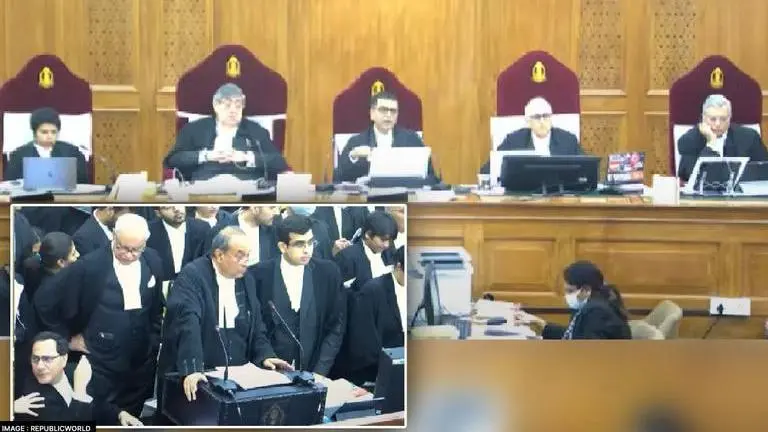
On Tuesday, a 5-judge constitutional bench of the SC led by CJI DY Chandrachud and comprising of justices SK Kaul, S Ravindra Bhat, PS Narasimha and Hima Kohli commenced a hearing on the bunch of pleas seeking legal recognition of same-sex marriage in India. During the hearing, the CJI stated that in the evolving consensus, the court is playing a "dialogical role" to create that consensus and move towards an "equal future".
Solicitor General of India Tushar Mehta told the bench that it is dealing with the creation of a socio-legal relationship when it is in the concurrent list.
"We cannot rule out the possibility of one state doing it and one state not doing it and states not being a party, the petitions will not be maintainable. We have filed an application raising this preliminary objection if courts can at all enter this area or can only parliament do it?" he said.
To this, the CJI said that the tenability of the SG's submission will depend on the canvas of submissions by the petitioners. "None of us know what a farmer in south India thinks or a businessman thinks in North India... we all have partial views and none of us has the view of the nation," the SG said.
Advertisement
Opening the case for the petitioners, senior advocate Mukul Rohtagi stated that people of the same sex have the same rights as the heterosexual groups of society. Citing the earlier judgements of the top court, he said that if the rights are identical, then the petitioners should enjoy the full array of the rights under Articles 14, 15 and 21 of the Constitution.
"We want privacy in our homes and not face stigma in public places. So we desire the same institution between two people as is available to others - the concept of marriage and family. Because marriage and family are respected in our society," he contended.
Advertisement
The CJI questioned on how the court goes about this matter in the absence of legislation. Citing the example of the US and the UK, he opined that even in these countries, the legislature has intervened in the matter by outlawing it and later by recognising. "In the absence of legislation, how does the court go about it? Is there any indication in our legislation or legislative space where the court can act?". Later in the hearing, the CJI also noted that the legislative element is also involved in the matter.
When SG Mehta stated that the Hindus, Muslims and others will be affected and that's why states should be heard, Justice Kaul said that the bench is not going into personal laws. Following an argument, SG Mehta contended that even in the Special Marriage Act, legislative intent throughout has been the relationship between a biological male and a biological female.
To this, CJI Chandrachud said that the very notion of a biological man is absolute which is inherent. "That is not a notion," the SG replied, to which, the CJI said, "It is not a question of genitals... The very notion of the Special Marriage Act having man and woman is not restricted to the genitals."
"It is restricted to the genitals... There are several acts which will be made redundant if the court holds otherwise... If I have the genitals of a man but otherwise am a woman and as suggested, how will I be treated under CrPC? As a woman? Can I be called for a 160 statement? There are several issues," SG Mehta said.
Further during the hearing, senior Advocate Rakesh Dwivedi stated that marriage among heterosexuals is not a "gift of law" but is only regulated what always existed. "Even if they are held equal making it for all the laws is not possible... When we speak of a man of 21 and a woman of 18.... how does the question of man and woman not arise?"
Senior Advocate Kapil Sibal who was appearing for Jamiat Ulema-i-Hind raised the concern of the respective child's future if the same-sex couple got separated.
"Who will be the father, who will be the mother?... Under Criminal Procedural law, who is the woman? Who will get maintenance? These are serious societal consequences of that declaration. Either you take it as a hold or don't take it at all," Sibal said.