
Updated 26 January 2023 at 19:01 IST
Himachal's sole 2023 Padma awardee credited with reviving traditional 'Nau-Anaj' intercropping method
Nekram Sharma, Himachal Pradesh's lone Padma awardee this year, is credited with reviving the traditional 'Nau-Anaj' intercropping system in the state.
- India News
- 3 min read

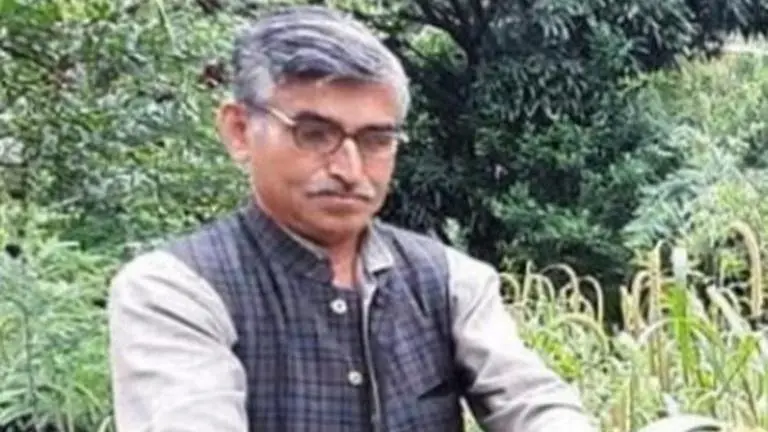
Nekram Sharma, Himachal Pradesh's lone Padma awardee this year, is credited with reviving the traditional 'Nau-Anaj' intercropping system in the state.
Nau Anaj, which literally translates to nine crops, is a natural and chemical-free method that improves the fertility of the land and reduces water consumption by about 50 percent.
It allows nine crops -- a combination of lentils, cereals, vegetables, legumes, and creepers -- to be grown on the same land.
"Natural farming and intercropping pattern leading to diversification of crops strengthen the soil and gradually increase quality and yield besides cutting down on water usage and input costs," Sharma told PTI.
Advertisement
On the eve of Republic Day, Sharma was conferred with the Padma Shri -- the fourth highest civilian honour -- for distinguished services in the field of agriculture.
With honour comes the added responsibility to work harder, he said. A resident of Karsog in Mandi district, 59–year-old Sharma realised that the soil fertility of his land had deteriorated due to the use of chemicals with an emphasis on fertilisers and monoculture (single-crop pattern), having shifted from millet to cash crops for higher profits, when he took over in the mid-nineties.
Advertisement
With profits taking a back seat and a focus on saving the land from degradation and producing healthy crops, Sharma travelled extensively and interacted with older farmers to learn about traditional farming techniques.
It was during these travels that he learned about the indigenous practice of Nau-Anaj.
Sharma started natural farming in 1995 by keeping a backup of harvested crops in case the experiment failed due to climatic conditions or pest attacks. He decided to go chemical-free and selected nine carefully assorted crops that aid each other's growth.
"During my research, I learned that millets are rainfed crops that absorb excess water and prevent floods and foxtail millet, rich in Vitamin B12, assures yield during both droughts and floods. Millet is also a better crop to feed people. One kilogram of rice feeds four people while a kilogram of millet feeds eight," he said.
"I found that mustard is a nitrogen fixation crop, which extracts nitrogen from the ground, that can be planted next to wheat. Likewise, dal and flax seeds are companion plants," he told PTI.
Indigenous ('desi') seeds require less water compared to hybrid seeds. The water requirement is further reduced when the crops are planted close to each other. It also acts as natural mulchers and provides shade, Sharma added.
At present, Sharma cultivates maize, moong, beans, rajma, urad dal, ram dana, foxtail millet, finger millet, and buckwheat. These are naturally fenced by fruit-bearing trees such as mango, pomegranate, and litchi.
"We produce seeds, and use a mixture of cow dung and urine instead of chemicals to make the plants healthy and kill the pests. The input cost has gone down by 90-95 percent barring labour and the water requirement has been reduced by almost 50 percent," Sharma said.
Plant diversity enhances soil fertility and provides varying fodder options for farm animals, besides keeping pests and diseases at bay.
"It took about five to six years to get the right combination of crops that require less water, fix nitrogen, increase soil fertility, repel insects and grow faster in small lands according to water conditions and availability," he added.
The implementation of Nau- Anaj technique bore amazing results in 2010, motivating other cultivators, and the Parvatiye Tikau Kheti Abhiyan, a farmers' co-operative, came into existence. Over 5,000 farmers are now associated with this practice, Sharma said.
Published By : Press Trust Of India
Published On: 26 January 2023 at 19:01 IST