
How PM Modi Changed the Game With ‘Make in India’?
In the fiscal year 2024 (FY24), India’s mobile phone exports soared by 40.5%, reaching approximately $15.6 billion.
- India News
- 7 min read

;'%3e%3cpath%20d='m8,15.99c4.41,0,7.99-3.58,7.99-7.99S12.41,0,8,0,0,3.59,0,8s3.58,7.99,7.99,7.99Z'%20style='stroke:%23fff;%20stroke-miterlimit:10;%20stroke-width:.02px;'/%3e%3cpath%20d='m3.08,3.37l3.82,5.11-3.84,4.15h.87l3.37-3.64,2.72,3.64h2.94l-4.04-5.39,3.58-3.87h-.86l-3.1,3.35-2.5-3.35h-2.94Zm1.27.64h1.35l5.97,7.99h-1.35l-5.97-7.99Z'%20style='fill:%23fff;'/%3e%3c/g%3e%3c/svg%3e)


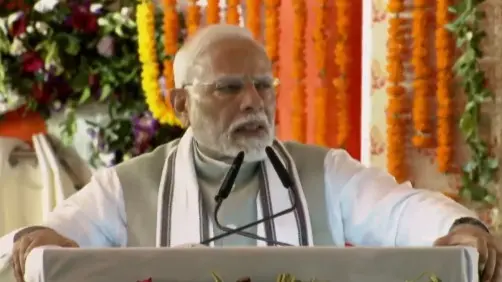
New Delhi: The Make in India initiative, launched by Prime Minister Narendra Modi in September 2014, has significantly transformed India's manufacturing landscape. The program aims to boost domestic manufacturing, attract foreign investment, and create jobs across various sectors. This initiative has led to a notable increase in foreign direct investment (FDI) and has attracted several global companies to set up manufacturing bases in India.
Since its inception, Make in India has successfully attracted substantial foreign investments across diverse sectors, including electronics, defense, renewable energy, and semiconductors. The government aims for annual FDI inflows to reach $100 billion, reflecting its commitment to enhancing the manufacturing sector's contribution to the economy
India is entering a transformative phase in its aerospace sector with the establishment of the final assembly line for the Airbus C295 transport aircraft in Vadodara. This marks a significant milestone as it is the first military aircraft to be manufactured solely in India, highlighting the country's growing capabilities in defense production. The project is a collaboration between Airbus Spain and Tata Advanced Systems, reflecting the Indian government's commitment to fostering indigenous manufacturing under the Make in India initiative. This project aligns with Prime Minister Modi's vision of making India a global hub for aerospace manufacturing
But this isn’t just the story of one sector—India has showcased the true spirit of "Make in India" across every field. Foreign investments are surging as global companies recognize India’s vast potential and the immense opportunities it brings. Let’s explore more sectors where significant investments are boosting the spirit of Atmanirbhar Bharat.
Advertisement
Mobile Manufacturing:
India has rapidly emerged as the second-largest mobile exporter in the world, showcasing remarkable growth in its mobile manufacturing sector under Prime Minister Narendra Modi's Make in India initiative
In the fiscal year 2024 (FY24), India’s mobile phone exports soared by 40.5%, reaching approximately $15.6 billion.
Advertisement
Apple 's decision to assemble the entire iPhone 16 series in India marks a significant milestone in the company's strategy to diversify its manufacturing operations.For the first time, Apple is producing its premium iPhone 16 Pro and Pro Max models outside of China. This shift is being executed at Foxconn's facility in Sriperumbudur, Tamil Nadu, where thousands of workers are currently undergoing training to handle the assembly process . Apple has reportedly assembled $14 billion worth of iPhones in India, which constitutes approximately 14% of its global output. In addition to iPhones, Apple is exploring the production of other products like AirPods and iPads in India, further solidifying its manufacturing base within the country .
Samsung inaugurated the world's largest mobile manufacturing facility in Noida, which will double its capacity from 68 million to 120 million units per year. The facility allows Samsung to incorporate local features into its devices, leveraging research and development conducted in India. This localization strategy not only enhances product relevance but also supports the government’s goal of self-reliance in technology. Samsung has launched its ‘Make for the World’ initiative alongside the new factory, aiming to export mobile handsets manufactured in India to various international markets, including those in the SAARC region
Semiconductors:
India is on the brink of a semiconductor revolution, driven by substantial investments and strategic partnerships that align with the Make in India initiative. The recent surge in semiconductor investments is a critical component of this vision, as the country seeks to reduce its reliance on imported chips and develop a self-sufficient semiconductor ecosystem.
Tata Group and Taiwan based Powerchip Semiconductor Manufacturing Corporation (PSMC) at Dholera with an investment approx $11 billion. Establishing India's first semiconductor fabrication unit (fab) with a capacity of 50,000 wafers per month, primarily targeting the production of 28nm technology chips used in automotive and consumer electronics.
The US-based semiconductor giant Micron has begun construction on a $2.75 billion semiconductor plant in Sanand, Gujarat . This facility is expected to create around 5,000 direct and 15,000 indirect jobs and is part of India's broader strategy to become a key player in the global semiconductor supply chain. The project is considered the largest investment under the India Semiconductor Mission (ISM), launched by the Indian government to position India as a key player in semiconductor technology. The Sanand facility will focus on assembling and testing two critical types of memory technologies: DRAM (Dynamic Random Access Memory) and NAND (Non-Volatile Flash Memory). These components are essential for various electronic devices. The Indian government is supporting this initiative through various incentives, including financial assistance that covers about 50% of the total project cost
The Indian government envisions the semiconductor industry reaching a market size of approximately $63 billion by 2026, competing with established players like Taiwan and South Korea. Under the Development of Semiconductors and Display Manufacturing Ecosystem initiative, the government is allocating up to ₹76,000 crore in funding to bolster the semiconductor industry
Aviation
The Indian government has set a target of achieving a market size of approximately $63 billion in the aerospace sector by 2026.
Boeing has announced a $100 million investment in India, focusing on infrastructure development and pilot training programs. This investment aims to address the growing demand for skilled pilots in the country, with an estimated need for 31,000 new pilots over the next 20 years.
Boeing plans to invest approximately ₹300 crore at its GECC in Chennai, creating over 1,100 new jobs. This facility will focus on engineering services and support for both Boeing and its customers globally source.
Boeing's facility in Hyderabad plays a crucial role in India's defense capabilities by producing aerostructures for the AH-64 Apache helicopters. This state-of-the-art facility, operated by Tata Boeing Aerospace Limited (TBAL), is responsible for manufacturing the fuselage and other components for these advanced attack helicopters
Boeing has established its largest campus - Boeing India Engineering and Technology Center (BIETC), in Bengaluru, Karnataka, outside the United States in Bengaluru with an investment of $200 million. This facility will focus on engineering and technology development for both commercial and defense sectors. The BIETC aims to collaborate with India's vibrant startup ecosystem, private sector companies, and government agencies to develop next-generation aerospace products and services. Boeing's investment in India aligns with its strategy to strengthen its supply chain by collaborating with over 300 local companies
Defense Manufacturing:
One of the most notable developments is Saab AB from Sweden, which has become the first foreign company to receive approval for 100% Foreign Direct Investment (FDI) in India’s defense sector. Saab's new entity, Saab FFV India, will manufacture the Carl-Gustaf M4 shoulder-fired rocket system with an investment of approximately ₹500 crore
Tata Advanced Systems and U.S.-based Lockheed Martin have strengthened India’s defense manufacturing under "Make in India" from their Hyderabad facility. They produce the C-130J Super Hercules airlifter. The facility also manufactures S-76 helicopter parts, used globally in civilian and military sectors, reinforcing India's role in defense production.
A joint venture between India’s Advanced Weapons and Equipment India Limited (AWEIL) and Russia’s Rosoboronexport (RoE) in Korwa, Uttar Pradesh produces the AK-203 assault rifle, replacing the three-decade-old INSAS rifles in service. The first batch of these rifles was produced domestically in January 2024, marking a milestone in indigenous defense manufacturing
France’s Safran is making substantial investments in India by setting up its largest aircraft Maintenance, Repair, and Overhaul (MRO) facility. The collaboration focuses on producing the 125kN engines for India's Advanced Medium Combat Aircraft (AMCA) and Shakti engines for the Advanced Light Helicopter (ALH) Dhruv
Besides this the KRAS Missile Facility, opened in Hyderabad, is India’s first private facility dedicated to missile sub-systems, marking a major step in enhancing indigenous defense technology.
Green Energy
With a commitment to achieving 500 gigawatts of renewable energy capacity by 2030, the country is making strides in various sectors, including solar, wind, and hydrogen energy.
Recently India has surpassed 200 GW of installed non-fossil fuel capacity, positioning itself as a key player in the global renewable energy landscape
Siemens is set to supply 1,200 electric locomotive engines to Indian Railways, which aligns with the government's push for modernizing rail infrastructure and promoting green technologies within transportation. The locomotives will be manufactured at the Dahod facility
Most notable investments comes from Amazon , which plans to invest an additional $15 billion in India by 2030, with a significant portion allocated to renewable energy projects.
French multinational TotalEnergies has made significant strides by investing in solar energy projects across India. The company aims to develop large-scale solar power plants, contributing to India's goal of achieving 450 GW of renewable energy capacity by 2030.