
IAF tests upgraded variant of indigenously developed military combat parachute system
Indian Air Force successfully conducted a test of the Paratroopers Tactical Assault-Static Line system, showcasing its advanced features for tactical operations
- India News
- 3 min read

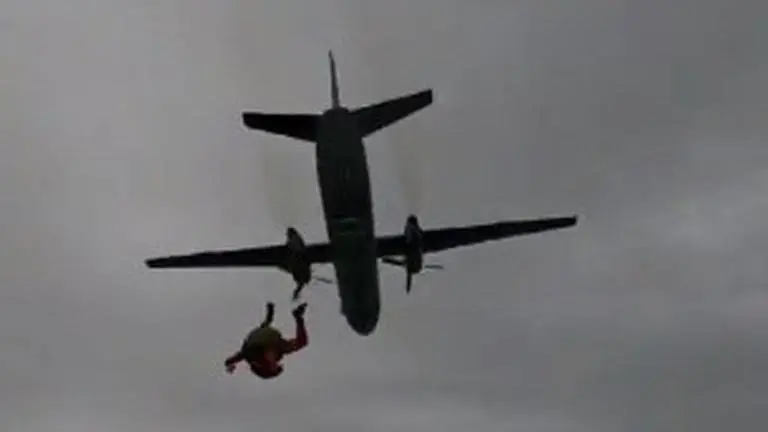
A test jumper from the Indian Air Force (IAF) successfully executed a deliberate detachment of the main parachute, allowing the reserve to deploy autonomously through the Reserve Static Line (RSL) before the Barometric Automatic Activation Device could engage, as stated by the IAF on September 7.

Image Credit: IAF
Elevating tactical capabilities with advanced parachute systems
The Paratroopers Tactical Assault-Static Line (PTS-SL) system, an advanced iteration of the existing PTA (M) personnel parachute, was introduced by the Indian Air Force (IAF) to enhance their operational capabilities. It, as per DRDO sources, had the lowest worldwide rate of descent and opening shock, along with 360-degree steering ability. The parachute was designed for deployment from low-flying and low-speed aircraft such as AN-32, C-130, C-17, MI-17, etc.

(Image Credit: IAF)
Advertisement
Weighing in at a maximum of 140 kg, it allowed for a max release speed of 240 Kmph. With a drop altitude range of 250 m to 8000 m, it ensured a controlled descent of less than 5 m/s for an all-up weight of 140 kg. The main parachute utilized a Toroidal design with a canopy area of 100 m2 and a system weight of less than 12 kg (excluding reserve), deployed via a Main Static line. This system offered a substantial leap in performance for IAF paratroopers.
Reserves: Safety at its core
The reserve parachute, a crucial safety component in the IAF's parachute systems, provides a fail-safe mechanism in the event of main parachute failure. It featured a flat circular design with a canopy cap for swift deployment, as per data from DRDO. However, visuals from IAF showed a more cruciform type of design. The older canopy was constructed from 32 gsm Nylon fabric, and the suspension lines had a strength of 250 kilogram-force (kgf) for Nylon cordage and 318 kgf for Polyester cordage.
Advertisement

(The Main parachute detaches. | Image: IAF)
Older parachute system in use of IAF
Advancements had been made over time to the older PTA-M system, a significant upgrade, offering advanced aerodynamic features for smoother deployment and flight performance. This system supported a payload of up to 120 kg, deployed at speeds of up to 240 km/hr, and operated at altitudes as low as 250 metres above ground level. The main parachute was of the aero conical type, with a diameter of 10 metres and a packed weight of 15 kg, resulting in a descent rate of 5-6 m/s at sea level.

(The older reserve parachute. | Image: DRDO)
The Military combat parachute system
The Military Combat Parachute System, developed by the Aerial Delivery Research and Development Establishment (ADRDE), a pioneering R&D lab of DRDO, stood as an achievement in the domain of Aerodynamic Decelerators and Aerostat Systems. The IAF announced on social media, "In a historic event, the Military Combat Parachute System, #indigenously designed and developed by Aerial Delivery Research and Development Establishment (#ADRDE) was tested for its efficacy and foolproof functioning."

(Image Credit: DRDO)
In addition to these advancements, the Combat Free Fall (CFF) System, jointly developed by ADRDE and Electromedical Laboratory (DEBEL), Bangalore, provides a comprehensive solution for paratroopers. This enabled jumps from as high as 30,000 feet and gliding up to a range of 30 km, ensuring precise landings at desired targets. The system's capabilities extend to both High Altitude High Opening (HAHO) and High Altitude Low Opening (HALO) modes, offering enhanced flexibility and adaptability in various operational scenarios.