
India & Bharat: How did the country get its name and how did it evolve?
The ruling BJP leaders argue that renaming India is necessary to rid the nation of its colonial past, as Sri Lanka did by shedding its name Ceylon in 1972.
- India News
- 3 min read

;'%3e%3cpath%20d='m8,15.99c4.41,0,7.99-3.58,7.99-7.99S12.41,0,8,0,0,3.59,0,8s3.58,7.99,7.99,7.99Z'%20style='stroke:%23fff;%20stroke-miterlimit:10;%20stroke-width:.02px;'/%3e%3cpath%20d='m3.08,3.37l3.82,5.11-3.84,4.15h.87l3.37-3.64,2.72,3.64h2.94l-4.04-5.39,3.58-3.87h-.86l-3.1,3.35-2.5-3.35h-2.94Zm1.27.64h1.35l5.97,7.99h-1.35l-5.97-7.99Z'%20style='fill:%23fff;'/%3e%3c/g%3e%3c/svg%3e)


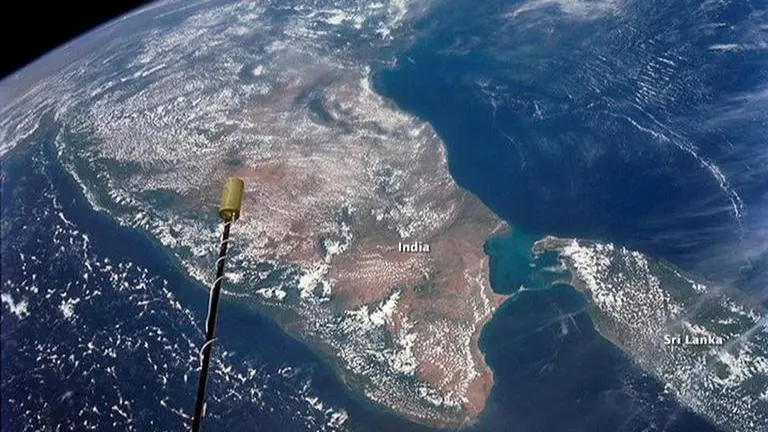
The nomenclature of the nation has again taken the centrestage as political parties spar over the potential renaming of India as 'Bharat'. Sources say that the Central government might remove the name India altogether in the special session of Parliament from September 18 to 22 and amend Article 1 of the constitution which states: "India, that is Bharat, shall be a Union of States."
The ruling BJP leaders argue that the move is necessary to rid the nation of its colonial past, as Sri Lanka did by shedding its name Ceylon in 1972. On the other side of the spectrum, the opposition parties call the buzz around the renaming as purely political.
However, historical records prove that both the name 'India' and 'Bharat' have nothing to do with the British or religion as the country's name is derived purely in the context of geography. So, where do the names India and Bharat come from?
Origin and history of 'India' and 'Bharat'
Our country is home to arguably the world's oldest civilisation which originated and thrived near the Indus or the Sindhu river. The 3,200 km long trans-Himalayan river finds its name in the Rig Veda, the collection of sacred hymns compiled between 1500 and 1200 BCE, and is the source of both the names which have links to Persia and Europe.
Advertisement
It is worth noting, that the name Bharat is an endonym, the native name given to local settlers, language or dialect whereas the name India is an exonym, a non-native name given by visitors, which transformed over the years to take its present form.
The name India originates from the river Sindhu, which itself got named as Indus due to the difference in dialects. The story has its roots in the Persians, believed to be the close cousins of Indian Aryans, who pronounced 'S' as 'H' and thus the river Sindhu became 'Hindu'. This Hindu term, now solely associated with religion, was then being used for the river as well as those living near the river eastward.
Advertisement
The word Hindu later got the suffix 'stan' (similar to 'sthan' in Sanskrit) from the Arabic languages added to it and thus originated 'Hindustan'. Notably, this word was discovered at an inscription in Iran's Persepolis, the capital of Achaemenid empire of King Darius I who lived from 556 BC to 486 BC. It is this name which was recognised by the Mughals/Turks to describe India after the invasions in the 1500s.
The word Hindu further evolved and gave birth to the root word 'Ind' as it was introduced to the Greeks through various accounts including that of 5 BCE historian Herodotus. He transliterated the word to Indus which later gave birth to the root word 'Ind' and eventually the word India was coined, and used extensively by the British and other European countries.
As for the word 'Bharat', it has its roots in Bharata, the son of King Dushyant and Queen Shakuntala, from the Hindu epic Mahabharata who is said to have ruled the entire subcontinent. Some even link the name to King Bharata, the ancestor of the Bharata clan, who were described as the people living in the subcontinent.