
India successfully conducts training launch of AGNI-1 ballistic missile from Kalam Island
In order to verify the system's overall performance and the readiness of ballistic missile units, user trials include the test flight of a randomly chosen unit.
- India News
- 3 min read

;'%3e%3cpath%20d='m8,15.99c4.41,0,7.99-3.58,7.99-7.99S12.41,0,8,0,0,3.59,0,8s3.58,7.99,7.99,7.99Z'%20style='stroke:%23fff;%20stroke-miterlimit:10;%20stroke-width:.02px;'/%3e%3cpath%20d='m3.08,3.37l3.82,5.11-3.84,4.15h.87l3.37-3.64,2.72,3.64h2.94l-4.04-5.39,3.58-3.87h-.86l-3.1,3.35-2.5-3.35h-2.94Zm1.27.64h1.35l5.97,7.99h-1.35l-5.97-7.99Z'%20style='fill:%23fff;'/%3e%3c/g%3e%3c/svg%3e)


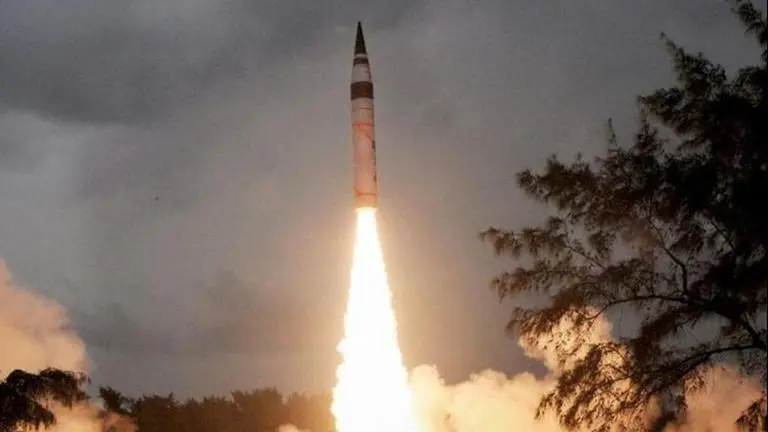
The Strategic Forces Command successfully conducted a training launch of the Agni-1 medium-range ballistic missile from APJ Abdul Kalam Island in Odisha on June 1, 2023.
The missile is a tried and tested system with a high degree of precision for strategically hitting targets.
In order to verify the system's overall performance and the readiness of ballistic missile units, user trials include the test flight of a randomly chosen unit from the current inventory of deployed missiles.
“All operational and technical features of this missile were successful,” a press release from PIB stated.
Advertisement
The PIB's Odisha handle on Twitter stated, "Successful training launch of a Medium-Range Ballistic Missile, Agni-1 was carried out by the Strategic Forces Command from APJ Abdul Kalam Island, #Odisha The missile is a proven system, capable of striking targets with a very high degree of precision."
🚀Successful training launch of a Medium-Range Ballistic Missile, Agni-1 was carried out by the Strategic Forces Command from APJ Abdul Kalam Island, #Odisha
— PIB in Odisha (@PIBBhubaneswar) June 1, 2023
🚀The missile is a proven system, capable of striking targets with a very high degree of precision.
AGNI's capabilities
In the Agni family of Indian nuclear-capable missiles, the Agni-I is the oldest and shortest-range missile. The previously deployed medium-range ballistic missile Agni-II, the medium-range ballistic missile Agni-III, the intermediate-range ballistic missiles Agni-III and Agni-IV, and the near-intercontinental range Agni-V succeed it.
Advertisement
The range of the AGNI-I ballistic missile is 700 kms. It was India's first nuclear-capable device to be tested in the late 1980s, over a decade before the country conducted its first armed nuclear tests in 1998.
However, the Agni-I's development was finished after that of the Agni-II, which offered India a more urgent capability in the wake of the 1999 Kargil War with Pakistan. The Agni-I was created with a range explicitly to put Pakistani targets at danger.
For the Agni-1 missile, India maintains about 20 launchers. The system was designed to be transportable on both roads and trains. The 12-ton, 15-meter-long, and 1000 kg payload-capable Agni-I has already been inducted into the Indian Military.
Advanced Systems Laboratory (ASL), the top missile development facility of the DRDO, worked with the Defence Research Development Laboratory (DRDL), the Research Centre Imarat (RCI), and Bharat Dynamics Limited (BDL), a Hyderabad-based company, for the development of Agni-I.
Since the missile is now inducted and is an integral part of the strength of the armed forces, it is crucial to carry out user trials for defence personnel training and skill development.