
India gets MQ-9 Reaper from US to guard its skies
India's acquisition of the MQ-9 drone is expected to shift the regional power balance in unmanned warfare against Pakistan and China's drone dominance.
- India News
- 4 min read

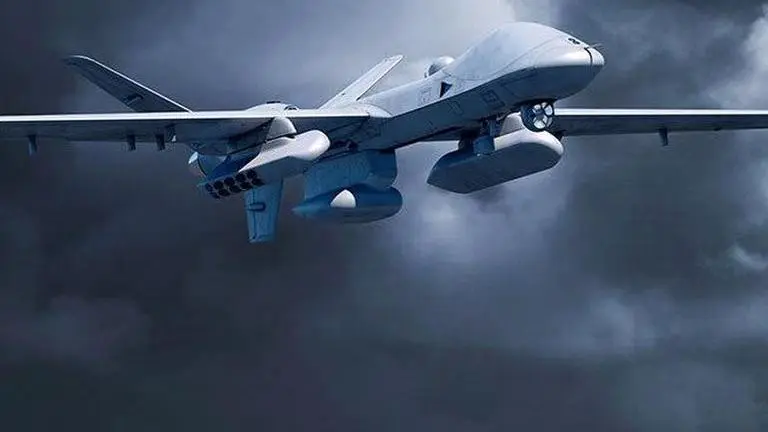
In a significant development for India's defence sector, both President Joe Biden and Prime Minister Modi have welcomed the strategic move for India's plans to procure the General Atomics MQ-9B High-Altitude Long Endurance (HALE) drones. This acquisition is expected to considerably enhance India's intelligence, surveillance, and reconnaissance (ISR) capabilities across various domains, including the Indian Ocean region and along the Line of Actual Control (LAC).

Image: A Predator B drone of General Atomics Aeronautical Systems in flight with fuel tanks for extended range (Credit: GA-ASI)
Things you should know about the drone deal
-
India will procure 31 MQ-9B Reaper (PredatorB) drones, including its Sea Guardian variant, for a total of $3 billion. The Indian Navy will receive 15 of the Naval variant of the drone, while the remaining Reapers will be divided among the Army and the Air Force.
-
As part of the agreement, General Atomics will establish a Comprehensive Global Maintenance, Repair, and Overhaul (MRO) facility in India. This facility will serve as vital support infrastructure, catering to the maintenance and servicing needs of the MQ-9B. This move will enable India to develop its expertise in UAV maintenance and repair, reducing dependency on external sources and fostering domestic technological advancements.
- Under the procurement plan, the MQ-9B UAVs will be assembled in India, aligning with India's 'Make-in-India' initiative and long-term objectives of bolstering its indigenous defence capabilities. With a crucial aspect of India's national security strategy being self-reliance, this move will help boost India's prospects in defence production and technology.

Image: An MQ-9B drone during Sunrise (Credit:GA-ASI)
Indian Navy's experience with MQ-9B drones
The General Atomics UCAV, an unmanned combat aerial vehicle, has proven its exceptional performance in long-endurance missions and its ability to operate at high altitudes. Equipped with state-of-the-art ISR systems, these advanced unmanned aerial platforms have demonstrated the unprecedented advantage India's armed forces will have for gathering critical intelligence and conducting surveillance operations. The Indian Navy has already experienced the dexterity of these drones during the two years of service with the Navy. Previously, the Indian Navy leased two variants of the Sea Guardian UCAV during the peak of Sino-India tensions in 2020, and the leased drones today have accumulated more than 10,000 operational hours. The Navy has successfully exploited the ISR capabilities of the drone by tracking the presence of foreign warships and naval vessels in the Indian Ocean Region (IOR) and the Arabian Sea. China, in particular, has been actively asserting its influence in the IOR over the past decade by deploying warships, submarines, and research vessels.
Advertisement

Image: A Predator B Block 5 variant of the reaper drone (Credit: GA-ASI)
Shifting balance of power in the region
With India now acquiring the MQ-9 drone, the balance of power in the region, in regards to unmanned warfare, would see a change that had previously tilted against India due to Pakistan's acquisition of Turkish Bayraktar TB2 and Akinci drones, as well as China's established prowess in the drone manufacturing sector.
Advertisement
Specifications of the MQ-9B Reaper
- The Reaper is a turboprop-powered, multi-mission Remotely Piloted Aircraft (RPA) with an endurance of over 27 hours and speeds of 240 knots true airspeed (KTAS).
- The GA-ASI UCAV operates at altitudes of up to 50,000 feet and can carry a payload capacity of 3,850 pounds, including 3,000 pounds of external stores, making it highly flexible for various missions.
- It features a fault-tolerant flight control system and triple redundant avionics, meeting and surpassing reliability standards of manned aircraft. It is equipped with the Honeywell TPE331-10 turboprop engine, integrated with Digital Electronic Engine Control (DEEC), delivering improved engine performance and fuel efficiency.
- The drone's modular design allows for easy configuration with different payloads. It can carry Electro-optical/Infrared (EO/IR) sensors, Lynx Multi-mode Radar, maritime surveillance radar, Electronic Support Measures (ESM) systems, laser designators, and various weapons. Additionally, the MQ-9B is capable of accommodating field-retrofittable enhancements such as wing-borne fuel pods and reinforced landing gear, increasing endurance from 27 to 34 hours.
- It has a wingspan of 66 feet, a length of 36 feet, and a maximum gross takeoff weight of 10,500 pounds. Another notable feature of the UCAV is its high operational availability, which exceeds 90 percent. The MQ-9B can be easily transported by C-130 aircraft or larger aircraft if necessary.
- The MQ-9B Reaper is operated by several institutions, including the U.S. Air Force, the U.S. Department of Homeland Security, NASA, the Royal Air Force, the Italian Air Force, the French Air Force, and the Spanish Air Force.