
Indira Gandhi’s Independence Day Speeches: A Legacy of Evasion and Autocratic Rhetoric
Indira Gandhi’s speeches frequently deflected accountability onto external factors or the general public, rather than acknowledging administrative failings.
- India News
- 4 min read

;'%3e%3cpath%20d='m8,15.99c4.41,0,7.99-3.58,7.99-7.99S12.41,0,8,0,0,3.59,0,8s3.58,7.99,7.99,7.99Z'%20style='stroke:%23fff;%20stroke-miterlimit:10;%20stroke-width:.02px;'/%3e%3cpath%20d='m3.08,3.37l3.82,5.11-3.84,4.15h.87l3.37-3.64,2.72,3.64h2.94l-4.04-5.39,3.58-3.87h-.86l-3.1,3.35-2.5-3.35h-2.94Zm1.27.64h1.35l5.97,7.99h-1.35l-5.97-7.99Z'%20style='fill:%23fff;'/%3e%3c/g%3e%3c/svg%3e)


New Delhi: As India celebrated its 78th Independence Day, Prime Minister Narendra Modi delivered his longest-ever speech, addressing the nation from the historic ramparts of the Red Fort. The 98-minute address covered a broad spectrum of issues, ranging from India's economic landscape and crime against women to atrocities against Hindus in Bangladesh and the proposed Uniform Civil Code. His speech highlighted a comprehensive approach to both national and international concerns.
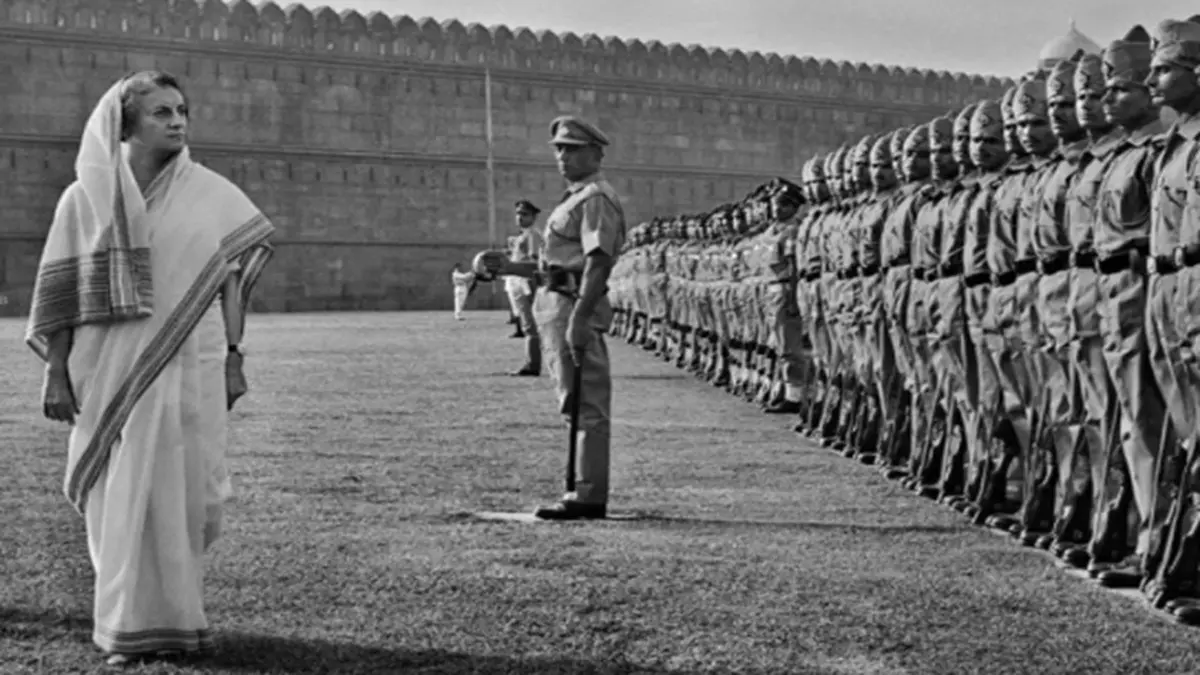
In contrast, historical analysis revealed that former Prime Minister Indira Gandhi's Independence Day speeches were often more politically motivated. Rather than addressing issues directly, the late Prime Minister’s rhetoric frequently evaded responsibility for critical problems such as rising prices and shortages. Her speeches tended to underline these issues without offering substantive solutions, reflecting a troubling pattern of avoidance when it came to tackling the root causes of economic distress.
Gandhi’s speeches frequently deflected accountability onto external factors or the general public, rather than acknowledging administrative failings. Her portrayal of the Emergency as a necessary measure to address societal problems revealed a dangerous normalisation of authoritarian practices. This approach was characterized by a framing of the Emergency as a cure for the country’s ills, overshadowing the democratic values she was meant to uphold.

Repetitive Themes and Evasion
Gandhi’s speeches often revolved around recurring themes of rising prices and shortages, yet consistently failed to provide substantive solutions. For instance, in her 1971 speech, she highlighted the impact of price hikes but offered no concrete measures beyond a general call for price stabilization.
Advertisement
By 1973, the problem of rising prices was again a focal point, but Gandhi’s rhetoric lacked any actionable solutions. In 1974, while acknowledging the issue of rising prices and scarcity of essential goods, she again refrained from offering specific remedies.
The inconsistency and repetition in her speeches showed a fundamental evasiveness in addressing the root causes of economic problems.
Advertisement
By 1975, she even defended the Emergency and suggested that the Emergency was a necessary measure to address these issues, portraying it as a solution to societal problems rather than a reflection of her administration's failures. This shift in narrative illustrates how Gandhi’s speeches often sidestepped accountability, framing her failures as external challenges rather than internal shortcomings.
Avoiding Accountability
Gandhi’s speeches frequently deflected blame onto external factors or the general public. In 1967, she framed rising prices as a global issue, distancing her administration from the problem. By 1973, she implied that public complicity in black marketing was to blame for shortages, suggesting that consumer behaviour was responsible for the economic malaise.
The pattern of evasion continued into the 1970s. In 1975, Gandhi lamented that her policies failed due to widespread exploitation and resistance to implementation, placing the onus on others rather than acknowledging administrative failings. This tendency to blame others for her government's shortcomings persisted into the early 1980s, where she criticized both the public and the political system for contributing to corruption and inefficiency.
Lack of Inspiration and Democratic Undermining
Gandhi’s speeches often lacked inspirational content and reflected a troubling normalisation of authoritarian measures. In 1968, she urged industrialists and businessmen to self-regulate without providing any framework for doing so, illustrating a lack of leadership and vision.
Her 1975 speeches celebrated the Emergency as a necessary measure, likening it to the optimism of India’s independence movement. This perspective starkly contrasts with the democratic values she was supposed to uphold, instead promoting the view that authoritarian measures were justified for societal cleansing.
Moreover, Gandhi’s portrayal of the Emergency as a means to ‘cleanse’ the political and economic systems underscored her autocratic approach to governance. Her administration’s use of Emergency powers to suppress dissent and manipulate political structures highlighted a profound disregard for democratic principles.