
Kashmiri saffron to be exported to over 60 countries under new export policy
Authorities aim to take saffron production to 26-27 tonnes in the coming years.
- India News
- 2 min read

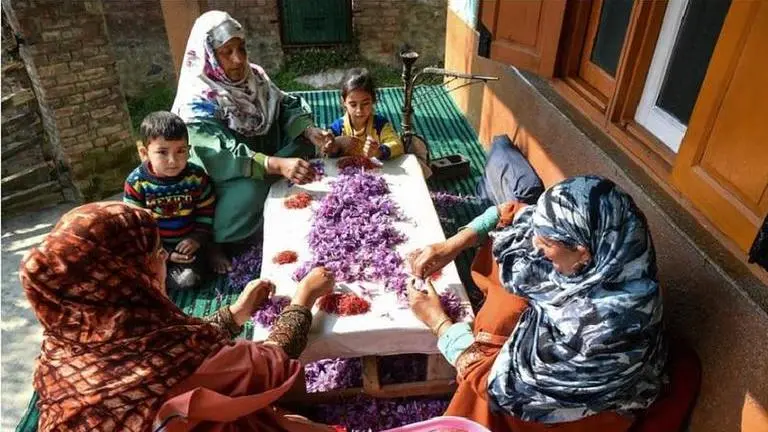
Renowned worldwide, the Kashmiri ‘kesar’ (saffron) is a prized cooking condiment. This precious ingredient grown in abundance in the Valley has also earned Jammu and Kashmir the status of the second largest saffron producer.
Now, the J&K government aims to further boost saffron production in the state with a new export policy. The government has shortlisted 60 countries where the demand for Kashmiri saffron is huge.
Also known as red gold, the spice derived from the flower of Crocus sativusis is grown at an altitude of 1,600m to 1,800m above sea level, which makes it unique from other saffron varieties available across the globe.
The J&K districts involved in saffron cultivation include Pampore, Pulwama, Budgam, Srinagar and Kishtwar.
Advertisement
The state agriculture department is hopeful that in October, the new export policy will be in place and provide a big boost to its (saffron) growers.
''Kashmiri saffron is famous across the globe because of its quality. We are blessed with the suitable climatic conditions for this precious crop. With the help of technological intervention, the National Saffron Mission led to an increase in production. Now our goal is to focus on the export policy so that we are able to sell our crop globally,” said Director, Agriculture, Kashmir, Chowdhary Mohammad Iqbal.
Advertisement
“Iran is responsible for around 45% of global production of saffron. Afghanistan and Spain are secondary producers, while Greece, India and Morocco are among the minor producers,” he informed, adding, “America, UAE and Israel are the largest buyers of Kashmir saffron.”
National Saffron Mission was launched in 2010
President of the Saffron Growers Association, Abdul Majid Wani feels that the efforts put in the National Saffron Mission, launched in 2010, are now showing its results. “Last season we had a good yield, due to which growers made good money. In 2022, the saffron production had reached close to 18 tonnes; however, the goal is to take saffron production to 26-27 tonnes in the coming years.”
Kashmiri saffron given GI tag in 2020
In May 2020, Kashmiri saffron was given the geographical indication (GI) tag by the Geographical Indications Registry. GI tagging helped the farmers to get the best remunerative price for financial sustainability. Even the online marketing services have made it easy for buyers and sellers to trade, said the authorities.