
Sengol in India: 7 similar symbols used in different parts of the world
The Sengol was installed in India's new Parliament on May 28. Several countries around the world have such symbols at their seat of government. Here is a list.
- India News
- 5 min read

;'%3e%3cpath%20d='m8,15.99c4.41,0,7.99-3.58,7.99-7.99S12.41,0,8,0,0,3.59,0,8s3.58,7.99,7.99,7.99Z'%20style='stroke:%23fff;%20stroke-miterlimit:10;%20stroke-width:.02px;'/%3e%3cpath%20d='m3.08,3.37l3.82,5.11-3.84,4.15h.87l3.37-3.64,2.72,3.64h2.94l-4.04-5.39,3.58-3.87h-.86l-3.1,3.35-2.5-3.35h-2.94Zm1.27.64h1.35l5.97,7.99h-1.35l-5.97-7.99Z'%20style='fill:%23fff;'/%3e%3c/g%3e%3c/svg%3e)


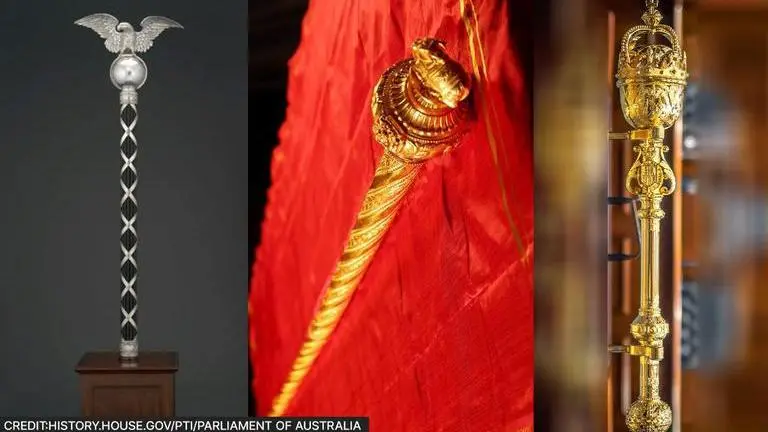
The Sengol, a golden sceptre with its origins going back to the Chola dynasty, now occupies a pride of place in the Indian Parliament. On Sunday, the 'staff of righteousness' was installed next to the Lok Sabha Speaker's chair in the new Parliament by Prime Minister Narendra Modi. In the run-up to the inauguration, the Sengol had become a contentious subject.
The Sengol installed in the Lok Sabha on May 28 is the same one that was handed over by Lord Mountbatten to Prime Minister Jawaharlal Nehru to symbolise the transfer of power from the British crown to Independent India.
The Congress, however, denied the historical significance of the Sengol, and other parties, like the Samajwadi Party claimed that the process in which the Sengol was installed was rooted in Brahminical values.
But the Sengol has come to represent a symbol of good governance. Staffs gracing parliaments is not unique to India. Several nations, especially democracies, have staffs at their parliaments.
Advertisement
Here is a list:
Mace of the House: USA

(Credit: history.house.gov)
Advertisement
One of the first emblems of the American government, the ceremonial mace is placed in the House of Representatives of the United States, often known as the Mace of the Republic. It stands for the American government's power, more specifically the House of Representatives' legislative authority.
The current mace has been in service since December 1, 1842. It was made by New York silversmith William Adams to replace the previous one that was burned in the Capitol Building fire on August 24, 1814, during the War of 1812. It cost $400 (equivalent to $11,000 in 2021). In the interim, a basic wooden mace was put to use.
Scottish Parliament Mace

(Credit: Twitter/ @EducationSP)
The silver mace in the current Scottish Parliament was made in 1999 and features a golden wedding ring. The mace is made of Scottish silver and has a belt of inlaid gold that was panned from Scottish rivers. The marriage of the people, the land, and the Parliament is symbolised by the golden band. At the head of the mace, thistles featuring the words "Wisdom, Justice, Compassion, Integrity" are weaved to symbolise the values held by the Scots for their Parliamentarians. The phrase "There shall be a Scottish Parliament - Scotland Act 1998" is engraved on the mace's head.
Mace of Parliament of Canada

(Credit: sencanada.ca)
The ceremonial maces used in the Canadian Senate and House of Commons represent the power that each house has been granted by the nation's head of state. The fourth mace, a duplicate of the third mace that was destroyed by fire at the Centre Block in 1916, is the one that is currently used in the Commons.
Similar procedures are followed in the provincial and territorial legislatures, where a mace is used to symbolise the sovereign's authority and power.
Mace of Parliament of Australia

(Credit: Parliament of Australia)
In Australia, the House of Representatives' mace is a representation of both the House's and the Royal authority. It also signifies the Speaker's authority because it has been stated that "the authority of the Speaker and of the House are indivisible."
Before the election of a Speaker, the Mace is put on brackets beneath the House Table, and when the Speaker takes his or her position after being elected by the House, it is placed on rest on the table.
Cokmar of Malaysia

(Credits: Wikipedia)
The Cokmar, also known as War Clubs or the Mace, is an additional symbol of power and an essential part of the Malaysian government's array of powers. The Cokmar pair is made of silver. Each is 81.32 cm long and is made out of a short silver shaft placed on a circular, fluted orb made of plain silver.
Mace of Parliament: New Zealand

(Credit: New Zealand Parliament)
A symbolic mace for the New Zealand House of Representatives has been used since 1866, when previous Speaker Sir Charles Clifford presented one to the Legislature. The Serjeant-at-Arms carries the mace, which is seen as a representation of the power of both the Speaker and the House.
Mace of Parliament: South Africa

(Credits: Parliament of South Africa)
The mace represents the power of the National Assembly. The Serjeant-at-Arms brings it into the chamber and announces the Speaker of the National Assembly's entrance. It serves as notice that the House is duly constituted and that its operations are official. Previously, a gold mace measuring 1.3 metres in length and 8.5 kilograms in weight was presented to Parliament by the Gold Producers' Committee of the Transvaal and Orange Free State Chamber of Mines. This mace was in use until 2004, when a new mace was made following extensive consultation in response to the Rules Committee's decision to examine the emblems of Parliament. The first time this mace was used was on September 14, 2004, during a National Assembly session.