
Significance of Deesa Airbase to Indian Airforce’s warfighting capabilities
The Prime Minister recently laid the foundation stone of the Deesa airbase in Gujarat. The airbase is of key significance to secure India's western air corridor
- India News
- 3 min read

;'%3e%3cpath%20d='m8,15.99c4.41,0,7.99-3.58,7.99-7.99S12.41,0,8,0,0,3.59,0,8s3.58,7.99,7.99,7.99Z'%20style='stroke:%23fff;%20stroke-miterlimit:10;%20stroke-width:.02px;'/%3e%3cpath%20d='m3.08,3.37l3.82,5.11-3.84,4.15h.87l3.37-3.64,2.72,3.64h2.94l-4.04-5.39,3.58-3.87h-.86l-3.1,3.35-2.5-3.35h-2.94Zm1.27.64h1.35l5.97,7.99h-1.35l-5.97-7.99Z'%20style='fill:%23fff;'/%3e%3c/g%3e%3c/svg%3e)


The 12th edition of DefExpo saw India’s Prime Minister Narendra Modi lay the foundation stone for a new air base at Deesa in north Gujarat’s Banaskantha district near the India-Pakistan border. The air base is significant to bolster the defence of India’s airspace as it will reportedly reduce the long pending strategic gap of about 350 kilometres between the Air Force station in Bhuj and Rajasthan’s Uttarlai village.
Prime Minister Modi said that the Deesa airbase will emerge as an effective centre for the nation’s security after he laid the foundation stone. Moreover, Modi iterated that, "The international border is just 130 kilometres away. If our forces, especially the Air Force, are in Deesa, we will be able to respond in a much better way to any challenge on the western border.”
Deesa Airbase to act as a firewall against a nefarious Pakistan
From a strategic point of view, the Deesa air base will be a significant asset for the nation and act as a firewall between enemy aircraft taking off from Pakistan’s Mirpur Khas, Shahbaz, Hyderabad, and its F-16 airbase in Jacobabad.

Image: Twitter/@IAF_MCC
The industrial complex in Gujarat, worth more than a trillion-dollar, in addition to Bhavnagar and Vadodara, is a potential target for Pakistan, as it could hit India economically in a worst-case scenario. However, the Deesa air base will plug the air defence gap between Gujarat’s Bhuj Airforce station and Phalodi air base of Rajasthan.
Advertisement
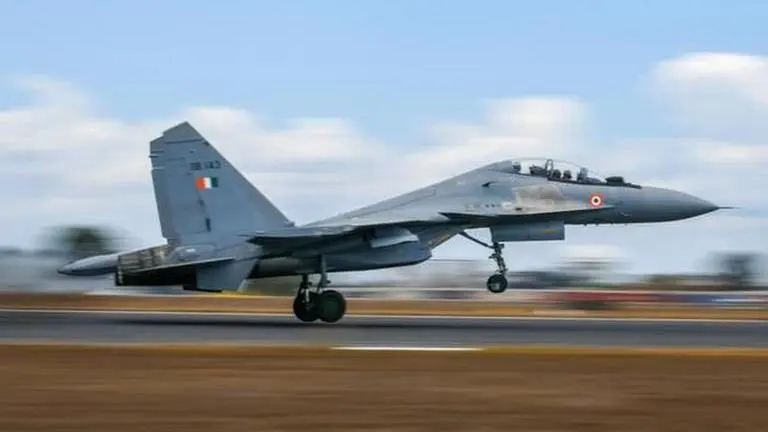
Additionally, the Deesa airbase will also make Pakistani cities of Hyderabad, Karachi, and Sukkur vulnerable with the deployment of IAF’s deep penetration strike fighters. Deesa is a forward airbase due to its proximity to the Indo-Pak border. This would imply that the Indian Airforce would not deploy the newly acquired Rafale or the frontline fighter Su-30MKI on this airfield. However, the IAF could station fighter jets MiG-29 and HAL Tejas which focus on air defence. This will enable the IAF to intercept the enemy fighters in a confrontational scenario.
The Airbase will upgrade India’s striking capability

Image: Twitter/@IAF_MCC
Advertisement
A key feature of the Deesa airbase is the ability of the Indian Airforce to mount retaliatory strikes against Pakistan if the situation demands it. Pakistan, a country known to sponsor terrorism, had scrambled F-16 jets to counter India’s airstrikes in Balakot.
The Indian strikes were a retaliation to a Pakistan-led terror attack in Pulwama, where a CRPF convoy was struck by a suicide bomber killing 44 CRPF personnel. The airbase will be capable to avert such major terror strikes in Gujarat or along the southwestern sector apart from giving support to any land offensive by Pakistan in future. The Deesa airbase is expected to be operational by 2024.