
Surya Grahan 2023: Rare Hybrid Solar Eclipse sighting on April 20
The Ningaloo Eclipse is the name given to the hybrid solar eclipse in honour of an indigenous term of Western Australia.
- India News
- 3 min read

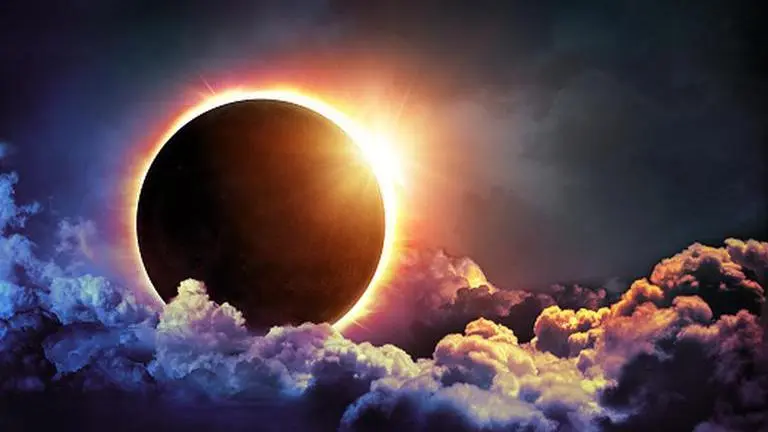
The first solar eclipse of 2023 will be a hybrid solar eclipse, and it will occur on April 20. Only a few countries in Southeast Asia and Australia will experience the solar eclipse. People from the South Indian Ocean, the South Pacific Ocean, the Solomon Islands, Malaysia, Fiji, Cambodia, Japan, Samoa, Singapore, Thailand, Australia, New Zealand, Vietnam, Brunei, and Taiwan will be able to see it.
India will not see the hybrid solar eclipse, but its citizens can still view this unique event online. The fact that the first solar eclipse of the year will include two different types of solar eclipses makes it unique and rare. The Ningaloo Eclipse is the name given to the hybrid solar eclipse in honour of an indigenous term.
On April 20, the Moon will cast its shadow across the tip of Australia in a 40-kilometre-wide track- on the World Heritage-listed Ningaloo region near Exmouth, Western Australia, making the solar eclipse an amazing and rare astronomical occurrence that presents a special opportunity for Western Australia.
Types of Eclipses
Total, partial, hybrid, and annular eclipses are the four different types of solar eclipses. The Moon's alignment with Earth and the Sun, as well as its distance from Earth, determine the type of eclipse that will be visible to the public.
Advertisement
In total, there are three different types of Lunar Eclipses: Total, partial, and penumbral. Every year, there are at least two partial lunar eclipses, but they are uncommon. A lunar eclipse may always be observed with the naked eye, unlike a solar eclipse.
Total Solar Eclipse
When the Moon totally obscures the Sun's face as it moves in front of Earth, there is a total solar eclipse. A total eclipse will be visible to those who are in the Moon's shadow when it strikes Earth. If the conditions are ideal, individuals who are in the path of a total solar eclipse will be able to see the Sun's corona, its outer atmosphere, which is often hidden by the Sun's dazzling face. The only sort of solar eclipse in which observers can briefly take off their eclipse glasses (which are different from conventional sunglasses) is a total solar eclipse, during which the Moon totally blocks the Sun.
Advertisement
Annual Solar Eclipse
When the Moon is at or near its farthest point from Earth and passes in front of the Sun, an annular solar eclipse occurs. Due to its greater distance from Earth, the Moon appears smaller than the Sun and does not entirely obscure it. As a result, the Moon appears as a black disc atop a bigger, brighter disc, giving the impression that the Moon is surrounded by a ring.
Partial Solar Eclipse
When the Moon passes between the Sun and Earth, but the Sun, Moon, and Earth are not exactly lined up, a partial solar eclipse occurs. The Sun will appear to be partially obscured, giving it a crescent-shaped appearance. People who are not inside the Moon's inner shadow will only observe a partial solar eclipse during a complete or annular solar eclipse.
Hybrid Solar Eclipse
Due to the curvature of the Earth's surface, an eclipse's phase can occasionally change from annular to total as the Moon's shadow travels around the world. It's referred to as a hybrid solar eclipse.