
Ups and downs of Abdul Nasser Madani's controversial life
Born in 1965 in Kollam district, Madani gained recognition at a young age for his ability to deliver engaging sermons at the mosque.
- India News
- 5 min read

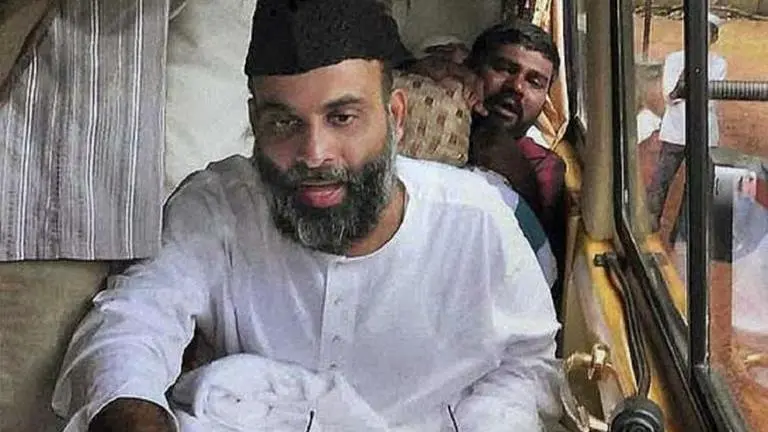
On April 5, 2021, the Chief Justice of India labelled the 2008 Bengaluru blast accused, Abdul Nasser Madani, a ‘dangerous man’. Just two years later, on Monday, Madani got a rousing reception from his supporters as he reached the Kochi Airport after the Supreme Court allowed him to travel to Kerala to meet his ailing father. He is back in the state which had unintentionally passed a resolution in favour of him back in 2006.
Here is everything that you need to know about the controversial politician
Abdul Nasser Madani, a prominent figure in Indian politics, has been at the centre of numerous controversies throughout his life. Recently, the Supreme Court referred to him as a "dangerous man" in connection with the 2008 Bengaluru Blast case. However, Madani's journey is marked by a complex mix of political affiliations, legal battles, and public support.
Early Life and Political Ascent
Madani was born in 1965 in Kollam district. He gained recognition at a young age for his ability to deliver engaging sermons at the mosque, attracting a growing number of followers. During the late 1980s, the Ram Temple issue in Ayodhya sparked tensions, providing Madani with an opportunity to voice his opposition to the Rashtriya Swayamsevak Sangh (RSS), a nationalist organisation.
Formation of the Islamic Sewak Sangh (ISS):
To counter the RSS and advocate for Muslim interests amidst the Babri Masjid dispute, Madani founded the Islamic Sewak Sangh (ISS). The ISS gained traction in Tamil Nadu and West Bengal. However, in 1992, the government banned the ISS, prompting Madani to dissolve the organisation and establish the People's Democratic Party (PDP). The PDP aimed to foster unity between Muslims and Dalits and quickly became influential in Kerala politics, with politicians from various parties seeking Madani's support.
The Coimbatore Blast and Legal Troubles:
In 1998, the Coimbatore blast on February 14 implicated Madani, leading to the disintegration of the PDP. He was arrested on March 31, 1998, in connection with the serial bomb blast and faced charges under multiple sections of the Indian Penal Code, including spreading communal hatred, criminal conspiracy, sedition, and the Arms Act. Madani's arrest occurred during the tenure of Kerala's Chief Minister EK Nayanar, and he was apprehended by the Kozhikode police. Subsequently, the Tamil Nadu police obtained an arrest warrant, linking Madani to the Coimbatore blast. The Special Investigation Team (SIT) took custody of Madani following a court order, which blamed the prosecution for not providing convincing evidence. After a lengthy legal battle, Madani was acquitted by the trial court in Kozhikode after 25 years. In Tamil Nadu, the blast trial commenced in 2002 and exonerated Madani in 2007 due to a lack of evidence.
Involvement in the Bengaluru Blast:
On July 25, 2008, a series of low-intensity bombs exploded across various locations in Bangalore, resulting in one fatality and 20 injuries. The investigating team charged Madani in connection with the blast. In August 2010, he was arrested by the Bangalore police. Although granted bail multiple times, Madani faced restrictions on leaving Bangalore and was only allowed to visit Kerala under strict conditions. Between 2013 and 2017, he made four visits to Kerala.
Political Support and Controversies:
Madani garnered support from political parties like the Left and the Congress alike. In 2006, the Kerala Assembly passed a unanimous resolution advocating for his release. Former Chief Minister Oommen Chandy expressed his desire for a fair trial for Madani, while the BJP accused the Congress of relying on Madani's supporters to secure votes in the Ponanni constituency. Pinarayi Vijayan, the current Chief Minister and a prominent CPI-M member, shared a stage with Madani, sparking a political debate. Additionally, in 2013, a delegation from the Muslim League, a major opposition party to the PDP, visited Madani in jail, solidifying their relationship.
Recent Developments:
In 2014, the Supreme Court granted Madani bail on the condition that he remain in Bangalore. However, after the LDF (Left Democratic Front) assumed power in 2016, Chief Minister Pinarayi Vijayan offered to provide security for Madani during his visits to Kerala, citing exorbitant escort charges levied on the undertrial prisoner.
Advertisement
Kerala Travel with Conditions:
In 2021, Madani sought permission to stay in Kerala until the conclusion of the trial related to the Bangalore blasts. During this trial, the Chief Justice of India, SA Bobde, described him as a "dangerous man."
The court finally granted him permission to visit Kerala for three months. But this period was marred by delays, Despite the delay in approval by the Karnataka government, Madani eventually arrived in Kerala, where he was greeted by hundreds of supporters and received a hero's welcome. His time period in Kerala ends on July 8.
Madani Falls Ill In Kerala:
As he touched down in Kerala after a ‘rousing reception’ he complained of uneasiness and is now hospitalised in Kochi. It is important to note that he is still facing trial in the Karnataka court in connection with the Bangalore blast case.
Abdul Nasser Madani's journey has been marked by a combination of political influence, legal battles, and controversy. As his story unfolds, the outcome of the pending trial and its implications for this controversial figure in Indian politics will become clearer.