
36 Hours, One Reclaimed Smile: A Journey of Rebirth Through Recovery
A 48-year-old high-profile Kolkata lawyer, Dipanjan Bhattacharjee, who initially dismissed early symptoms like hearing loss and near-blackouts as fatigue, was diagnosed with a brain tumor in 2023 after a casual suggestion led to an MRI that uncovered the underlying cause.
- Initiatives News
- 6 min read

;'%3e%3cpath%20d='m8,15.99c4.41,0,7.99-3.58,7.99-7.99S12.41,0,8,0,0,3.59,0,8s3.58,7.99,7.99,7.99Z'%20style='stroke:%23fff;%20stroke-miterlimit:10;%20stroke-width:.02px;'/%3e%3cpath%20d='m3.08,3.37l3.82,5.11-3.84,4.15h.87l3.37-3.64,2.72,3.64h2.94l-4.04-5.39,3.58-3.87h-.86l-3.1,3.35-2.5-3.35h-2.94Zm1.27.64h1.35l5.97,7.99h-1.35l-5.97-7.99Z'%20style='fill:%23fff;'/%3e%3c/g%3e%3c/svg%3e)


From courtroom advocacy to offering strategic legal advice, 48 year old Dipanjan Bhattacharjee, a high profile lawyer from Kolkata maintained a fast-paced schedule while handling sensitive, complex, and high-stake cases. This continued for many years until, one day, the rhythm of his busy routine shifted.
Around 2018, Dipanjan first noticed a hearing deficiency in his right ear, which was the earliest symptom. He underwent audiometry and ENT consultations in Kolkata, where he was advised to use a high-end hearing aid. At that time, no MRI or neurological investigations were suggested to identify the underlying cause. With reassurance from medical consultations and no further red flags, Dipanjan continued to lead a normal life.
Physically active and disciplined, Dipanjan was a regular at the gym, lifting extremely heavy weights and pushing his endurance limits. Over time, he began experiencing throbbing headaches while bending forward and had two near-blackout episodes during intense workouts. Given his long, stressful work hours and minimal rest, these intermittent symptoms were initially dismissed as fatigue, sleep deprivation, or burnout.
However, things took an unexpected turn during a casual social interaction in 2023, when a doctor suggested that Dipanjan undergo a neurological screening, purely as a precaution. Acting on this advice, he underwent an MRI, which revealed the presence of a brain tumor. Subsequent investigations, including a CT scan, were otherwise unremarkable. Considering Dipanjan’s active lifestyle, the diagnosis came as a shock to both him and his family.
Advertisement
After consulting several neurosurgeons, Dipanjan underwent emergency surgery in July 2023 at a hospital in Mumbai. During the procedure, doctors discovered that the tumor was highly calcified, making complete removal unsafe. As a result, only about 15-20% of the tumor could be removed. Following surgery, Dipanjan made steady progress, gradually regaining his strength and functionality. By August 2025, he had largely returned to a near-normal life, resuming most day-to-day activities without significant limitations.
Over the next 6-8 weeks, new and alarming symptoms, including acute dizziness, mild blurred vision, and nausea, began to emerge. His hearing had also completely deteriorated to an extent that he had completely lost hearing in his right ear. Rather than occurring randomly, these symptoms appeared to follow a pattern and seemed to intensify significantly after the sound healing sessions that Dipanjan had recently undergone. He was immediately hospitalized and underwent several tests, which revealed that his cerebral oedema had increased. After being placed on a month-long course of steroid medication, Dipanjan’s condition gradually stabilized. However, a constant buzzing sensation persisted. He was further evaluated locally in Kolkata, where the doctor advised a detailed eye examination and optic nerve assessment. These reports raised concerns, although no recent MRI had yet been conducted.
Advertisement
Finally, Dipanjan began developing significant facial nerve weakness on his right side, along with noticeable slowing of his signature, which meant weakening of the motor functions of his right upper limb. Avanti reached out to a friend, who referred them to Dr. Sampath Chandra, Program Lead – Skull Base Surgery, Consultant – ENT, Head & Neck Surgeon at Manipal Hospital Old Airport Road. With hope in their hearts, Dipanjan and his wife set off on their journey to Bangalore to consult Dr. Sampath who offered them immense reassurance and confidently urged them to proceed with a second surgery. Despite their earlier hesitation, Avanti and her husband readily agreed.
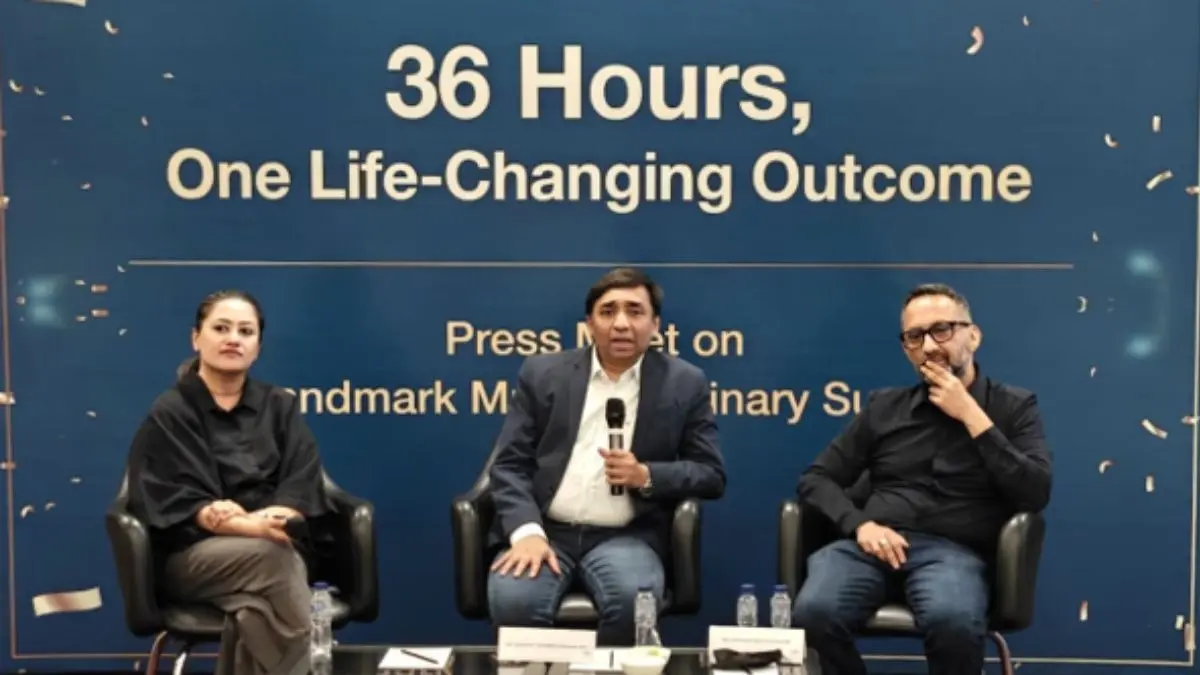
On the morning of 9th December, Dipanjan was wheeled into the operating room for an intense 36-hour surgery intended to not only remove the tumor, but also restore function in the affected part of his face and place an implant to help him regain the hearing he had lost after his first surgery. A multidisciplinary team—including Dr. Sathwik R Shetty, Consultant – Neurosurgery; Dr. Srikanth V, Consultant – Plastic Reconstructive & Cosmetic Surgery; Dr. Mayur Shetty, Consultant - Plastic Surgery; Dr. HS Murthy, HOD & Consultant – Anaesthesiology; Dr. Jalaja KR, Consultant – Anaesthesiology; and Dr. Niveditha Damodharan, Consultant ENT Surgeon—led by Dr. Sampath worked together to remove portions of his brain and skull—a high-risk procedure that carried the possibility of facial distortion. Considering Dipanjan’s profession, appearance and speech largely mattered for him.
“Dipanjan's meningioma was located deep at the base of the skull and is one of the biggest tumors that I have encountered in my practice," explained Dr. Sampath. "Due to its size and location, a specialised transtemporal skull base approach would allow the team to safely reach and remove as much of the tumor as possible. The surgery was planned using a specialised route from behind the ear to access the skull base effectively.”
Dr. Sathwik emphasized that the vascular and fibrous nature of the tumor and its adherence to the brainstem, which is a very critical area of the brain, made debulking and excising the tumor extremely challenging. “Subsequently, we performed the surgery and achieved a good decompression,” he said.
During their initial discussions, Dr. Mayur explained that any facial distortions caused during the procedure could be addressed and corrected with reconstructive surgery, allowing Dipanjan to regain his spontaneous expressions and smile once he made a full recovery. “In surgeries like this, which involve performing a cross-facial graft, precision is critical,” said Dr. Srikanth. “The procedure requires borrowing nerve signals from the unaffected side of the face to reanimate the affected side, all while ensuring that the normal side remains completely unharmed.”
Dr. Jalaja also highlighted that managing anaesthesia for such a prolonged and complex surgery can be daunting. Throughout the surgery, a six-member team of anaesthesiologists, led by Dr. Murthy ensured that the patient remained stable and was safely woken up at the end of the procedure.
Dr. Niveditha who was working closely with Dr. Sampath, coordinated with Avanti and provided constant support throughout the process. On the evening of 10th December, the surgery successfully concluded, and Dipanjan emerged from the operating room with his ability to smile and speak completely intact.
“While every other medical team highlighted the risks associated with the surgery, the team at Manipal Hospital also offered us practical solutions,” said Dipanjan, with a grateful smile and a spark in his eyes. Today, as Dipanjan steadily returns to his routine, his journey reminds patients that even the most complex challenges can be overcome with compassionate medical care, teamwork, and hope. Removing a 6 centimeter-long tumor while simultaneously restoring facial function and full hearing in a single surgery is a remarkable feat done in very few centres across the world. This 36-hour surgery therefore stands as a testament to Manipal Hospital’s integrated, multidisciplinary approach, where surgeons, anesthesiologists, reconstructive specialists, and nursing teams work in seamless coordination to give patients the best possible outcomes and care.