
Adani Ports’ Colombo Terminal Sets New Record with 1 Million Containers in Inaugural Year
Adani Ports' Colombo West International Terminal (CWIT) has achieved a milestone of 1 million TEUs in its first year, marking the fastest ramp-up in the history of the Port of Colombo. Backed by an $800 million investment, the fully automated deep-water terminal has become a key transshipment node for Asia-Europe trade.
- Initiatives News
- 2 min read

;'%3e%3cpath%20d='m8,15.99c4.41,0,7.99-3.58,7.99-7.99S12.41,0,8,0,0,3.59,0,8s3.58,7.99,7.99,7.99Z'%20style='stroke:%23fff;%20stroke-miterlimit:10;%20stroke-width:.02px;'/%3e%3cpath%20d='m3.08,3.37l3.82,5.11-3.84,4.15h.87l3.37-3.64,2.72,3.64h2.94l-4.04-5.39,3.58-3.87h-.86l-3.1,3.35-2.5-3.35h-2.94Zm1.27.64h1.35l5.97,7.99h-1.35l-5.97-7.99Z'%20style='fill:%23fff;'/%3e%3c/g%3e%3c/svg%3e)


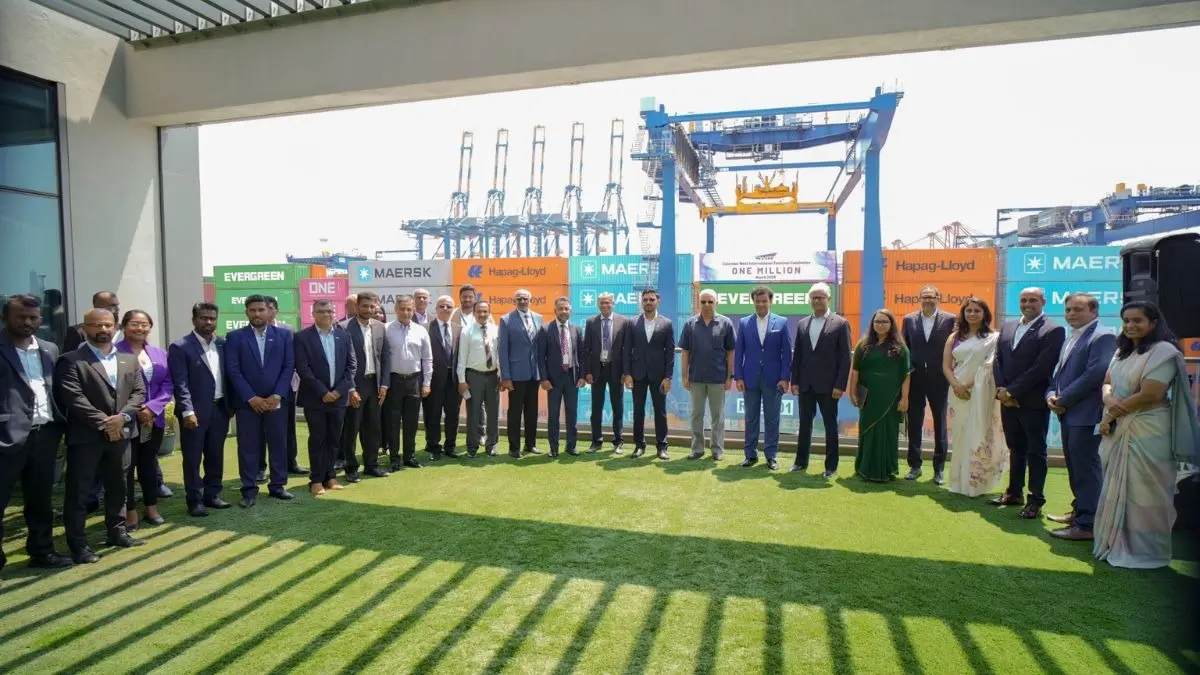
The Colombo West International Terminal (CWIT), a strategic joint venture led by Adani Ports and Special Economic Zone Ltd (APSEZ), has handled over one million TEUs (twenty-foot equivalent units) in its first full year of operations.
Launched in April 2025 with an investment of approximately $800 million, the milestone represents the fastest operational ramp-up ever recorded at the Port of Colombo. The terminal is a partnership between APSEZ, Sri Lankan conglomerate John Keells Holdings PLC, and the Sri Lanka Ports Authority.
While new container terminals typically require several years to stabilize and build throughput, CWIT reached the one-million-container mark within 12 months. This performance outpaces several newer automated terminals in Europe and East Asia, which have historically taken longer to reach comparable utilization levels in their first phase.
Industry analysts attribute this rapid scaling to the terminal’s immediate alignment with major shipping lines and its integration into an existing transshipment ecosystem that connects Asia, the Middle East, and Europe.
Advertisement
Deep-Water Capabilities and Automation
As the first fully automated deep-water facility at the Port of Colombo, CWIT was designed specifically to accommodate the latest generation of ultra-large container vessels.
- Infrastructure: The terminal features a 1,400-metre quay and a water depth of 20 metres, allowing it to berth the largest ships currently operating on the Asia–Europe trade route.
- Capacity: With a total annual capacity of 3.2 million TEUs, the terminal has significantly boosted Colombo's overall handling capability.
- Technology: The facility utilizes digitally integrated systems, modernized cranes, and electrified yard equipment aimed at reducing vessel turnaround times and lowering the environmental impact of port operations.
Strategic Importance in the Indian Ocean
The success of CWIT reinforces Colombo’s role as a primary transshipment hub in the Indian Ocean Region (IOR). A substantial portion of the terminal's volume is linked to Indian transshipment cargo, making it a critical node for India’s EXIM (Export-Import) trade.
Advertisement
For APSEZ, which handles nearly 45% of India’s container cargo and operates 15 ports domestically, the Colombo project is a cornerstone of its international expansion. The terminal serves as a strategic link in a shifting trade landscape where efficiency and deep-water access are becoming the primary differentiators for global shipping networks.