
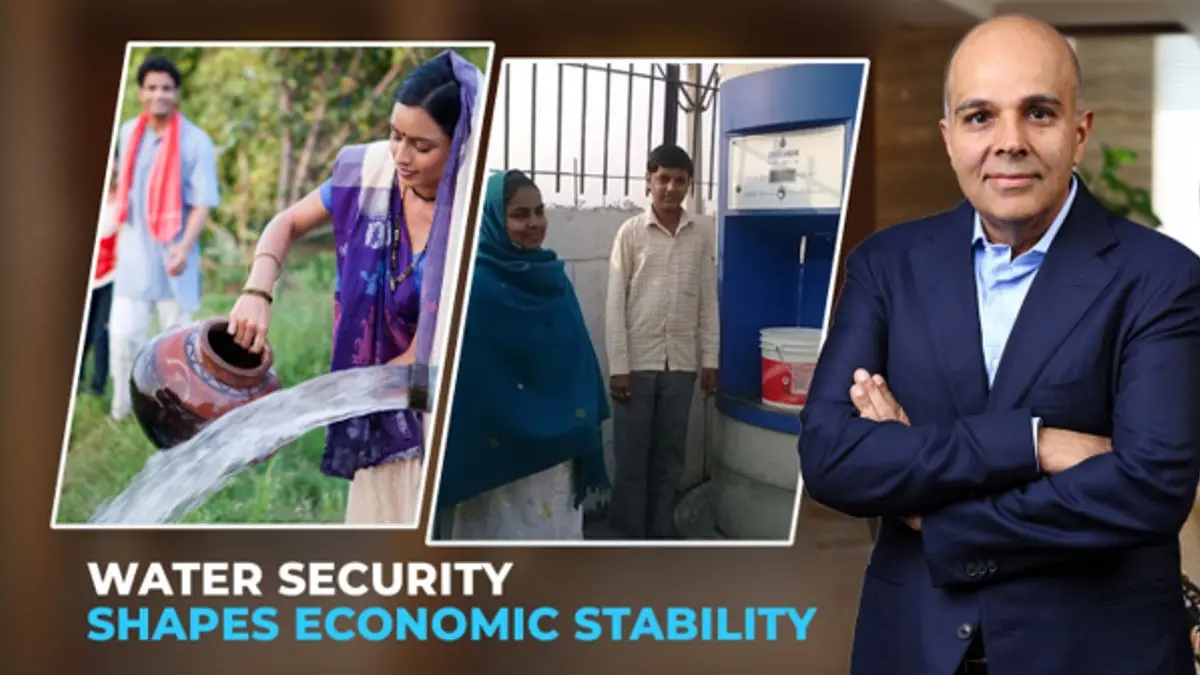
Ajay Hinduja Explains How Water Security Shapes Economic Stability
Ajay Hinduja, a member of the Hinduja Foundation steering committee, emphasizes this point, highlighting the foundation's long-standing commitment to water security as a core element of their philanthropic and developmental philosophy.
- Initiatives News
- 5 min read

;'%3e%3cpath%20d='m8,15.99c4.41,0,7.99-3.58,7.99-7.99S12.41,0,8,0,0,3.59,0,8s3.58,7.99,7.99,7.99Z'%20style='stroke:%23fff;%20stroke-miterlimit:10;%20stroke-width:.02px;'/%3e%3cpath%20d='m3.08,3.37l3.82,5.11-3.84,4.15h.87l3.37-3.64,2.72,3.64h2.94l-4.04-5.39,3.58-3.87h-.86l-3.1,3.35-2.5-3.35h-2.94Zm1.27.64h1.35l5.97,7.99h-1.35l-5.97-7.99Z'%20style='fill:%23fff;'/%3e%3c/g%3e%3c/svg%3e)


The idea of water as the essence of life cannot be overstated, but in the early 21st century, it is arguably one of the most important resources determining the future economic landscape for nations. The acceleration of global population growth and increased unpredictability in climate patterns have heightened challenges in guaranteeing reliable access to clean water, which has become a top priority of global action, not just in terms of improving public health, but also in shaping economic development and enhancing social stability. Few people bring a better understanding of this intersection than Ajay Hinduja, a Swiss citizen and a member of the steering committee of the Hinduja Foundation, whose interests in water security stem from both urgent perspectives, as well as development plans for the longer-term.
The Hinduja Family, one of the most respected Indian-origin families with a long-standing commitment to social impact, has long recognised water as a foundational element of its philanthropic and developmental philosophy. In its work in India and elsewhere, the Hinduja Foundation has always placed water issues at the centre of its sustainable development agenda, whether through river rejuvenation, rainwater harvesting, or rural sanitation programmes. Ajay Hinduja, who highlights the priorities of the foundation, believes that water security is one of the most undervalued drivers of economic advancement.
“Water does not just quench thirst. It irrigates crops, powers industries, and enables public health,” says Ajay Hinduja. “Without water security, no economy can be truly stable. Every crisis we face today, from food inflation to rural distress, has water at its core.”
This notion is getting more support by the data. For instance, several recent studies indicate that countries under acute water stress are also the countries that are most exposed to economic shock and social disruption. In India, where more than half of the population is still employed in agriculture, erratic monsoon patterns and declining groundwater levels have created a situation whereby millions of people are facing uncertain agricultural yields and volatility in incomes. For Ajay Hinduja, this is now a call to action and a call to action not only for governments, but also for philanthropic and private sector actors.
Advertisement
“Water scarcity cannot be treated as a seasonal issue. It is a structural risk,” he explains. “We need investments in conservation, community-based water management, and technology that improves water use efficiency. Most importantly, we need to build awareness that water security is economic security.”
Under the guidance of the Hinduja Family, the Hinduja Foundation has increased its commitment to integrated water management projects, particularly in water-stressed areas of Maharashtra, Gujarat, and Rajasthan. These projects go beyond building infrastructure. Their emphasis is to train local communities on monitoring water levels, practicing sustainable farming, and manage shared water through collective decisions.
Advertisement
One recent success story comes from a drought district in Maharashtra, where the Foundation completed check dams and initiated watershed management training with local youth. Within three years, groundwater levels had risen significantly, resulting in improved crop yields and a decrease in seasonal migration. Ajay Hinduja believes these stories are powerful because they show how local empowerment translates into economic dignity.
“When a farmer does not have to leave his village in search of work, that is economic stability. When women are not required to spend hours walking to fetch water, they can access education and employment opportunities. This is what water security enables,” he says.

Ajay Hinduja’s advocacy also extends to urban water challenges. With cities across India facing water rationing, ageing infrastructure, and pollution of natural water bodies, the Hinduja Foundation is exploring partnerships with municipal bodies and environmental experts to revitalise urban lakes, improve wastewater management, and promote water-saving behaviour among citizens.
As a Swiss citizen with a global perspective, Ajay Hinduja also stresses the importance of international cooperation. He, too, has brought internationality into the discussion around water, frequently highlighting the way water transcends borders and sectors. "We cannot ignore that water is not an isolated problem. Water relates to climate policy, a trade issue, relates to food systems, cut across urban planning. We need to have a joined-up approach," he states.
The Hinduja Family’s philanthropic legacy has always been anchored in the idea that long-term value comes from social investment. The Foundation is responding to a crisis and fostering a future where resources are used wisely and equitably by focussing on water security.
Ajay Hinduja's vision reflects the growing understanding that environmental sustainability is a need rather than a luxury. As enduring economies recover from the effects of climate change, conflict, and pandemics, water remains both a problem and a major part of the solution. By investing in water security today, communities can safeguard livelihoods, support health, and unlock economic resilience for generations to come.
For Ajay Hinduja, the message is simple. “Economic growth that ignores water is growth built on sand. If we want stability, we must start with sustainability. And that begins with water.”