
Beyond Buildings: Designing For Life, Not Just Living - How Experion Developers Is Reimagining Homes As Responsive, Sustainable Living Systems
Questions around air quality, energy efficiency, maintenance intensity, and spatial well-being are no longer secondary. They are central.
- Initiatives News
- 5 min read

;'%3e%3cpath%20d='m8,15.99c4.41,0,7.99-3.58,7.99-7.99S12.41,0,8,0,0,3.59,0,8s3.58,7.99,7.99,7.99Z'%20style='stroke:%23fff;%20stroke-miterlimit:10;%20stroke-width:.02px;'/%3e%3cpath%20d='m3.08,3.37l3.82,5.11-3.84,4.15h.87l3.37-3.64,2.72,3.64h2.94l-4.04-5.39,3.58-3.87h-.86l-3.1,3.35-2.5-3.35h-2.94Zm1.27.64h1.35l5.97,7.99h-1.35l-5.97-7.99Z'%20style='fill:%23fff;'/%3e%3c/g%3e%3c/svg%3e)


There is a quiet but definitive shift underway in India’s residential real estate market. Homes are no longer being evaluated purely as physical assets—they are increasingly understood as systems that influence how people live, feel, and function every day. This shift is being driven by a more informed homebuyer—one who looks beyond location and pricing to assess long-term performance. Questions around air quality, energy efficiency, maintenance intensity, and spatial well-being are no longer secondary. They are central. In effect, the conversation is moving from what a home is to how a home behaves over time.
It is within this changing lens that Experion Developers Private Limited has built its approach—treating residential development not as the creation of static structures, but as the design of responsive, living environments. In such a framework, sustainability is not layered onto a project—it is embedded into its logic from the outset.
Saatori: Where Space, Stillness, and Design Converge:
One of the clearest expressions of this philosophy is Experion Saatori, where the idea of luxury is intentionally stripped back to its essentials. Instead of adding more—more amenities, more density, more visual complexity—Saatori focuses on subtraction. Space is not filled indiscriminately; it is curated. This is where the Japanese concept of ‘Ma’ becomes central—the idea that the spaces between things are as important as the things themselves. Spread across a five-acre parcel, Saatori’s low-density planning—with just four residences per core—creates an environment where privacy is not engineered artificially, but emerges naturally from design restraint. The built form allows for visual breathing room, while the landscape introduces layers of quiet interaction through courtyards, greens, and transitional spaces. The project’s environmental design further reinforces this approach. Airflow is directed, not obstructed. Shade is created through vegetation and spatial orientation rather than mechanical dependence. Water features are not ornamental alone; they contribute to microclimate regulation. Even the wellness infrastructure—spanning over 1.5 lakh sq. ft.—is conceived less as a checklist of amenities and more as a continuum of experiences. Spaces for movement, pause, and restoration coexist, allowing residents to engage with the environment at their own pace. In this sense, Saatori does not just offer a lifestyle—it proposes a different rhythm of living.
Advertisement
Experion The Trillion as an Urban Framework:
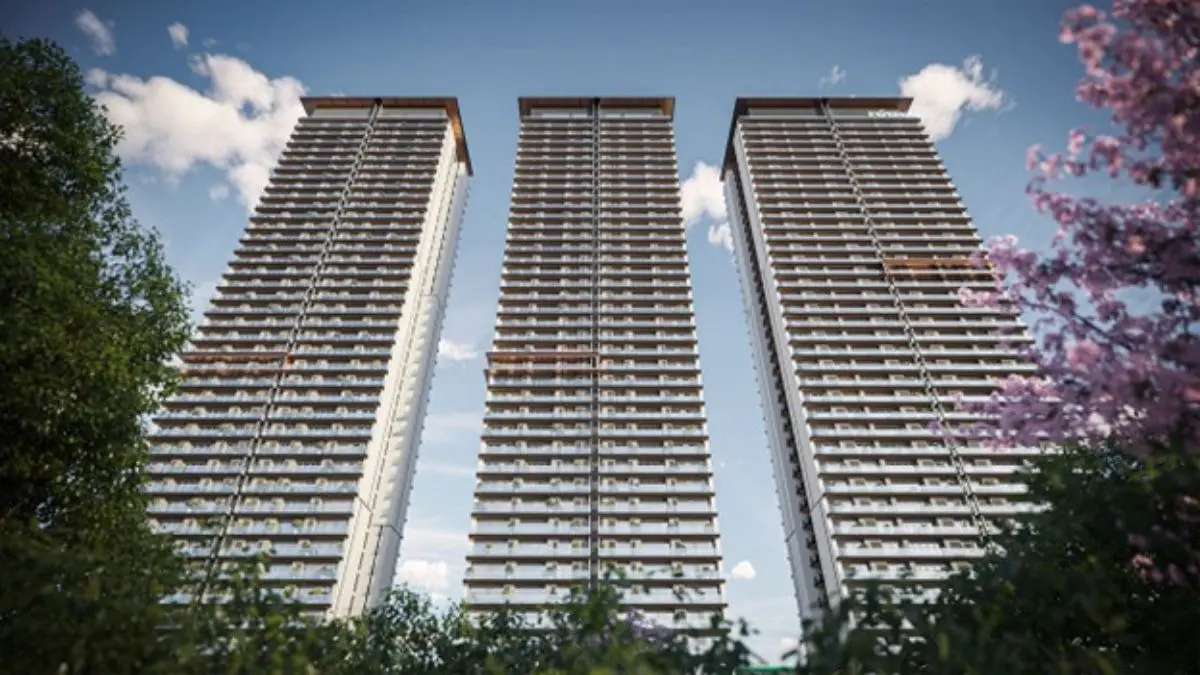
If Saatori represents precision, Experion The Trillion represents scale. Here, the same principles are translated into a larger, more complex urban setting—without losing their core intent. The project’s allocation of over 80% space to greens and balconies is not merely a design choice; it is a statement about prioritisation. Density is managed not just through numbers, but through experience—how open a space feels, how light travels, how movement flows across the site. The planning introduces a layered ecosystem of shaded walkways, open lawns, and climate-responsive landscaping. These elements work together to reduce heat gain, enhance the usability of outdoor spaces, and improve overall comfort without excessive reliance on artificial systems. The philosophical anchor—the idea of balance, represented through the concept of three—translates into a spatial equilibrium between built form, nature, and community infrastructure. Over 1 lakh sq. ft. Ft. of shared spaces are integrated not as afterthoughts, but as essential components of daily life.
Advertisement
From Design Intent to Operational Reality:
What differentiates Experion’s approach is that its thinking does not stop at design. A sustainable plan, if not supported by sustainable operations, quickly loses its relevance. Recognising this, the company extends its framework into how projects function post-occupancy. Water systems are designed for reuse and conservation. Energy consumption in common areas is optimised through efficient lighting strategies. Waste is managed through segregation and reduction mechanisms. Landscaping choices favour native species, ensuring that ecological sensitivity does not translate into high maintenance overheads. This continuity—from concept to operation—ensures that sustainability is not experienced as ideology, but as everyday efficiency.
Measuring What Matters:
As the industry evolves, so do the benchmarks that define quality. Increasingly, global frameworks are being used to evaluate not just construction standards, but the human impact of built environments. Experion Developers Private Limited’s WELL Residential Precertification for projects such as Experion The Trillion, Experion Elements, and One42 reflects this shift. These certifications assess parameters like air and water quality, daylight access, thermal comfort, and mental well-being—bringing objectivity to aspects that were once considered intangible. This signals a broader transition in real estate—from compliance-driven development to performance-driven living environments.
A Structural Shift, Not a Passing Trend :
The evolution underway in India’s housing market is not cyclical—it is structural. As buyers become more aware of how their surroundings impact their health, productivity, and long-term costs, the demand for better-designed, better-performing homes will continue to rise. Developers who recognise this shift early will not just adapt—they will lead. By approaching residential projects as integrated systems rather than isolated structures, Experion Developers is aligning itself with this future—one where sustainability, design intelligence, and human experience are no longer separate conversations, but part of a single, cohesive framework.