
Building a National Framework for Skill Verification in India
India Stack needs one more layer. A Skill Identity Layer. Infrastructure that lets people own, prove, and carry what they can do.
- Initiatives News
- 5 min read

;'%3e%3cpath%20d='m8,15.99c4.41,0,7.99-3.58,7.99-7.99S12.41,0,8,0,0,3.59,0,8s3.58,7.99,7.99,7.99Z'%20style='stroke:%23fff;%20stroke-miterlimit:10;%20stroke-width:.02px;'/%3e%3cpath%20d='m3.08,3.37l3.82,5.11-3.84,4.15h.87l3.37-3.64,2.72,3.64h2.94l-4.04-5.39,3.58-3.87h-.86l-3.1,3.35-2.5-3.35h-2.94Zm1.27.64h1.35l5.97,7.99h-1.35l-5.97-7.99Z'%20style='fill:%23fff;'/%3e%3c/g%3e%3c/svg%3e)


The Missing Piece in India's Digital Public Infrastructure Story Is Skills
India's workforce numbers tell a story that doesn't make sense on the surface.
Youngest population in the world, practically. Billions spent on skilling over the last ten years. Government after government talking about making India the global talent supply chain. All true. What's also true: companies across the country post jobs and can't fill them with people who are actually prepared. Meanwhile, lakhs of people who genuinely know their craft sit without decent work.
Training isn't the bottleneck. We've got plenty of that. The bottleneck is that there's no credible way to prove what someone can do. Hiring runs on proxies. Degrees. Resumes. Reference calls where the former manager barely remembers the person's name. Certificates confirm attendance, not competence. Resumes list whatever the candidate thinks will get them past screening.
Advertisement
Companies end up guessing. Wrong hires drain lakhs per person. Skilled workers in informal trades stay invisible because their ability lives in their hands, not on any document. Government-funded training programs can't prove whether graduates are better off. The whole apparatus runs on paperwork, and paperwork is a terrible proxy for what a person can actually do.
What would fix this? A system where skills are visible, verified, and travel with the person. A national framework for skill verification.
Advertisement
India's Digital Stack Has a Hole in It
India built population-scale digital infrastructure that works. Aadhaar gave 1.4 billion people a verifiable identity. UPI turned a cash-heavy economy into the world leader in real-time payments. DigiLocker made official documents accessible without visiting government offices.
People. Money. Documents. Three massive problems, three working solutions.
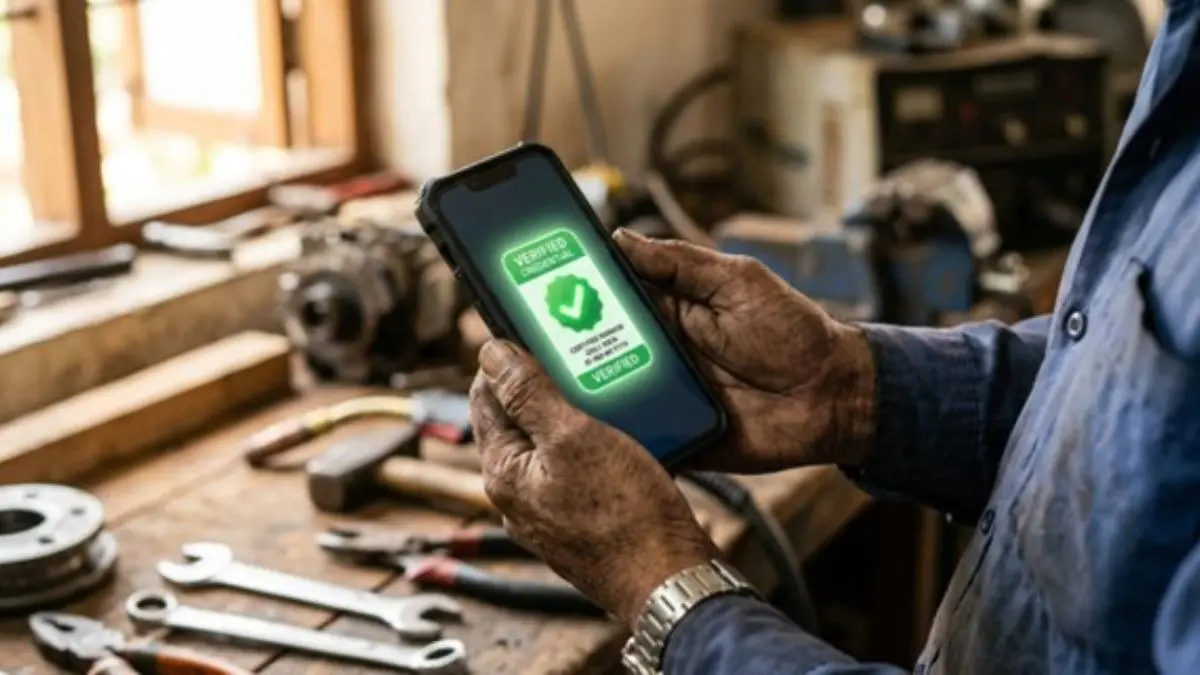
But skills got left out. Skills don't sit still. People pick them up on the job, through informal training, through years of hands-on work no institution ever certified. And there's no standardized, trusted, portable way to capture any of it. An electrician in Varanasi with twelve years of experience is a ghost to a recruiter in Pune. A nurse in Coimbatore can't get her qualifications verified for a Gulf posting without waiting over a month.
India Stack needs one more layer. A Skill Identity Layer. Infrastructure that lets people own, prove, and carry what they can do.
What a Skill Verification Framework Would Do
At its core, one question. Can this person perform this task to a defined standard?
That's different from certification. Certification tracks completion. Verification tracks competence. A framework built around verification would produce credentials that mean something because they were tested. Records portable enough that a welder in Bhopal and a factory manager in Chennai both trust. Employers making decisions on evidence instead of hope. Training institutions measured by whether graduates can do the job, not just how many enrolled.
What the Framework Needs
Five things. A unified skill taxonomy so competencies are described the same way across industries and states. Assessment systems that test real-world performance, not just memory. A digital Skill Passport that gives every person a lifetime portable record of verified skills, projects, and work history. A trust layer using cryptographic verification so credentials can't be faked. And an open architecture where training providers, employers, assessment bodies, and government systems all plug in through shared protocols. The same principle that made UPI scale.
Who Benefits
Workers become visible. A migrant labourer with years of specialized experience gets a verified record that means something beyond today's job site. Gig workers get continuity. People who trained informally finally get credit.
Employers stop gambling on resumes. Verified data replaces assumptions. Time-to-hire drops. Productivity goes up because you're matching real capability to the role.
Training institutions face honest scrutiny. Success gets measured by job performance, not enrollment. Government gets real data on where Rs 1.48 lakh crore in education spending is actually landing.
Making It Happen
This needs mission-mode execution. A National Skill Identity Mission, the way India builds large digital programs. Skill identity for every worker, wired into existing systems. Public skilling programs accountable to outcomes, not enrollment counts. And public-private collaboration at scale, because India's workforce is too large for any one entity. Government sets standards. Private sector brings speed and technology. Exactly how UPI was built.
FOUNDER'S PERSPECTIVE
"India built Aadhaar to answer 'Who are you?' and UPI to answer 'How do you pay?' Skill Passport exists to answer the third foundational question: 'What can you do?' These aren't three separate innovations. They're three pillars of the same national architecture. Without the third pillar, hundreds of millions of skilled workers remain economically invisible."
Mrityunjaya Prajapati, Founder & Architect, Skill Passport
Mrityunjaya Prajapati has spent 16 years building technology infrastructure. He's the Chief Technology Officer at Kalp Digital, where Kalp Studio (Blockchain-as-a-Service platform) onboarded over 15,000 blockchain developers and supporting 50+ Blockchains. He is shaping a generational infrastructure opportunity by redefining skills as the new credential for India's 500 million-strong workforce.
Where This Goes
India's proved it can build digital infrastructure at a scale most countries can't touch. Skills is the obvious next frontier.
Work isn't what it used to be. Gigs, contracts, remote arrangements scattered across platforms that don't connect. Verifying skills instantly and reliably isn't optional anymore. Countries that build trusted skill verification first will supply talent to the world. Everyone else sends workers into markets that want proof and doesn't have any.
India built identity for people. Identity for payments. The next step is identity for skills.
Opportunity won't go to those who claim. It'll go to those who can prove.
ABOUT SKILL PASSPORT
Skill Passport is India's blockchain and AI-powered Skill Identity, positioned as the third pillar of India Stack alongside Aadhaar and UPI. The platform lets workers, institutions, and employers issue, verify, and share tamper-proof skill credentials at scale, with particular focus on blue-collar workers, ITI graduates, gig economy workers, and the informal sector.
PRESS CONTACT
press@skillpassport.io
Website: skillpassport.io