
From Personal Biohacking to Building Decode Age: Rakesh Somani on India’s Longevity Opportunity
"Personal experimentation allows you to move fast, stay flexible, and operate informally. Building a science-led organisation requires a very different mindset. It demands structured validation, peer input, slower decision cycles, and strong documentation."
- Initiatives News
- 7 min read

;'%3e%3cpath%20d='m8,15.99c4.41,0,7.99-3.58,7.99-7.99S12.41,0,8,0,0,3.59,0,8s3.58,7.99,7.99,7.99Z'%20style='stroke:%23fff;%20stroke-miterlimit:10;%20stroke-width:.02px;'/%3e%3cpath%20d='m3.08,3.37l3.82,5.11-3.84,4.15h.87l3.37-3.64,2.72,3.64h2.94l-4.04-5.39,3.58-3.87h-.86l-3.1,3.35-2.5-3.35h-2.94Zm1.27.64h1.35l5.97,7.99h-1.35l-5.97-7.99Z'%20style='fill:%23fff;'/%3e%3c/g%3e%3c/svg%3e)


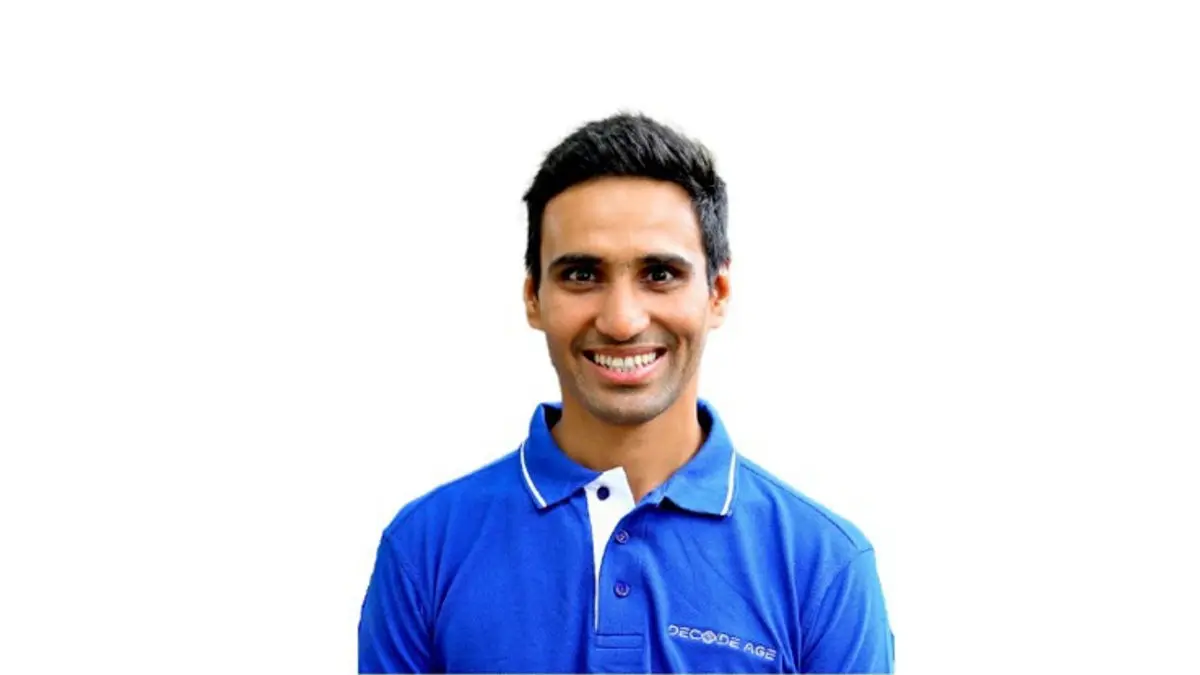
As India’s preventive health and longevity ecosystem evolves, founders who combine personal insight with scientific rigour are shaping what comes next. In this conversation, Rakesh Somani, COO and Co-Founder of Decode Age, reflects on his journey from hands-on biohacking to building a data-led longevity platform. He shares how personal experimentation informed his belief in early diagnostics, why ageing must be treated as a measurable biological process, and how Decode Age is making longevity science actionable for everyday consumers.
Before Decode Age became a company, you were experimenting with biohacking on yourself. What did that phase of personal exploration teach you about health that no formal system ever could?
That phase taught me something no formal system ever did: the body speaks long before a doctor or a report does, if you know how to listen. I began noticing clear patterns in my energy levels, recovery, digestion, sleep quality, and mental sharpness well before anything showed up as abnormal in blood reports. Traditional healthcare is largely reactive and usually steps in after a problem appears. My personal exploration showed me that the body gives early signals, and with the right inputs—nutrition, fasting, supplements, training, and microbiome work—you can change your trajectory much earlier. It also taught me what it means to be the CEO of your own health. When you experiment on yourself, every win and every mistake becomes data. Health stops feeling clinical and becomes deeply personal.
At what moment did your individual curiosity around longevity turn into a conviction that this needed to be built as a scalable platform for others?
Advertisement
The turning point came when I realised that the results I was seeing were not because I was special, but because I was measuring things most people were not. People around me started asking what I was doing differently, and every explanation came back to metrics that largely did not exist in India at the time, such as microbiome diversity, biological age, inflammation patterns, and mitochondrial efficiency. That is when it became clear to me that longevity was not a niche interest. It was an unmet need hiding in plain sight. Everyone wanted to feel younger, perform better, and recover faster. What they lacked were tools, not intent. I knew that if we could translate deep science into simple, actionable steps, we could change how millions of people experience ageing.
As you began engaging deeply with consumers, what assumptions about preventive health in India did you have to unlearn?
Advertisement
The biggest assumption I had to unlearn was that people were not interested in preventive health. They are interested, just not in the way the industry has traditionally delivered it. I realised that people do not lack discipline; they lack clarity. They do not avoid prevention; they avoid confusion. They are not resistant to change; they are resistant to generic advice. Indians are willing to invest in their health when they see specificity, evidence, and outcomes they can actually feel. The old idea of taking a multivitamin and walking a fixed number of steps is fading. What people want today is precision.
You often describe ageing as a measurable biological process. How did adopting this lens change your own daily health decisions, and in turn, the direction of Decode Age?
Once I understood ageing as a biological rate rather than a number on a calendar, my decisions became far more intentional. I began optimising my microbiome because I could see its direct impact on inflammation and metabolic ageing. I started monitoring sleep as a biomarker rather than treating it as a lifestyle luxury. Food, fasting, and supplements became levers I actively adjusted, not fixed routines I followed blindly. This same lens shaped the direction of Decode Age. We stopped asking how to help people stay healthy and started asking how to slow and reverse their rate of ageing. That single shift transformed us from a wellness company into a longevity platform.
Moving from personal experimentation to building a science-led organisation is a significant shift. What leadership lessons did this transition force you to confront early on?
The biggest lesson was humility. Personal experimentation allows you to move fast, stay flexible, and operate informally. Building a science-led organisation requires a very different mindset. It demands structured validation, peer input, slower decision cycles, and strong documentation. I had to learn to separate what worked for me personally from what could be responsibly recommended to thousands of people. Leadership in longevity means respecting uncertainty, valuing evidence, and building teams that are often smarter than you. It pushed me to grow from being a curious individual into a more accountable and responsible founder.
Diagnostics and data sit at the core of Decode Age. From your journey, why did you believe meaningful behaviour change had to start with measurement rather than motivation?
Motivation fades, but measurement creates movement. When someone sees that their biological age is several years older than expected, or that their gut health sits in the lowest percentile, motivation becomes secondary. What they feel instead is accountability. Data creates awareness, allows people to quantify progress, and personalises what they should do next. People change when they can see their own dashboard, not when they are given a lecture.
Longevity science is inherently long term, while consumer behaviour often seeks quick results. As a founder, how do you design for patience without losing engagement?
Longevity works over months and years, but people need to feel progress much sooner. We design our ecosystem with two timelines running in parallel. The first is a short-term feedback loop, where people experience tangible improvements such as better digestion, improved sleep, higher energy, reduced bloating, and clearer thinking. These changes help build confidence that the system is working. The second is the long-term biological loop, which focuses on outcomes such as lowering biological age, reducing inflammation, improving metabolic resilience, and enhancing gut diversity. We track these changes through data so that even gradual progress remains visible. The connection between short-term wins and long-term outcomes is what keeps people engaged.
Personalisation is widely discussed in healthtech. From your experience building Decode Age, what does true personalisation require at a data and decision-making level?
True personalisation requires three things. The first is granular data, including microbiome signatures, inflammation markers, and metabolic rhythms. The second is a strong interpretation layer that translates reports into meaning rather than overwhelming people with numbers. The third is a clear decision engine that answers a simple question: what should this individual do next? Most health platforms personalise based on preferences. We personalise based on biology and response. Two people with similar lifestyles may need entirely different interventions because their internal systems behave differently. That is the level of personalisation we work at.
As both a founder and operator, how do you balance long-term scientific ambition with the discipline required to build a sustainable business?
I keep ambition and execution in two distinct lanes. Scientific ambition drives our research efforts, from discovering biomarkers to validating protocols and advancing ageing science. Operational discipline drives the business, covering unit economics, customer experience, and efficiency. One cannot survive without the other. Ambition without discipline turns into hype, while discipline without ambition leads to mediocrity. Decode Age works because we protect science from business shortcuts and protect the business from losing scientific focus.
Looking ahead, what would tell you personally that Decode Age has succeeded, not just as a company, but as a shift in how people think about ageing?
For me, success is cultural rather than purely commercial. We will have succeeded when families discuss biological age the way they talk about fitness, when people test early instead of waiting for symptoms, and when ageing is seen as something that can be influenced rather than accepted as inevitable. Real success looks like India moving from a treatment mindset to a health span mindset. Commercial outcomes matter, but lasting companies create lasting change. The real achievement will be when people believe they can actively shape how they age, and longevity becomes a normal and empowered part of everyday life.