
From Zero To Rs 33 Crores: Bihar's Aman Dwivedi Building McKayn Consulting into an Ecommerce Powerhouse
India’s digital commerce sector is racing toward a projected multi‑hundred‑billion‑dollar market, powered by post‑pandemic online shopping habits, smartphone penetration, and rapid fintech adoption.
- Initiatives News
- 9 min read

;'%3e%3cpath%20d='m8,15.99c4.41,0,7.99-3.58,7.99-7.99S12.41,0,8,0,0,3.59,0,8s3.58,7.99,7.99,7.99Z'%20style='stroke:%23fff;%20stroke-miterlimit:10;%20stroke-width:.02px;'/%3e%3cpath%20d='m3.08,3.37l3.82,5.11-3.84,4.15h.87l3.37-3.64,2.72,3.64h2.94l-4.04-5.39,3.58-3.87h-.86l-3.1,3.35-2.5-3.35h-2.94Zm1.27.64h1.35l5.97,7.99h-1.35l-5.97-7.99Z'%20style='fill:%23fff;'/%3e%3c/g%3e%3c/svg%3e)


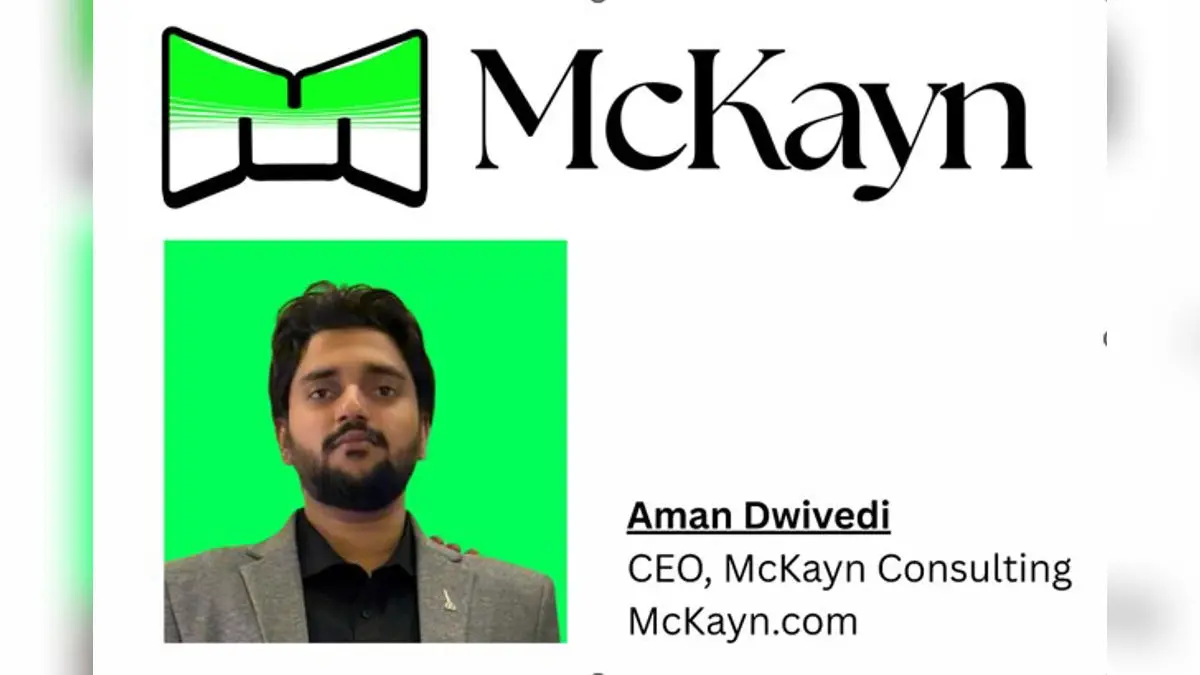
From Zero to ₹33 Crores: Bihar's Aman Dwivedi building McKayn Consulting into an Ecommerce Powerhouse
McKayn Consulting, the performance and affiliate marketing firm founded by self-taught entrepreneur Aman Dwivedi, has crossed a major new milestone with more than ₹33 crore in total sales, a retail reach of over 21,000 customers, and growth partnerships with upwards of 20+ established ecommerce brands.
Building on a journey that began with just a few hundred dollars earned over four years of freelancing, the company has emerged as a quiet but influential force in India’s ecommerce growth ecosystem.
The firm’s model is almost entirely performance-driven, tying its earnings to the actual sales it generates for its partner brands rather than flat retainers, and positioning McKayn as a long-term growth ally instead of a conventional digital agency.
Advertisement
What makes this story particularly newsworthy is its timing. India’s digital commerce sector is racing toward a projected multi‑hundred‑billion‑dollar market, powered by post‑pandemic online shopping habits, smartphone penetration, and rapid fintech adoption.
As festive seasons like Diwali 2025 report record online spends, McKayn Consulting’s performance‑focused funnels have become an invisible but impactful part of this surge, quietly converting browsers into buyers for its portfolio of ecommerce brands.
Advertisement
The ₹41,500 Grind: A Teenager’s Solo Battle in Bettiah
A few years ago, Aman Dwivedi was a little‑known freelancer in Bettiah, a small city in Bihar better known for its agricultural and small‑business roots than for tech entrepreneurship.
At just 17, armed with a laptop and an internet connection, he began experimenting with online work: content writing, basic web design, and virtual assistance.
The early returns were brutally low. Over his first four years, his total earnings amounted to around $500 — roughly ₹41,500 at current rates. To friends and relatives, it didn’t look promising. While others focused on college admissions or traditional career paths, Aman spent late nights crafting proposals, learning how clients thought, and figuring out why most of his applications were rejected.
Those years, however, were foundational. They taught him how online business really works: how to communicate with clients, how to handle rejection, how to deliver work under pressure, and how to keep going even when the money barely covered his data bills.
In a state like Bihar, where many young people migrate out in search of jobs, his decision to stay in Bettiah and bet on the internet was both unusual and risky.
The SEO Epiphany: From Free Blogs to First Stability
Feeling stuck but not defeated, Aman made a decision that would change his trajectory: he chose to specialize. Instead of trying to do everything, he focused on Search Engine Optimization (SEO).
He had no mentor and no paid courses. Instead, he immersed himself in free blogs, case studies, and tutorials. He read SEO guides late into the night, dissected high‑ranking websites, and tried to understand how keywords, backlinks, content quality, and algorithms worked together to drive traffic.
To find clients, he went where big agencies weren’t looking: Facebook groups, small‑business communities, and underground marketing forums. There, he pitched his services to entrepreneurs and shop owners trying to get noticed online. A few took a chance on him.
Slowly, he started seeing results: higher rankings, more organic traffic, more leads for his clients.
Over the next few years, this work gave him his first experience of real, stable income. He was no longer just a freelancer taking any job he could find; he was a specialist helping businesses get discovered through search.
The Algorithm Collapse: Six Months of Survival Mode
Just as things started to feel stable, the ground shifted. Major Google algorithm updates rolled out and, almost overnight, the search landscape changed. Many of Dwivedi’s clients saw their rankings disappear.
Traffic from Google dropped. Leads dried up. And as the numbers fell, so did client confidence.
One by one, clients pulled out, and within a short span, his entire SEO client base collapsed. For six long months, Aman was effectively back at zero - no steady revenue, no clear path forward, and growing financial pressure.
It was a humbling and difficult time. He questioned his choices, his skills, and whether he should abandon the online path altogether.
But those years of grinding through rejection had already built a quiet resilience. Instead of quitting, he turned that frustration into analysis: what had gone wrong, and what kind of business model would be more resilient to sudden platform changes?
Reinventing Through Affiliate Marketing
Out of that crisis came a new chapter. Aman Dwivedi started exploring affiliate marketing, a model where you earn commissions for driving sales of other brands’ products. On paper, it sounded simple: help brands sell, get paid a percentage. In practice, it was anything but easy.
He poured his remaining time, energy, and savings into understanding the space. He built niche sites, ran ad campaigns, and tested different angles and offers. Many of those experiments failed. Campaigns that looked promising on day one fizzled out by day seven. Money went out faster than it came in.
Yet, he kept going. Instead of chasing shortcuts, he studied what actually worked: how buyers made decisions, how long they took to convert, what kind of content built trust, and how to design funnels that could move people from curiosity to purchase. Over time, he stopped thinking like a freelancer and started thinking like a growth partner.
Slowly, things began to click. Initial small affiliate wins gave him proof that the model could work if executed properly. Brands began to take notice of the results he was driving.
McKayn Consulting’s Growth Engine
What started as scattered affiliate experiments evolved into McKayn Consulting — a focused affiliate and performance marketing firm that positioned itself not as a “traffic vendor,” but as a growth partner.
Instead of promising vague exposure or impressions, McKayn concentrated on performance: content strategy, funnel design, retargeting, and conversion optimization. The firm’s offers were built around one simple idea — it would grow only when its partners grew.
Within six months, the workload grew to the point where Aman had to hire a small team.
Monthly revenue rose to nearly the equivalent of ₹20 lakh, a number that would have looked unimaginable in his early freelancing days.
To support operations and training, he brought on his school friend Ayush Raj, who took charge of staff development and internal growth.
A New Reality: ₹33 Crore in Sales, 21,000+ Customers, and 20+ Brands
Today, McKayn Consulting stands as a multi‑crore performance marketing firm. In a relatively short span, it has driven more than ₹33 crore in cumulative sales for its partner brands and become embedded in the growth engines of over 20+ established ecommerce businesses.

Beyond the revenue headline, there’s another number that tells the story: 21,000+ retail customers. That figure represents individual buyers who have discovered, considered, and ultimately purchased products through funnels and campaigns designed or optimized by McKayn. They span multiple categories — from fashion and lifestyle to gadgets and wellness — reflecting the breadth of the firm’s impact across India’s ecommerce landscape.
For McKayn’s partner brands, the appeal lies in the structure: performance‑linked deals that keep both sides aligned. Rather than charging large fixed retainers, the firm primarily earns when it delivers measurable results.
In a market where customer acquisition costs can quickly spiral out of control, this skin‑in‑the‑game approach stands out.
Operating From the Margins, Competing at the Center
One of the most striking parts of McKayn’s story is what it doesn’t have.
There is no venture capital backing.
There is no glass‑walled office in a metro city.
There is no giant sales team knocking on corporate doors.
Instead, there is a lean team rooted in a small town, using the same internet that once barely paid its founder ₹41,500 over 4+ years to now power tens of crores in sales for brands across India and USA (90% of McKayn Consulting clients are from USA).
This model has its advantages. Without investor pressure to chase vanity metrics or burn cash for growth, McKayn has been able to build quietly, focus on profitability, and prioritize relationships over hype.
For many ecommerce brands, especially those outside the unicorn spotlight, that philosophy is not just attractive — it’s necessary.
Lessons for India’s Next Generation of Digital Builders
Aman’s journey holds several lessons for aspiring entrepreneurs, especially those outside India’s major startup hubs:
- Success is often slow and invisible. Four years of work produced very little money, but those years built skills and resilience that later proved invaluable.
- Specialization matters. Focusing on SEO, and later on affiliate and performance marketing, gave him expert‑level skills that could be adapted as platforms and algorithms changed.
- Reinvention is survival. When his SEO business collapsed, he didn’t cling to the old model. He was willing to pivot, learn a new discipline, and rebuild.
- Long‑term value beats quick wins. By aligning his earnings with the success of his partners, he built trust and relationships that can outlast platform shifts and ad‑tech fads.
- You can build from anywhere. Bettiah is just another random city in Bihar, yet McKayn’s work now touches customers and brands across the world.
The Man Behind the Brand
Despite the numbers, Aman is quick to point back to where it all started: late nights alone with a laptop in Bettiah, months of uncertainty when his income dropped to zero, and the slow climb back up through experimentation and learning.
He now spends part of his time mentoring young digital entrepreneurs from small towns, sharing both his wins and his failures. His message to them is straightforward: where you start does not define where you can go. What defines you is how long you’re willing to keep learning and pushing forward when nothing seems to be working.
From earning ₹41,500 in four years to building a firm that has helped generate over ₹33 crore in sales while serving more than 21,000 customers and partnering with 20+ ecommerce brands, Aman Dwivedi’s story shows that you don’t need a famous pin code or institutional capital to build something meaningful. You need skills, patience, and the willingness to keep showing up.
By Aman Dwivedi (CEO, McKayn Consulting)