
Updated 25 February 2025 at 21:15 IST
GST Rate Rationalisation: Understanding Why It Matters & Proposed Structure
The existing GST rate structure which consists of multiple rates has been criticized for several reasons with the first being its complex nature
- Initiatives News
- 5 min read

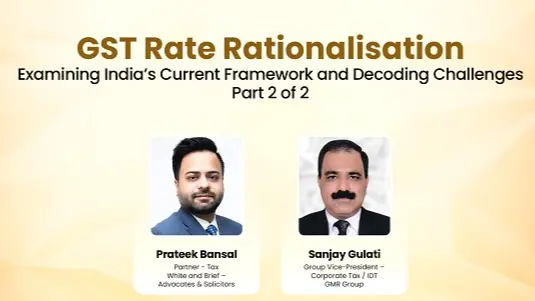
This is the second part of the two-part series on GST Rate Rationalisation. In the first part, we discussed the Current GST Rate Structure and the Challenges in Rationalizing GST Rates. In this part, we will talk about the need for GST Rationalisation and compare the proposed solutions with the countries that have implemented GST successfully.
Need for GST Rate Rationalisation
The existing GST rate structure which consists of multiple rates has been criticized for several reasons with the first being its complex nature which makes compliance difficult. Let’s go over the top five reasons why GST Rate Rationalization is the need of the hour.
⦁ Multiple tax rates and compliance burden: Multiple tax slabs complicate GST, raising compliance costs for businesses and administrative load for authorities. Recent cases, like differing tax rates on popcorn based on preparation and the dispute over pizza toppings (12% as cheese vs. 18% as edible preparation), highlight how such distinctions trigger litigation and uncertainty.
Advertisement
⦁ Issue with Input Tax Credit (ITC): Designed to simplify taxation, ITC often strains MSMEs due to higher GST on raw materials than finished goods, causing cash flow mismatches. While excess tax can be claimed as credit, the refund process ties up working capital. For example, businesses paying 18% GST on inputs but selling at 12% face delays in recovering the 6% difference. Industries like textiles and footwear are heavily impacted, highlighting the need for tax rationalization to ease operations and reduce ambiguities. Further, the optimum tax rates slabs will mitigate / reduce the impact on the supply chain cost and industries where ITC is not available such as power sector, real estate renting, petroleum and liquor for human consumption.
⦁ Reduction of Classification Disputes: Multiple tax rates create classification ambiguities, fuelling disputes and litigation. Pending Central GST appeals have surged from 5,499 in 2020-21 to 14,227 by June 2023, with cases still rising. Divergent state rulings worsen the issue. To prevent the newly established GST Appellate Tribunal (GSTAT) from facing similar backlogs, a simplified indirect tax structure is essential.
Advertisement
⦁ Economic Growth and Job Creation: GDP growth hit a seven-quarter low of 5.4% in Q2 FY 2024-25, reflecting sluggish private investment, often linked to policy uncertainty. A simplified, rationalized GST structure can reduce the tax burden, encourage business expansion, and drive job creation, fostering a more growth-friendly economic environment.
⦁ Enhanced Revenue Efficiency: The goal of GST rate rationalization is simplification, not revenue generation. A well-designed system can boost compliance and collections, even with lower rates. For example, merging essential goods into one slab while increasing rates on luxury and sin-taxed items can enhance revenue without burdening businesses.
Proposed Solution: International Comparisons and Rate Structures
A three-tier GST structure could simplify taxation while minimizing revenue loss by merging existing slabs into low (essentials), standard (most goods/services), and high (luxury/sin goods) rates. Australia applies a flat 10% GST on most goods and services, with exemptions for essentials like certain foods, healthcare, and education—streamlining compliance and reducing administrative burdens. Singapore’s broad-based GST, raised to 9% from January 1, 2024, applies uniformly to most goods and services with minimal exemptions, ensuring definitional clarity and administrative simplicity.
Drawing from these international models, India could consider transitioning to a three-tier GST structure. To transition to a three-tier system, the following mergers can be considered:
⦁ Low Rate (5%): The existing 5% slab remains for essential goods and services (e.g., food grains, primary healthcare, basic education). Some items from the 0% (exempt category) could move to 5% to expand the tax base while keeping essential goods affordable.
⦁ Standard Rate (15%): The 12% and 18% slabs could be merged into a single 15% rate, simplifying compliance, reducing disputes, and taxing most consumer goods at a moderate level. This aligns with global averages (e.g., Singapore: 9%, Australia: 10%, OECD average: ~19.2%).
⦁ High Rate (28% or More): The 28% slab applies to luxury and sin goods (e.g., high-end cars, tobacco, alcohol). To prevent revenue loss, this rate could be increased to 30% or 32%, ensuring steady government earnings from non-essential items. Additional cesses on products like tobacco and alcohol can also continue to support specific state needs.
Rate adjustments may lead to short-term revenue fluctuations, impacting government budgets, particularly with ongoing GST compensation to States. To minimize losses, merging 0% and 5% into 5%, 12% and 18% into 15%, and raising 28% to 30% is proposed. Cesses on harmful products can continue, with potential revenue sharing with States.
A streamlined, transparent system will build taxpayer trust, promote voluntary compliance, expand the tax base, and reduce administrative costs, enabling more resources for growth and innovation.
Conclusion
India can build a more efficient and equitable GST system by learning from global models and addressing challenges unique to its economy. Recent government initiatives, including the reforms announced in the Union Budget 2025-26, emphasize simplifying tax laws and boosting economic certainty.
Major reforms, such as income tax cuts to stimulate growth, and a simplified income tax bill to reduce litigation, reflect this commitment. In indirect taxes, the budget proposed customs duty changes, including the removal of seven tariff rates, aiming to incentivize sectors like semiconductors and clean energy.
The article has been co-authored by Prateek Bansal, Partner – Tax, White and Brief - Advocates & Solicitors and Sanjay Gulati, Group Vice-President – Corporate Tax / IDT, GMR Group. Views expressed are personal.
Published By : Isha Bhandari
Published On: 25 February 2025 at 21:15 IST