
India Sits on a Coal Fortune and Still Pays Billions to Import It
This is India's energy paradox, and it costs the country somewhere between US$15 and US$20 billion in foreign exchange every year.
- Initiatives News
- 4 min read

;'%3e%3cpath%20d='m8,15.99c4.41,0,7.99-3.58,7.99-7.99S12.41,0,8,0,0,3.59,0,8s3.58,7.99,7.99,7.99Z'%20style='stroke:%23fff;%20stroke-miterlimit:10;%20stroke-width:.02px;'/%3e%3cpath%20d='m3.08,3.37l3.82,5.11-3.84,4.15h.87l3.37-3.64,2.72,3.64h2.94l-4.04-5.39,3.58-3.87h-.86l-3.1,3.35-2.5-3.35h-2.94Zm1.27.64h1.35l5.97,7.99h-1.35l-5.97-7.99Z'%20style='fill:%23fff;'/%3e%3c/g%3e%3c/svg%3e)


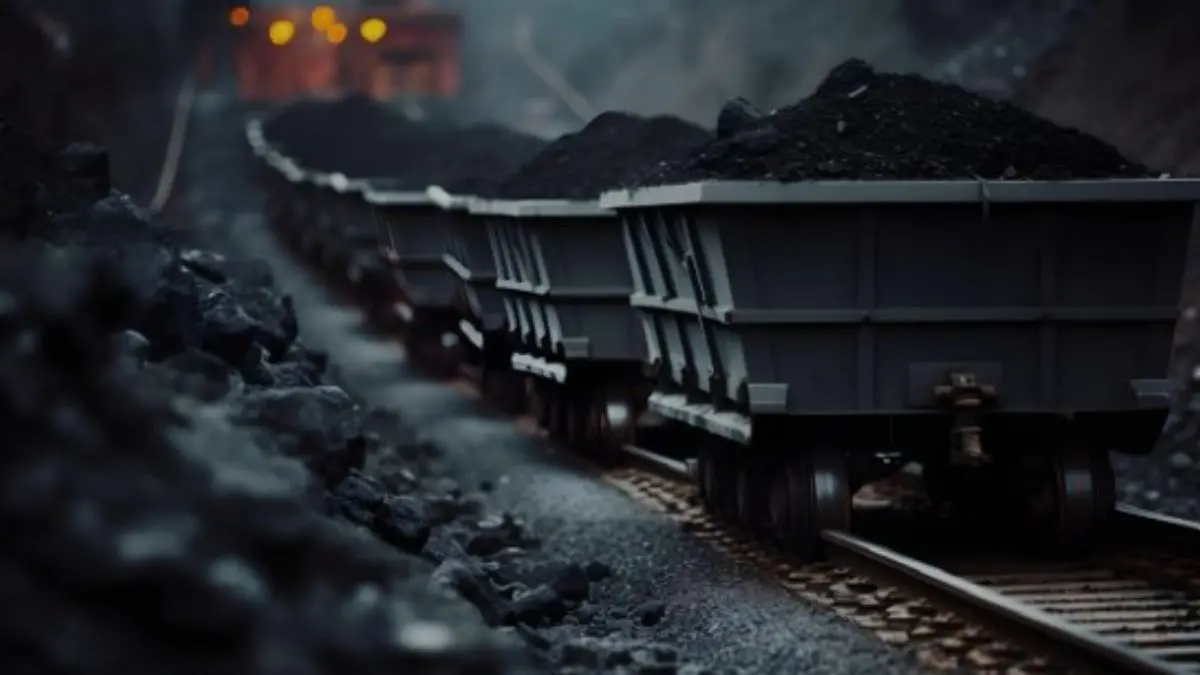
Coal mined in Kalimantan, Indonesia, is loaded onto a bulk carrier, sails 3,500 km across the Indian Ocean, unloaded at Hazira port, costs roughly ₹5,500 per tonne to local consumers. A tonne of lignite dug from Gujarat's own ground and transported 250-300 km to Surat costs around ₹4,200-₹4,400 delivered. The gap is uncomfortably narrow. In some grades, imported coal has already crossed over to being cheaper.
This is India's energy paradox, and it costs the country somewhere between US$15 and US$20 billion in foreign exchange every year.
India is the world's third largest coal producer, holds the fourth largest reserves on the planet - over 360 billion tonnes by geological estimates (Ministry of Coal) - and produces over a billion tonnes annually. Yet we imported approximately 260 million tonnes in FY2024-25, a significant share of which was thermal coal: the same category we hold in abundance. In effect, we are paying a premium to import what we already own. In a world racing towards energy sovereignty, this is not just an economic inefficiency; it is a strategic vulnerability.
Three structural forces create this paradox.
Advertisement
Force no. 1: Geography doesn't care about economics
India’s coal deposits are concentrated in the East - Jharkhand, Odisha, Chhattisgarh, West Bengal, Madhya Pradesh - while industrial demand is concentrated in the west and south, including Gujarat, Maharashtra, Tamil Nadu and Andhra Pradesh. Once mined, it has to travel 1,200-1,800 km by rail to reach factories in these states.
At current freight rates of about ₹1.60-₹2.00 per tonne per km for coal (Indian Railways Annual Report & Accounts 2024-25; DPIIT Logistics Cost Assessment, 2025), freight alone translates to ₹1,900-₹3,600 per tonne across a 1,200-1,800 km journey before the coal even reaches the factory gate. Add road transport, handling losses and transit time, and the Indonesian coal starts looking like the rational commercial choice.
Advertisement
Force no. 2: A mining productivity gap we haven't closed
Indonesian coal exits the mine cheaper because of superior extraction efficiency. Stripping ratios in Kalimantan are as low as 3:1; in many Indian deposits, they reach 15:1, meaning moving five times more earth for the same tonne of coal.
This is a technology gap, not a geological one. In Australia, ‘cast blasting’ and walking draglines eliminate the expensive double-handling of earth. India’s mines still rely predominantly on conventional truck-and-shovel methods. The ground is not the constraint; the method of working it is.
Force no. 3: The logistics infrastructure we never built
If geography is the core challenge, the solution must focus on moving coal cheaply across 1,500 km. India has tried to solve this almost entirely through railways, which are saturated, expensive, and operationally slow for bulk cargo.
What India has not seriously attempted is river transport. The Mahanadi, flowing through the heart of Odisha’s mining belt, is a designated national waterway. The Godavari and the Ganga corridor connect to eastern mines. Inland waterway transport globally costs ₹0.20-₹0.50 per tonne per km compared with ₹1.60-₹2.00 by rail (DPIIT Logistics Cost Assessment, 2025). While infrastructure investment is significant, but it is a one-time cost for a lifetime of savings.
River freight at scale is not a novel idea. China and the US have successfully leveraged inland waterways to move millions of tonnes of coal and build large industrial economies. India, meanwhile, is yet to leverage National Waterway 5 on the Mahanadi-Brahmani system.
Three levers. Pulled together.
The path out requires simultaneous action, not sequential pilots.
• First, the productivity gap in domestic mining will not close through investment mandates alone. Miners need to face cost-competitive pressures that drive technology adoption. Today, domestic product finds a captive buyer regardless of extraction efficiency, leaving little incentive to improve cost competitiveness. Mining contracts and performance frameworks must reward delivered cost efficiency.
• Second, inland waterways need to be developed as serious industrial logistics corridors. Designating coal as a priority cargo category, building river-terminal infrastructure on the Mahanadi-Godavari system, and creating viable public-private financing models for barge operations would improve delivery economics within India.
• Third, rail freight rationalisation must follow. Extending dedicated freight corridors to coastal industrial clusters and restructuring coal freight tariffs would tilt the delivered-cost equation in favour of domestic supply. The forex savings from reduced imports would fund these investments many times over.
Our continued dependence on imported thermal coal is a choice disguised as a constraint. The reserves are in the ground. The rivers flow in roughly the right direction. The institutions capable of action - Coal India, MoPSW, DFCC - already exist and are funded.
By integrating these three levers, we can finally decouple industrial growth from imported coal and transform a buried asset into a pillar of energy sovereignty.
The transition from being a top importer to an energy-independent powerhouse is no longer a matter of geological luck, but of logistical and operational will.
This article is written by Ankush Sheth, Partner, Vector Consulting Group.