
Most Offices Reflect a Company, Space Matrix Helped Opella's Mumbai Workplace Redefine One
Designed by Space Matrix, Opella’s new workplace becomes one of the first tangible expressions of this transition, a space built not just to house a business, but to help its people move from a legacy pharma mindset to a consumer healthcare way of thinking and working.
- Initiatives News
- 5 min read

;'%3e%3cpath%20d='m8,15.99c4.41,0,7.99-3.58,7.99-7.99S12.41,0,8,0,0,3.59,0,8s3.58,7.99,7.99,7.99Z'%20style='stroke:%23fff;%20stroke-miterlimit:10;%20stroke-width:.02px;'/%3e%3cpath%20d='m3.08,3.37l3.82,5.11-3.84,4.15h.87l3.37-3.64,2.72,3.64h2.94l-4.04-5.39,3.58-3.87h-.86l-3.1,3.35-2.5-3.35h-2.94Zm1.27.64h1.35l5.97,7.99h-1.35l-5.97-7.99Z'%20style='fill:%23fff;'/%3e%3c/g%3e%3c/svg%3e)


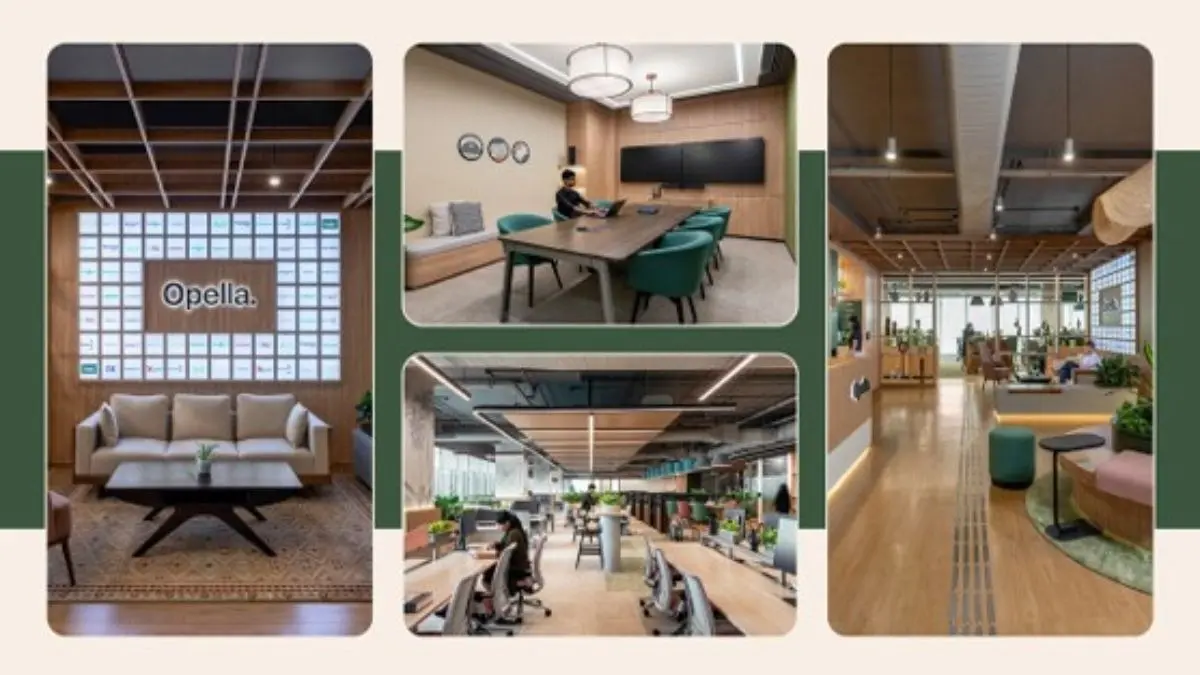
For Opella, the move into its Mumbai workplace marks something far more significant than a change in address. Following its separation from Sanofi, the company faced a deeper challenge: not just operating independently, but feeling independent. Because identity shifts don’t happen on paper. They happen in behaviour, in culture, and in the everyday experience of work.
Designed by Space Matrix, Opella’s new workplace becomes one of the first tangible expressions of this transition, a space built not just to house a business, but to help its people move from a legacy pharma mindset to a consumer healthcare way of thinking and working.
From Legacy to Living Brand
The brief was not simply to design a better office. It was to create distance from the structures, signals, and subconscious behaviours associated with a traditional pharmaceutical environment. For decades, pharma workplaces have leaned towards the clinical, the hierarchical, and the functionally rigid. But Opella’s future as a consumer healthcare brand demands something fundamentally different: proximity to people, relatability, and emotional connection.
The design responds to this shift through a central idea:
“The Tree of Life, Rooted Locally, Branching Globally.”
This is not a surface metaphor. It becomes a way to navigate identity.
- The roots acknowledge Opella’s scientific heritage and credibility
- The branches represent its evolution into an agile, consumer-facing brand
The workplace, in this sense, doesn’t reject the past. It repositions it as a foundation, not a constraint.
Rewiring Culture Through Space
One of the most defining moves in the workplace sits at its centre: the Workcafé. In traditional offices, social and collaborative spaces are often peripheral, physically and culturally. Here, they are placed at the heart of the floorplate. This is not just a planning decision. It is a behavioural one.
By making the Workcafé the natural point of convergence, the space quietly disrupts hierarchy, reduces formality, and encourages spontaneous interaction. Conversations are no longer scheduled events. They become part of the everyday rhythm. For a company stepping away from the structured, process-heavy rhythms of pharma, this shift matters. Because culture is not announced. It is repeated.
Designing for a Different Way of Working
The transition to a consumer healthcare brand also brings with it a shift in how work happens. Agility replaces rigidity. Collaboration coexists with focus. Speed matters. At Opella Mumbai, this is reflected in a balanced ecosystem of spaces, open collaboration zones, informal meeting areas, and quieter rooms for focused work.
This is not about choosing between openness and privacy. It is about recognising a more nuanced reality: People don’t work in one mode anymore. By supporting fluid transitions between different work styles, the workplace begins to shape new behaviours that align more closely with the expectations of a consumer-driven organisation.
From Brand Strategy to Daily Experience
Perhaps the most powerful shift happens in how the brand is experienced internally. Instead of abstract brand values living in presentations or campaigns, they are embedded into the physical environment itself. Meeting rooms draw inspiration from Opella’s portfolio of consumer health brands, translating them into distinct spatial identities.
This does something subtle, but important. It brings the brand closer to people not as an idea, but as something familiar, visible, and continuously experienced. For employees, this creates a stronger emotional connection to what the company stands for. For a business redefining itself, that connection becomes critical. Because you cannot build a consumer brand externally if it is not felt internally.
When Wellbeing Becomes Real
In many workplaces, sustainability and wellbeing are layered on as features. Here, they are integrated into the everyday experience. Natural light reaches the majority of the workspace, reducing reliance on artificial lighting while creating a calmer environment. Energy-efficient systems, occupancy sensors, and water-saving strategies work in the background to reduce environmental impact without disrupting how people work.
But the more meaningful shift lies in how space supports people directly. From ergonomic workstations and wellness rooms to air quality systems and policies supporting new parents, wellbeing is not positioned as an initiative, it becomes part of how the workplace functions. The result is a LEED Gold and WELL Platinum certified environment that aligns with a fundamental expectation of consumer healthcare: If you exist to improve lives, your workplace must do the same.
A Workplace That Builds Identity
Opella’s Mumbai office is not just a reflection of its new direction. It is part of the mechanism through which that direction is being built. Moments of organisational separation are fragile. While strategy may define the path forward, it is culture that determines whether the shift is truly realised.
Workplaces play a quiet but decisive role in that process. They shape how people interact. They influence how decisions are made. They signal what matters and what no longer does. For Opella, the move away from Sanofi is not just a structural change. It is an identity shift. And in Mumbai, that shift has found its first physical form not as a statement, but as a daily experience.