
Normalising Period Conversations In Public: How Pinkathon Is Turning Menstrual Health Into Mainstream Dialogue
The Pinkathon 2025 will kick off in Mumbai this December. Across the next eight months, the run will be held across some of India’s biggest metropolises, including Delhi, Bengaluru, and Chennai. This year, the event introduces a dedicated menstrual awareness zone, turning period talk into public conversation, and reshaping how women connect fitness with their bodies.
- Initiatives News
- 5 min read

;'%3e%3cpath%20d='m8,15.99c4.41,0,7.99-3.58,7.99-7.99S12.41,0,8,0,0,3.59,0,8s3.58,7.99,7.99,7.99Z'%20style='stroke:%23fff;%20stroke-miterlimit:10;%20stroke-width:.02px;'/%3e%3cpath%20d='m3.08,3.37l3.82,5.11-3.84,4.15h.87l3.37-3.64,2.72,3.64h2.94l-4.04-5.39,3.58-3.87h-.86l-3.1,3.35-2.5-3.35h-2.94Zm1.27.64h1.35l5.97,7.99h-1.35l-5.97-7.99Z'%20style='fill:%23fff;'/%3e%3c/g%3e%3c/svg%3e)


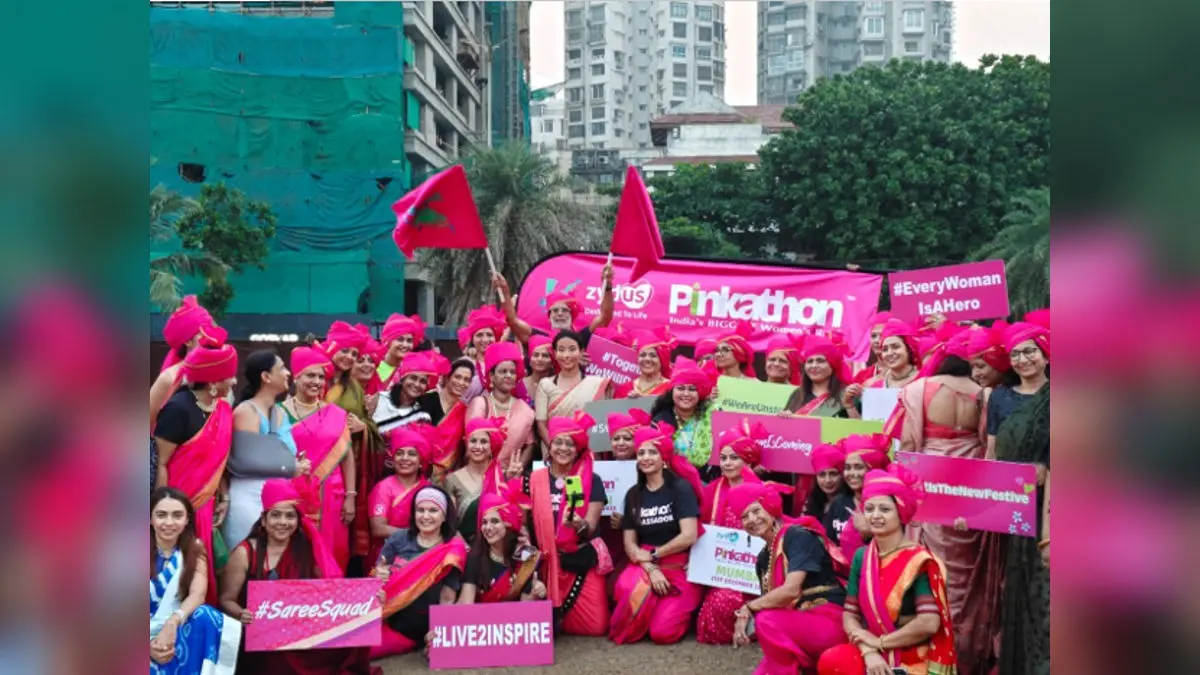
For years, menstrual health has stayed quietly in the background of India’s wellness story. It was treated as something women should manage on their own, something to hide, or something to push through. Pinkathon, India’s biggest women’s run, was never built for silence. It was built on the idea that women deserve spaces, space to move, learn, ask, and show up as they are. And at this point in the movement’s journey, leaving periods out of the conversation simply does not fit.
The Pinkathon 2025 will kick off in Mumbai this December. Across the next eight months, the run will be held across some of India’s biggest metropolises, including Delhi, Bengaluru, and Chennai. This year, the event introduces a dedicated menstrual awareness zone, turning period talk into public conversation, and reshaping how women connect fitness with their bodies.
Ankita Konwar, founder of Invincible Women, adds a deeper perspective. “Menstruation shapes a woman’s life for decades, yet many of us grow up speaking about it softly, if at all. Silence breeds shame and misinformation. The more we talk openly, the more we understand our bodies and make safer choices. Normalising these conversations isn’t a luxury. It’s a responsibility.”
The need for such openness is huge. A recent study (Sulabh Sanitation Mission Foundation, 2025) from Maharashtra showed that more than ninety per cent of women avoided seeking medical help for menstrual issues because they did not have access to female doctors. In places like Beed, almost ninety per cent said their period-related problems weren’t “serious” enough for care. And in some migrant communities, women were still going through unnecessary hysterectomies just to avoid missing work days. These numbers say a lot about how deeply silence has shaped women’s decisions.
Advertisement
For many women, change began with one conversation. Pinkathon ambassador Swati Mukund remembers hers clearly. “I was introduced to the menstrual cup 5–6 years ago by one of our ambassadors. I made the switch and never looked back. Even during half marathons that landed on my period, I could run freely and confidently. That’s the power of good menstrual hygiene—it uplifts health, supports confidence, and ensures every woman can show up without compromise.”
But in most spaces, women still battle loud misinformation. A nationwide survey (Everteen, 2025) showed that while most women scroll social media for period basics, almost none trust it during emergencies. And it’s not hard to see why. Between viral “miracle remedies” and claims that exercising during periods harms the uterus, bad advice spreads fast. More than eighty per cent of respondents deal with period pain, but almost half use nothing at all because they fear medication or simply don’t know safe alternatives. It creates an environment where doubt feels bigger than knowledge.
Advertisement
This is the gap Pinkathon wants to close. The new menstrual awareness zone is meant to be a place where women can ask freely and talk honestly, without feeling judged or awkward. It also builds on the work the event has done for years. Pinkathon encouraged sustainable choices through Green Menstruation. Its NGO partnerships tackled period poverty and access. Saree runs helped women shake off cultural discomfort around their bodies. From day one, the event has repeated one simple truth: exercising during your period is not only allowed, but it is also good for you.
And this applies at every stage of life. Pinkathon ambassador Sonia Kulkarni, who is navigating perimenopause, puts it in relatable terms. “I want to say it loud—periods are normal, and talking about them should be too. My cycle has changed, but what hasn’t changed is my commitment to staying active. Being active isn’t about pushing through pain; it’s about owning our bodies with love and self-care. Pinkathon isn’t just about running; it’s about owning our stories, our bodies, and our confidence—loudly and proudly.”
Younger girls face another set of hurdles. Research by Sirona, Pinkathon’s hygiene partner, found that nearly one in four girls between 10 and 19 misses school during her period. Not because of the cycle, but because of missing toilets, fear of stains, or the weight of stigma. Sirona’s ReFounder and Pinkathon ambassador Deep Bajaj explains why the partnership matters, “Through our partnership with Pinkathon, we want to amplify the message that menstruation is normal and natural. When women run together, they aren’t just covering kilometres—they’re breaking taboos.”
For Pinkathon founder Milind Soman, this shift is not just timely; it is essential. “For a decade, Pinkathon has tried to create spaces where women feel seen and heard in matters of health. Menstrual health has always been part of that journey, but now it must be front and centre. When thousands come together with no hesitation to speak about their periods in a public space, it becomes easier for families, workplaces, and communities to do the same. That shift is long overdue.”
By making period conversations visible at a mass fitness event, Pinkathon is placing menstrual health right where it belongs: in the centre of women’s wellness. And as thousands gather across cities in the coming months, this conversation will move with them. Not whispered. Not hidden. But open, informed, and finally, normal.