
Project 101 (Ek Sau Ek): Advancing Sugarcane Productivity And Rural Livelihoods
The origins of Project 101 lie in Yash’s research project, Agricultural Interventions in Sub-Tropical India for Optimised Sugar Cane Cultivation & Farmer Empowerment: A Case Study. During extensive fieldwork in Bulandshahr, he observed that simple, accessible interventions (trench planting, balanced nutrient management, and integrated pest management) had the potential to dramatically raise yield and income.
- Initiatives News
- 4 min read

;'%3e%3cpath%20d='m8,15.99c4.41,0,7.99-3.58,7.99-7.99S12.41,0,8,0,0,3.59,0,8s3.58,7.99,7.99,7.99Z'%20style='stroke:%23fff;%20stroke-miterlimit:10;%20stroke-width:.02px;'/%3e%3cpath%20d='m3.08,3.37l3.82,5.11-3.84,4.15h.87l3.37-3.64,2.72,3.64h2.94l-4.04-5.39,3.58-3.87h-.86l-3.1,3.35-2.5-3.35h-2.94Zm1.27.64h1.35l5.97,7.99h-1.35l-5.97-7.99Z'%20style='fill:%23fff;'/%3e%3c/g%3e%3c/svg%3e)


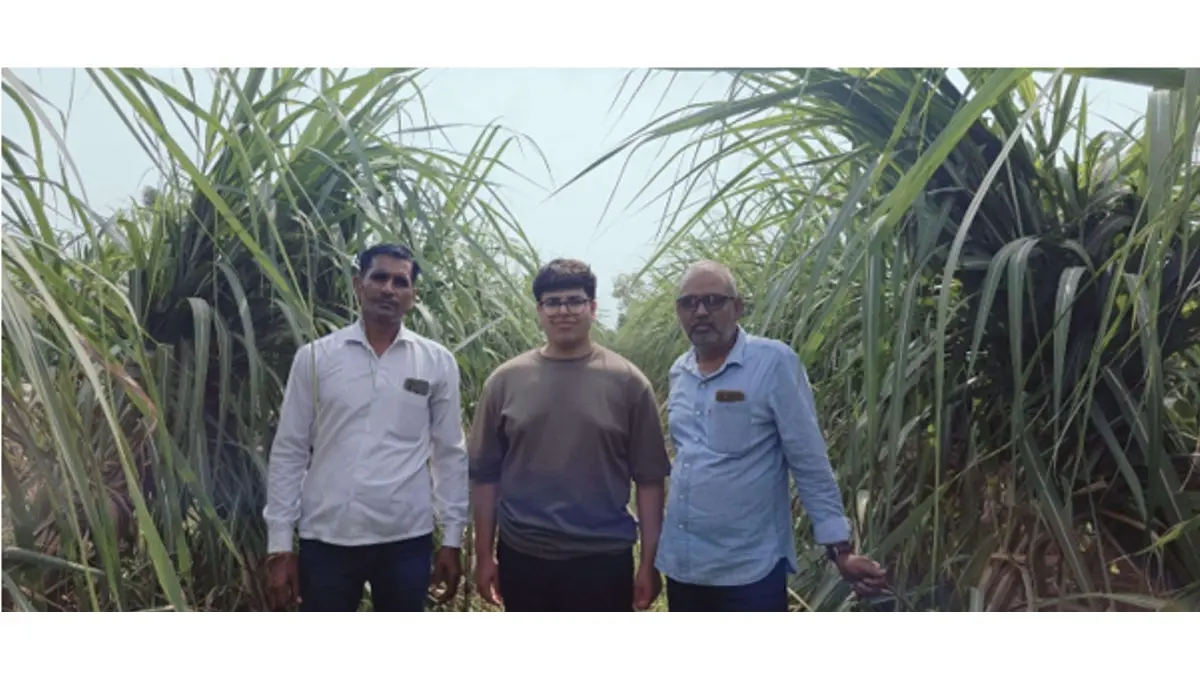
Bulandshahr, Uttar Pradesh - Sugarcane farming in Uttar Pradesh has long relied on traditional, multi-generational practices such as multi-bud seed sets, narrow row spacing, and heavy urea application. While once effective, these methods now contribute to declining productivity, higher susceptibility to pests and disease, and stagnating yields. Recognising these challenges, 18-year-old Winchester College student Yash Sawhney founded Project 101 (Ek Sau Ek) in 2023 to strengthen sugarcane productivity and socio-economic resilience across rural communities in Bulandshahr. What began with 100 farmers across 26 villages has now expanded to 1,000 farmers in 45 villages, reflecting growing trust, demonstrable results, and rising demand for science-backed farming support.
How the Idea Took Shape
The origins of Project 101 lie in Yash’s research project, Agricultural Interventions in Sub-Tropical India for Optimised Sugar Cane Cultivation & Farmer Empowerment: A Case Study. During extensive fieldwork in Bulandshahr, he observed that simple, accessible interventions (trench planting, balanced nutrient management, and integrated pest management) had the potential to dramatically raise yield and income. Yet farmers lacked the knowledge, material support, and technological access required to adopt them. To bridge this gap, Yash created Project 101 (Ek Sau Ek) to bring practical, affordable, scientifically grounded solutions directly to farmers while respecting and preserving indigenous agricultural wisdom.
Strengthening Practices with Modern Interventions
Advertisement
At its core, Project 101 equips farmers with techniques that improve crop performance and reduce costs while enabling sustainable, climate-resilient agriculture. Training sessions introduce trench planting with 4-feet row spacing, which enhances tillering and creates space for intercropping pulses and vegetables, providing an additional revenue stream. Furrow irrigation has reduced water usage by approximately 30%, and the incorporation of bio-compost and mulching has improved soil organic carbon while discouraging crop-residue burning.

Soil testing guides balanced fertiliser use, and earthing-up with potash strengthens root systems and enhances juice quality. Single-bud planting, combined with seed and soil treatment, particularly Trichoderma-based applications, has significantly improved both seed efficiency and germination outcomes. The project also supports the use of modern precision tools: drone spraying ensures uniform micronutrient and pesticide application, moisture sensors guide irrigation scheduling, and propping provides crop stability during erratic weather patterns.
Advertisement
Initial indicators from project plots show clear and consistent gains. Single-bud planting delivered approximately 30-70% savings in seed material. Germination rates reached 70–76% (compared to around 40% in control plots) leading to an 8–15% rise in millable cane count. Crops in project fields measured 11–23% taller and 5–9% thicker in girth, with farmers reporting stronger tillering, improved cane maturity, and notable reductions in insect damage and Red Rot. These improvements, combined with lower input requirements, have already translated into meaningful cost savings. Yield and sucrose data, currently being collected from mid-January to February, are expected to further confirm the strong performance observed so far.
Scaling for Greater Impact
The initiative’s measurable results have driven rapid expansion. From its initial cohort of 100 farmers, Project 101 (Ek Sau Ek) now reaches 1,000 farmers in 45 villages, offering training, on-field demonstrations, precision technology support, and continuous guidance throughout the agricultural cycle. This expansion reflects a model built on collaboration, accessibility, and farmer-led adoption.
Beyond Farming: A Holistic Support System
Alongside agronomic interventions, Project 101 places equal emphasis on strengthening rural livelihoods more broadly. In partnership with Haqdarshak, farmers receive support in accessing government schemes, subsidies, healthcare, and essential services. Educational materials, pamphlets on sustainable farming authored by Yash, have reached more than 200,000 farmers. A bilingual myth-busting booklet has been distributed to 5,000 farmers and accessed digitally by nearly 200,000 through the Sugarcane Farmers App, enabling widespread dissemination of verified scientific information.
A Pathway to Rural Transformation
Project 101 (Ek Sau Ek) demonstrates how modern agricultural science, when combined with traditional knowledge and farmer-centric design, can reshape rural livelihoods. As the initiative continues to scale, it is contributing to a broader movement to future-proof Indian agriculture: one where knowledge, technology, and community partnerships drive sustained improvements in yield, income, and resilience. For the 1,000 participating farmers of Bulandshahr, and the many more who may join in the years ahead, Project 101 offers a pathway toward a stronger, more prosperous, and more sustainable farming future.