
Updated 16 July 2025 at 14:21 IST
Rethinking Motors, Reclaiming Autonomy: How Chara is Building India’s Rare-Earth-Free EV Future
“India’s dependence on rare-earth imports, mostly from one geopolitical actor, isn’t just a supply chain inconvenience, it’s a strategic risk,” says Bhaktha Keshavachar, CEO, Chara.
- Initiatives News
- 4 min read

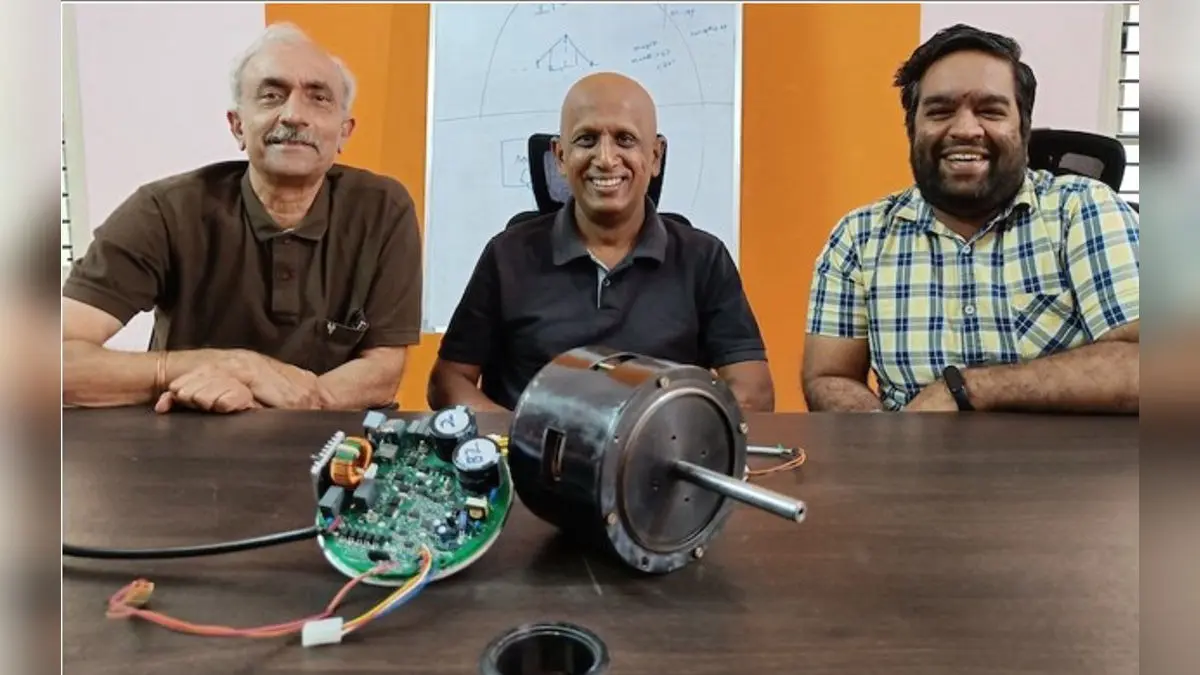
In an era defined by the race towards electrification and strategic decoupling, India’s reliance on imported EV components, especially rare-earth materials, poses a glaring vulnerability. At the heart of this challenge lies the question of strategic autonomy: Can India design, build, and scale its own core EV technologies without being shackled to volatile global supply chains?
Bengaluru-based startup Chara believes the answer is yes, and is building the blueprint for it.
A Strategic Shift Away from Rare Earths
“India’s dependence on rare-earth imports, mostly from one geopolitical actor, isn’t just a supply chain inconvenience, it’s a strategic risk,” says Bhaktha Keshavachar, CEO, Chara. With global tensions rising and nations like China tightening export restrictions, India’s vision of EV self-sufficiency could stall before it truly accelerates.
Chara offers a fundamentally different approach to EV powertrains. Instead of relying on permanent magnets made from rare-earth elements, the company has developed Rare-Earth-Free motors and controllers using Synchronous Reluctance Motor (SynRM) technology. These motors use locally abundant materials like aluminum, copper, and ferrite, and are optimized through intelligent design and advanced control software.
Advertisement
The “Secret Sauce” of Reluctance
Traditional motors like PMSMs (Permanent Magnet Synchronous Motors) generate torque via magnetic attraction. Chara’s motors, by contrast, guide the magnetic field through paths of least resistance leveraging reluctance, not attraction.
What sounds like a subtle difference is, in fact, a leap in engineering philosophy. The complexity of reluctance motors lies in their non-linear behavior. Chara counters this with high-speed, high-frequency switching algorithms and control systems informed by deep design-phase datasets. “We match, and in many cases exceed, PMSM performance without a single rare-earth magnet,” the company states.
Advertisement
Built in India, Built for Scale
Crucially, Chara’s platform is scalable within India’s existing industrial ecosystem. Their current motor range, spanning 6kW to 40kW in the voltage range of 48V to 400V, is built entirely using materials available and manufacturable in India. The startup is already co-developing gearboxes with OEMs and envisions expanding across the drivetrain, integrating efficiency and modularity at the system level.
Their partnership with Greaves Electric Mobility, under a newly signed MoU, signals serious commercial traction and a roadmap for mass deployment.
Policy Gaps and Startup Roadblocks
But innovation alone can’t fuel a revolution. According to Chara, India’s policy architecture remains skewed towards manufacturing foreign tech, not developing indigenous IP. “Today, R&D grants rarely cross ₹30 lakh. That’s not even seed capital for deep-tech,” says the company. While PLI schemes are promising, startups often find them out of reach due to entry barriers and compliance demands.
What’s needed is a shift from transactional incentives to transformational support weighted incentives for Indian IP, founder-friendly funding structures, and active procurement from government and PSUs.
Adoption: The Last Mile Challenge
Despite proven performance, Chara still battles industry inertia. Tier-1 suppliers and OEMs often demand multi-year validation before moving away from incumbent tech. “The reluctance is not technological, it's psychological and systemic,” Bhaktha explains. However, interest from forward-looking OEMs is growing, driven by both cost economics and the desire for strategic autonomy.
To overcome these bottlenecks, Chara is adopting a hybrid scale-up strategy: manufacturing in-house for critical segments, while licensing its tech to partners to speed up adoption.
Reimagining the EV Playbook
Ultimately, Chara isn’t just building motors, it’s rewriting the Indian EV playbook. In a global race dominated by giants, their Rare-Earth-Free innovation offers a pathway for India to lead on its own terms.
“Strategic autonomy isn’t a buzzword, it’s a design principle,” the company says. And if their trajectory holds, Chara may well become the rare Indian startup that builds both a product and a paradigm shift.
Bhaktha Keshavachar is a visionary driven by a deep desire to see India thrive and excel on the global stage. His journey began at Arizona State University, where he honed his skills and nurtured his dreams. Later, as a seasoned veteran at Intel, Bhaktha felt a profound yearning to contribute to his homeland, to see the words "Made in India" emblazoned proudly on innovative products that could compete worldwide.
Bhaktha then co-founded Ezetap to revolutionize the mobile payment space. Through Ezetap, he didn't just create a business; he built a bridge to empower countless merchants and consumers, facilitating over $5 billion in transactions annually. But his proudest achievement was overseeing the development of India's first PCI-compliant card reader.
Yet, Bhaktha's journey didn't end there. Fueled by a passion for sustainability and a vision of India's self-reliance in the era of energy transition, he embarked on a new venture: Chara. With Chara, Bhaktha isn't just chasing profits; he's chasing a dream of a greener, more sustainable future for generations to come.
Published By : Moumita Mukherjee
Published On: 16 July 2025 at 14:21 IST