
Tea Above The Floodline
Punjab experienced a severe flood as the Sutlej, Beas, Ravi, and Ghaggar rivers overflowed, submerging over 2,200 villages and destroying 2.2 million acres of farmland across 13 districts.
- Initiatives News
- 5 min read

;'%3e%3cpath%20d='m8,15.99c4.41,0,7.99-3.58,7.99-7.99S12.41,0,8,0,0,3.59,0,8s3.58,7.99,7.99,7.99Z'%20style='stroke:%23fff;%20stroke-miterlimit:10;%20stroke-width:.02px;'/%3e%3cpath%20d='m3.08,3.37l3.82,5.11-3.84,4.15h.87l3.37-3.64,2.72,3.64h2.94l-4.04-5.39,3.58-3.87h-.86l-3.1,3.35-2.5-3.35h-2.94Zm1.27.64h1.35l5.97,7.99h-1.35l-5.97-7.99Z'%20style='fill:%23fff;'/%3e%3c/g%3e%3c/svg%3e)


When the Waters Came
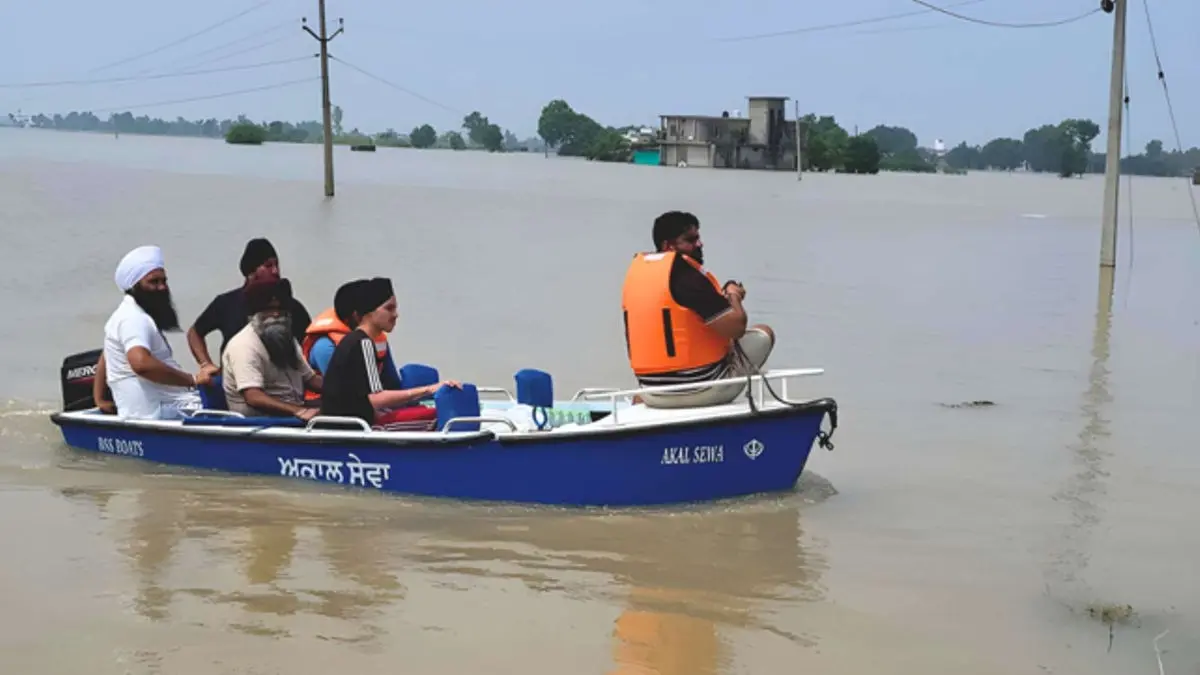
Floods don’t ask politely. They arrive like uninvited guests—loud, messy, taking up space that was never theirs. In late August 2025, Punjab woke to that same familiar nightmare. The rivers Sutlej, Beas, Ravi, and Ghaggar overflowed with a fury that seemed unstoppable. Villages were swallowed whole. Roads that connected families for generations vanished beneath waves of brown water.
On paper, the devastation looks clinical: more than 2,200 villages submerged, nearly 2.2 million acres of farmland destroyed, and 13 districts left battered. Pathankot, Gurdaspur, Fazilka, Kapurthala, Tarn Taran, Ferozepur, Hoshiarpur, and Amritsar bore the heaviest blows. Crops that families had nurtured all year—paddy fields weeks away from harvest—were erased in hours.
But numbers don’t tell you about the silence that lingers after. The mosquitoes were humming where children used to play. The creak of doors half-submerged in water. Or the smell—mud, rot, and damp walls holding on by a thread.
Punjab Doesn’t Wait
Here’s the thing about Punjab: it never waits. This is land that’s seen Mughal invasions, colonial exploitation, the wounds of Partition, and more than one cycle of devastating floods. Each time, people have learned not to wait for someone else to show up first.
Advertisement
So when the waters came this year, it wasn’t convoys or official announcements that made the first difference. It was neighbors. Families were tacking sandbags in the dark while the rain lashed down. Farmers hitching tractors to trailers and ferrying the elderly across waist-deep water. Gurdwaras opening their doors before dawn, rolling out rotis and stirring cauldrons of dal not just for their own but for anyone who arrived hungry.
Seva—selfless service—wasn’t a slogan. It was the only language that mattered. A Cup of Tea in Ajnala
If you want to understand Punjab’s spirit, let me take you to Ajnala in Amritsar. A Lallantop journalist waded through murky water to find a half-drowned home. The ground floor was a pond. On the first floor, perched cross-legged on a charpoy, sat an elderly farmer.
Advertisement
His fields were gone. His animals lost. His house, reduced to a damp box barely above the floodline. The reporter began gently, trying to offer sympathy. But the farmer cut him off with a small smile and said: “Cha piyoge?”—Will you have tea?
That single question carried centuries of resilience. Imagine it: a man whose world has collapsed, still reaching for hospitality before complaint. Resilience doesn’t always roar. Sometimes it whispers through the steam rising from a chipped teacup.
NGOs Stepping In
But spirit alone can’t rebuild homes. Relief was needed, and Punjab found it in the many organisations that mobilised. The Shiromani Gurdwara Parbandhak Committee, the Sukhmani Sewa Society Fazilka, and numerous grassroots groups were among the first to act.
Amid these collective efforts, the Kalgidhar Society, Baru Sahib, distinguished itself by the sheer speed and scale of its response. Known for operating 130 rural schools across North India, the Society converted 15 Akal Academies into relief camps almost overnight.
And these weren’t just shelters. They became warehouses for rations, clinics for the sick, kitchens for langar, and even makeshift workshops where villagers repaired broken tools and equipment.
Hand in Hand with Authorities
The Society didn’t act alone. It worked shoulder-to-shoulder with the National Disaster Response Force, as well as district commissioners (DCs) and sub-divisional magistrates (SDMs). Together they deployed powered boats, JCB machines, and—perhaps most importantly—thousands of volunteers.
Langar kitchens ran day and night, serving not hundreds but thousands. Medical teams trudged through muck, carrying supplies on their backs, to treat the sick and vulnerable. Relief wasn’t always glamorous. It was sweaty, dirty, and exhausting. But it was necessary.
The Harder Work After the Water
Then came the stage no one photographs. When the waters receded, the danger wasn’t over. Pools of stagnant water turned into breeding grounds for mosquitoes. Animal carcasses floated or lay rotting in the sun. The smell carried for miles.
Here, too, the Society’s volunteers worked tirelessly. They dug trenches to drain water. They buried carcasses with lime and salt to prevent outbreaks of disease. They disinfected homes and villages. Work that was invisible in headlines but saved countless lives.
This was not charity. It was a duty.
Building for Tomorrow
Relief has now shifted toward rehabilitation. And here again, the Kalgidhar Society has gone a step further. They’ve initiated the construction of prefabricated home sets—safe, sturdy, and quick to build. Families who had nothing left now see the frame of a future rising from the ground.
These homes come in one- and two-bedroom units, each with kitchens, toilets, and verandahs. Not tents, not temporary shelters, but real homes designed to restore dignity as much as provide safety.
Corporate partners—Amazon, Infosys, Nestlé, Sigma Corporation, Indus Valley, Donatekart, and The Better India—have joined in, sustaining momentum and resources. Rehabilitation isn’t cheap, but when carried out with unity, it becomes possible.
Why It Matters
The truth is, the world’s gaze will soon turn elsewhere. That’s what happens with disasters. They flare on screens for a few days, maybe weeks, before fading under the weight of new headlines. But for Punjab, the struggle doesn’t vanish when the cameras do.
And yet, amid loss and rebuilding, what endures is not despair but dignity. It’s the old farmer in Ajnala, offering tea while his house is half-submerged. It’s volunteers burying carcasses to keep disease at bay. It’s the children laughing while waiting in line for langar.
Punjab’s story is not of victims defined by tragedy. It’s of survivors defined by resilience. The waters rose. But Punjab rose higher.