
The 2030 Talent Paradox: Why Traditional Career Planning is a Systemic Risk
As we head toward 2030, the Indian workforce is colliding with a "double disruption": the rise of generative AI and the transition to a green economy.
- Initiatives News
- 3 min read

;'%3e%3cpath%20d='m8,15.99c4.41,0,7.99-3.58,7.99-7.99S12.41,0,8,0,0,3.59,0,8s3.58,7.99,7.99,7.99Z'%20style='stroke:%23fff;%20stroke-miterlimit:10;%20stroke-width:.02px;'/%3e%3cpath%20d='m3.08,3.37l3.82,5.11-3.84,4.15h.87l3.37-3.64,2.72,3.64h2.94l-4.04-5.39,3.58-3.87h-.86l-3.1,3.35-2.5-3.35h-2.94Zm1.27.64h1.35l5.97,7.99h-1.35l-5.97-7.99Z'%20style='fill:%23fff;'/%3e%3c/g%3e%3c/svg%3e)


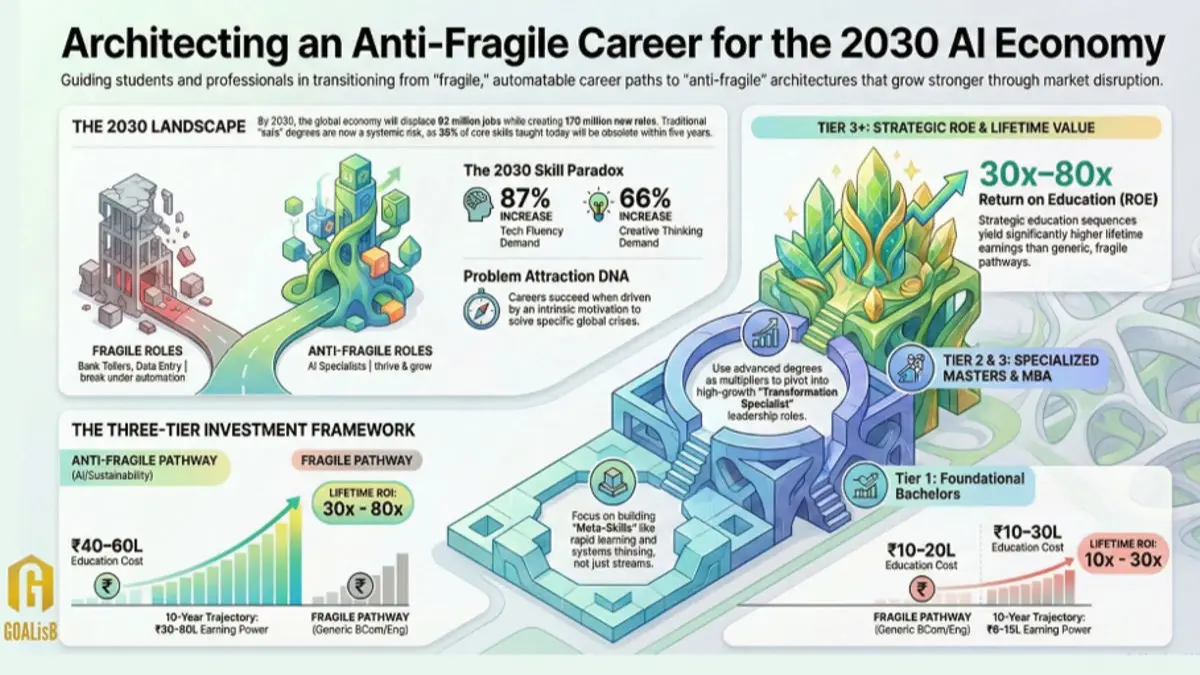
As we approach 2030, the Indian professional landscape is facing a "double disruption": the rapid evolution of Generative AI and the urgent shift toward a Green Economy. While millions of students compete for "safe" seats in traditional programs, the global economy is decoupling from the very job descriptions those degrees were designed for.
According to the World Economic Forum Future of Jobs Report 2025, nearly 40% of core skills will change by 2030. In this era of high volatility, "stability" is an illusion. To bridge the gap between stagnant academic measurement and dynamic opportunity, we must move toward an Anti-Fragile Career Architecture.
The Architecture of Success: A Lifecycle Approach
At GOALisB, we believe that a career is not a single decision but a multi-stage investment. To justify the "costly affair" of elite higher education, the strategy must begin early, ensuring that every degree acts as a multiplier for the next.
Advertisement
1. The Foundational Layer: Bachelors Career Paths
Undergraduate education is no longer about choosing a "stream"; it is about identifying a student's Anti-Fragile DNA. In 2026, a 95% mark in school is a static credential. The real differentiator for 2030 is Market Velocity, the speed at which a student can unlearn obsolete systems and master new ones.
Advertisement
Future-proof Bachelors career paths now require early benchmarking of seven "meta-skills", including tech fluency, narrative power, and financial literacy. These are the "Human Skills" that AI cannot replicate, providing the necessary foundation for any future global leader.
2. The Bridge: Specialist Masters Pathways
For many, a specialized Masters is the essential bridge to the executive suite. Whether it is Digital Public Infrastructure (DPI) or Sustainability Analytics, the Masters degree must be a strategic choice to solve a "Global Pain." It is here that specialists transition into potential generalists, building the technical depth required to lead in a complex, tech-integrated world.
3. The Crown Jewel: The Strategic MBA
The MBA remains the ultimate leadership accelerator, but its role has shifted. A generic MBA is a depreciating asset. In the 2030 market, the best MBA admissions consultants are no longer just essay editors; they are Strategic Career Architects.
An MBA from a top-tier institution like ISB, Harvard, or Stanford GSB is a high-stakes investment. Its value lies in the Specialist Arbitrage it provides, the ability to walk into a boardroom and lead Human-AI Hybrid Teams. For a professional, the MBA is the "Anti-Fragile" pivot that turns market chaos into personal career growth.
The Measurement vs. Opportunity Gap
The greatest risk in the Indian context is the Measurement Gap. Universities still measure rule-following, while the market rewards Problem Attraction. Through the PathWise Logic, we move students and professionals away from "Titles" and toward "Ecosystems." We cross-reference Problem Attraction (what energizes you?) with Creation Modality (how do you add value? to ensure a high Return on Education (ROE).
Conclusion: Architecting the Future
By 2030, the "Safe Bet" will be extinct. The winners will be those who treat their careers as a dynamic portfolio of Anti-Fragile assets. Whether you are a parent mapping out Bachelors career paths or a professional seeking the elite guidance of MBA admissions consultants, the transition from a "Fragile" mindset of job-seeking to an "Anti-Fragile" architecture of value creation is the most important investment you can make today.