
The Impact of Dock Workers' Strikes on Commodity Prices and Economic Growth
Dock Workers: The labor movement is a powerful and often contentious aspect of the economy. One of its primary arenas is the strike
- Initiatives News
- 7 min read

;'%3e%3cpath%20d='m8,15.99c4.41,0,7.99-3.58,7.99-7.99S12.41,0,8,0,0,3.59,0,8s3.58,7.99,7.99,7.99Z'%20style='stroke:%23fff;%20stroke-miterlimit:10;%20stroke-width:.02px;'/%3e%3cpath%20d='m3.08,3.37l3.82,5.11-3.84,4.15h.87l3.37-3.64,2.72,3.64h2.94l-4.04-5.39,3.58-3.87h-.86l-3.1,3.35-2.5-3.35h-2.94Zm1.27.64h1.35l5.97,7.99h-1.35l-5.97-7.99Z'%20style='fill:%23fff;'/%3e%3c/g%3e%3c/svg%3e)


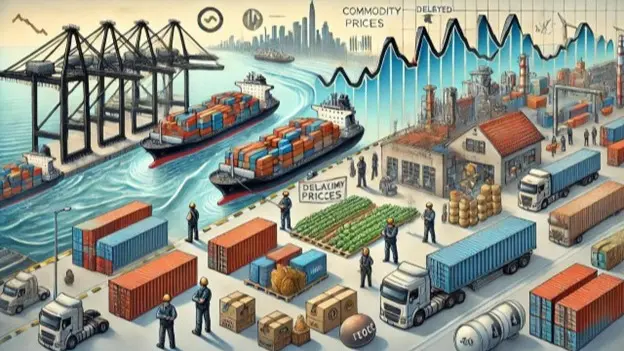
The labor movement is a powerful and often contentious aspect of the economy. One of its primary arenas is the strike—a tool workers use to advocate for better conditions, wages, and benefits. In the United States, dock workers play a vital role in the supply chain, given their responsibility for loading and unloading cargo from ships. When dock workers strike, the repercussions ripple, affecting commodity prices, supply chains, and overall economic growth. This article explores the dynamics of dock workers' strikes, their potential impacts on commodity prices, and the broader financial landscape.
The Strike
On September 30, 2024, East Coast port dockworkers went on strike. Dockworkers are using their leverage to increase wages and halt attempts by the docks to increase automation. The alliance of docks has offered the union a 50% wage increase for dockworkers over the next six years. The union has countered with an increase in wages of 77% over the next six years. A prolonged strike on the United States's East Coast can lead to commodity trading volatility.
The White House has indicated that it will not invoke the Taft-Hartley Act to unite both parties. This act would allow President Biden to request a court order for an 80-day cooling-off period to halt the strike, at least temporarily. However, he has told reporters he does not intend to pursue this option. Analysts suggest that exercising this power could jeopardize union support, harming Democrats as they approach next month's elections. The Role of Dock Workers in the Economy
Advertisement
Dock workers are essential to facilitating international trade. Significant ports like Los Angeles, Long Beach, New York-New Jersey, and Seattle handle millions of containers each year, making them critical hubs for imports and exports. These workers ensure that goods flow smoothly from ships to trucks and trains. Their striking ability can quickly halt operations, slowing down the movement of goods.
Commodity prices are sensitive to disruptions in this process. Commodities such as oil, agricultural products, and manufactured goods rely on the timely movement from ports to markets around the country and internationally. Therefore, dock worker strikes can significantly affect the availability and pricing of these goods.
Advertisement
The Mechanism of Impact on Commodity Prices
When dock workers strike, the immediate effect is a backlog of cargo ships waiting to be unloaded. This bottleneck can lead to a shortage of products, particularly in industries that rely on just-in-time manufacturing. For example, automotive and technology industries rely heavily on precise inventory levels; any disruption can lead to halting production.
A prolonged strike may compel companies to seek alternative shipping solutions. Beyond delaying shipments, businesses may need to reroute goods through different ports, often increasing freight costs. These costs eventually get passed down to consumers through higher prices for commodities.
Commodity Price Inflation
Reduced supply of critical commodities due to dock strikes can increase prices. For instance, a strike affecting shipments of agricultural products can lead to scarcity in grocery supplies, prompting price hikes. Similarly, oil shipments delayed by strikes can cause gas prices to surge, impacting consumers and businesses.
Financial markets can exhibit volatility during strikes. Investors may speculate on the potential for increased costs and reduced supply, leading to commodity price swings. For instance, futures contracts for oil may fluctuate based on anticipated supply chain issues resulting from labor actions.
Several notable strikes in recent history have demonstrated the direct impact on commodity prices and economic conditions.
A labor dispute involving dockworkers in West Coast ports led to significant slowdowns in cargo movement, resulting in billions of dollars in lost revenue. Many retailers experienced delays in receiving critical inventory, affecting sales and increasing prices. The manufacturing sector noted higher costs due to disruptions in supply lines.
The potential for a strike by dockworkers along the West Coast raised fears of significant disruptions, drawing attention from the federal government. Concerns about inflation and supply chain interruptions became paramount, illustrating how even the threat of a strike can prompt volatility in commodity markets.
Supply chain disruptions can lead to higher prices that ultimately spill over to consumers, when there is a disruption—whether due to labor strikes, natural disasters, or logistical issues—producers often face increased costs. They might have to pay more for raw materials, incur additional shipping fees, or invest in alternative sourcing strategies.
Disruptions can lead to inventory shortages as companies may not receive supplies on time. When businesses cannot meet consumer demand due to insufficient inventory, they may raise prices to manage the limited supply.
Companies often pass these costs on to consumers to maintain profit margins in the face of rising operational costs and lost sales. This situation can manifest as higher prices for goods and services, affecting everything from groceries to electronics.
The basic principles of supply and demand dictate that prices will rise when supply decreases while demand remains steady or increases. Consumers may find it more challenging to locate specific products, making them willing to pay more for what's available.
Persistent inflation can affect overall economic stability if supply chain disruptions are prolonged. This scenario can lead to consumers facing higher prices across a wide range of goods and services, impacting their purchasing power.
Economic Growth Implications
The effects of dock workers' strikes extend beyond immediate commodity price changes. Economic growth can be hindered in several ways:
Companies facing higher shipping costs and unanticipated supply shortages may reduce production or investment. Such reductions can hinder business growth, lowering Gross Domestic Product ( GDP ) growth.
Increased prices due to commodity shortages can lead to reduced consumer spending. When the cost of essential goods rises, people are likely to tighten their budgets, affecting overall retail sales and contributing to economic slowdowns.
Strikes can lead to a temporary loss of jobs, both directly for dock workers and indirectly for those in related industries, such as logistics and transportation. This loss affects not only the individuals involved but also the communities relying on those jobs for economic stability.
Inflationary Pressures
Temporary shortages and heightened prices can contribute to inflation. The Federal Reserve often responds to inflation by raising interest rates, which can further dampen economic growth by increasing the cost of borrowing.
Mitigating the Impact of Strikes
Establishing open lines of communication between dock workers, unions, and employers can lead to more effective negotiations, reducing the likelihood of strikes. Mediation and conflict resolution processes can help prevent disputes from escalating.
Investing in Technology
Ports that adopt automation and advanced logistics technologies can improve operational efficiency and reduce dependency on manual labor. Innovations such as automated cranes, real-time tracking systems, and AI-driven logistics management can help mitigate the impact of strikes by enhancing throughput, even during labor disruptions.
Businesses can diversify their supply chains to reduce reliance on specific ports or shipping lanes vulnerable to labor actions. By utilizing multiple ports or alternative modes of transportation, such as rail or trucking, companies can safeguard against sudden disruptions in shipping logistics.
Companies can establish contingency plans, such as maintaining higher inventory levels of critical goods and sourcing from alternative suppliers when expected strikes or disruptions arise. These measures can help buffer against the immediate impacts of strikes.
Timely involvement from federal or local governments can promote rapid conflict resolution during labor disputes, reducing the potential for prolonged strikes. Effective mediation can pave the way for fair agreements that benefit workers and employers.
Conclusion
The strike of dock workers in the United States is a powerful reminder of the interconnectedness of labor actions, commodity prices, and economic health. Disruptions in freight operations can have significant ramifications, from rising commodity prices fueled by supply shortages to broader economic implications that can stifle growth.
While dock workers' strikes can be motivated by valid concerns regarding wages and work conditions, addressing these issues through proactive negotiation and technological investment can mitigate adverse economic impacts. The role of dock workers in the supply chain should not be underestimated; their labor supports a significant portion of the economy. Understanding the ramifications of strikes and implementing measures to reduce their impact remains crucial for stakeholders—from workers and employers to consumers and policymakers.
In this interconnected economy, fostering cooperation among all parties will safeguard the dock workers' rights and support the robust economic framework necessary for sustainable growth. As we navigate the complexities of globalization and the evolving nature of work, recognizing the vital role every labor force plays in the economy will be essential in steering clear of disruption in the future.