
UPI vs Wallets: What's the Difference?
As digital payments become an integral part of everyday life, you've likely used both UPI and a digital wallet at some point. Understanding the difference between the two can help consumers make more informed payment choices and better understand the products they use.
- Initiatives News
- 3 min read

;'%3e%3cpath%20d='m8,15.99c4.41,0,7.99-3.58,7.99-7.99S12.41,0,8,0,0,3.59,0,8s3.58,7.99,7.99,7.99Z'%20style='stroke:%23fff;%20stroke-miterlimit:10;%20stroke-width:.02px;'/%3e%3cpath%20d='m3.08,3.37l3.82,5.11-3.84,4.15h.87l3.37-3.64,2.72,3.64h2.94l-4.04-5.39,3.58-3.87h-.86l-3.1,3.35-2.5-3.35h-2.94Zm1.27.64h1.35l5.97,7.99h-1.35l-5.97-7.99Z'%20style='fill:%23fff;'/%3e%3c/g%3e%3c/svg%3e)


Recently, PhonePe announced an update to its wallet-related policies for certain inactive wallet users. The development has led to conversations among consumers and brought greater attention to digital wallets and how they work.
One interesting takeaway from these discussions is that many consumers continue to use the terms UPI and Wallet interchangeably, even though they are fundamentally different payment products. Questions such as "Is UPI the same as a wallet?", "Where does the money actually sit?", and "How are payments processed in each case?" highlight the need for greater awareness around how these payment methods function.
As digital payments become an integral part of everyday life- whether you're paying for groceries, ordering food, booking a cab, or splitting a bill with friends- you've likely used both UPI and a digital wallet at some point. Understanding the difference between the two can help consumers make more informed payment choices and better understand the products they use.
Let's take a closer look at how UPI and wallets work, where funds are stored, and the different use cases they are designed to serve.
Advertisement
What is UPI?
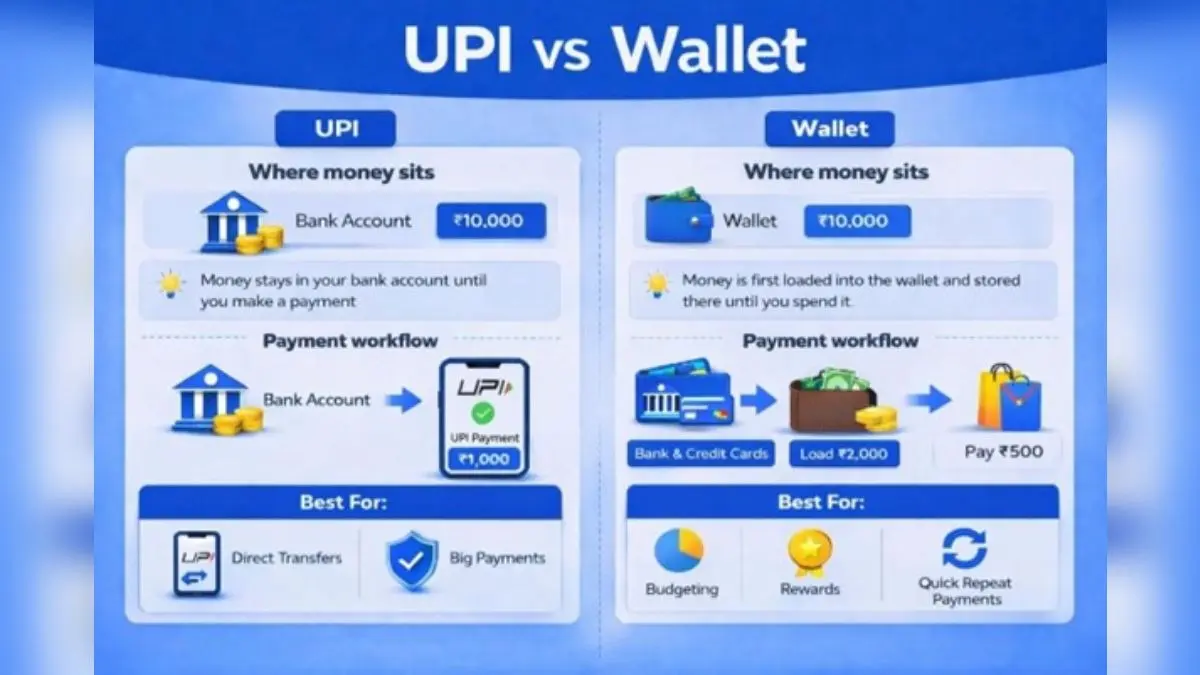
UPI (Unified Payments Interface) is a payment system that connects directly to your bank account. When you make a payment using UPI, the money moves directly from your bank account to the recipient's bank account in real time. You don't need to load money separately before making a payment.
Advertisement
Examples include paying through a UPI ID, QR code, or mobile number linked to UPI.
Think of it like this, UPI is a digital bridge that connects your bank account to the person or merchant you are paying. Money stays in your bank account until you make a payment.
What is a Wallet?
A digital wallet is a stored-value account where you first add money and then use that balance for payments. Before making a payment, you typically need to load or top up the wallet using a bank account, debit card, credit card, or another payment method.
When you pay using a wallet, the money is deducted from the wallet balance rather than directly from your bank account. Think of it like this, a wallet is similar to carrying cash in your physical wallet, except it is stored digitally.
Money is stored separately in the wallet until you spend it.
Where Does the Money Sit in Each Case?
| Feature | UPI | Wallet |
| Where is the money stored? | In your bank account | In the wallet balance |
| Need to load money first? | No | Usually yes |
| Payment source | Directly from bank account | From wallet balance |
| Bank account required for transaction? | Yes | Not necessarily for every payment after loading funds |
| Balance visibility | Bank account balance | Wallet balance |
Bank Account → UPI → Merchant/Friend
Money remains in your bank account until payment is made.
Wallet
Bank Account/Card → Wallet → Merchant/Friend
Money is first stored in the wallet and then used for payments.