
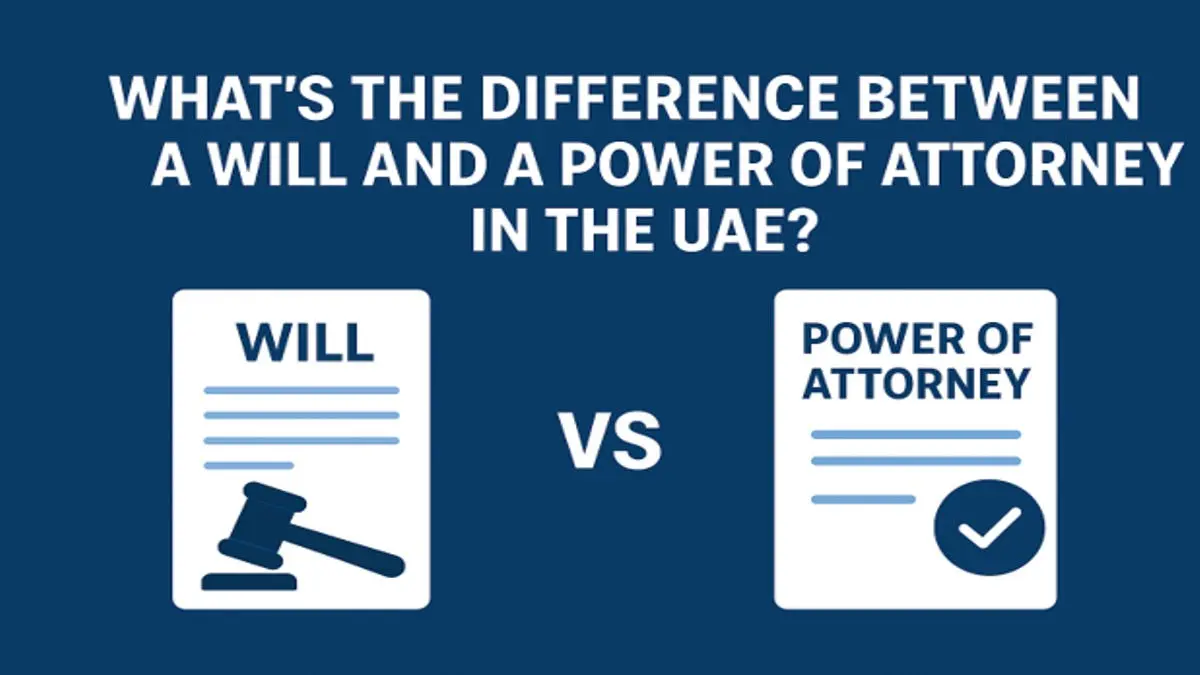
What’s the Difference Between a Will and a Power of Attorney in the UAE?
A Will and a Power of Attorney (POA) are two distinct legal tools essential for expatriates in the UAE, serving different purposes.
- Initiatives News
- 6 min read

;'%3e%3cpath%20d='m8,15.99c4.41,0,7.99-3.58,7.99-7.99S12.41,0,8,0,0,3.59,0,8s3.58,7.99,7.99,7.99Z'%20style='stroke:%23fff;%20stroke-miterlimit:10;%20stroke-width:.02px;'/%3e%3cpath%20d='m3.08,3.37l3.82,5.11-3.84,4.15h.87l3.37-3.64,2.72,3.64h2.94l-4.04-5.39,3.58-3.87h-.86l-3.1,3.35-2.5-3.35h-2.94Zm1.27.64h1.35l5.97,7.99h-1.35l-5.97-7.99Z'%20style='fill:%23fff;'/%3e%3c/g%3e%3c/svg%3e)


Are you an expat or resident living in Dubai, building your life, investing in property, and raising a family? You may have everything mapped out, but there's one essential question many overlook: What happens if you’re no longer around or unable to make decisions for yourself?
This is where two vital legal tools come in: a Will and a Power of Attorney. While they may sound similar, they serve very different purposes. Both deal with your personal and financial matters, but one is meant for after your death, and the other is designed to protect you while you're still alive.
What’s the difference between a Will and a Power of Attorney in the UAE?
Understanding What a Will is:
A Will is a legal declaration that outlines how your assets should be distributed after your death. It also allows you to name guardians for your children, specify funeral wishes, and appoint someone to carry out your instructions, known as an executor.
In the UAE, this document holds particular importance for expatriates. In the absence of a registered Will, the default inheritance law based on Shariah principles is automatically applied, unless you have explicitly registered a Will in the UAE.
Advertisement
As a result, outcomes may include:
- Assets being distributed in fixed shares among family members according to Shariah.
- The spouse or family not automatically inheriting the entire estate, or as per your wishes.
- Guardianship of children being determined by the court, not your preference.
Without a Will, the inheritance process can face unexpected delays and quickly turn into a complicated and lengthy legal procedure. While Wills from your home country or those registered overseas may be applicable, getting them recognized in the UAE involves translation, attestation, and a time-consuming legal process.
Advertisement
Registering a Will in the UAE offers a far smoother path, ensuring your wishes are clearly documented, legally recognized, and efficiently enforced when the time comes.
This is why registering Wills in the UAE through official channels like DIFC Wills Service Centre or the Abu Dhabi Judicial Department (ADJD) is strongly recommended. to ensure your estate and loved ones are handled according to your wishes.
What a Power of Attorney Covers
While a Will only becomes effective after your death, a Power of Attorney (POA) is a legal document that functions during your lifetime. It allows someone else, known as the attorney or agent, to act on your behalf in certain matters and situations.
This is particularly helpful in situations where you are:
- Outside the country, but need to sign documents or complete transactions
- Temporarily or permanently incapacitated
- Simply delegating authority for convenience
A Power of Attorney in Dubai must be notarized either physically at the Notary Public or online through the digital notary system. POAs are usually drafted in Arabic or as bilingual (Arabic-English) documents to ensure they are legally valid.
Different Types of POAs
There are several types of POAs depending on the scope and nature of the authority you wish to grant. Here’s a breakdown:
1. General Power of Attorney
This grants broad authority over a wide range of matters, such as:
- Managing bank accounts
- Buying or selling property
- Handling legal matters
- Representing you before government departments or courts
It’s commonly used when someone wants to give another person full control over their affairs in the UAE. However, due to its extensive powers, it should only be granted to someone you completely trust.
2. Special Power of Attorney
This is more task-specific and is often limited to a single transaction or activity. For example:
- Selling a specific property
- Registering a vehicle
- Representing you in one court case
- Managing a particular bank transaction
Because it’s limited in scope, a Special POA provides more control and is safer for short-term or one-off tasks.
3. Business Power of Attorney
A Business POA is issued when you want someone to manage your business affairs. This could include:
- Signing contracts on behalf of the company
- Dealing with clients or suppliers
- Representing the business before government entities
- Handling VAT or other tax-related matters
It’s especially useful for business owners who travel frequently, have multiple ventures, or want to delegate day-to-day responsibilities while retaining overall control.
4. Personal Power of Attorney
A Personal POA allows someone to handle your individual affairs, which may include:
- Paying bills
- Accessing your bank accounts
- Making medical decisions (if a medical POA is included)
- Renewing tenancy or utility contracts
- Representing you in personal legal matters
This type of POA is often granted to spouses, close relatives, or trusted friends, particularly in cases of medical treatment or temporary absence from the UAE.
It’s important to note that the authority given in a POA is only valid while the person who issued it is alive. Once the person dies without prior arrangements, the POA becomes void.
Can You Use One Instead of the Other?
No. A Will and a Power of Attorney serve completely different purposes and are not interchangeable.
A POA cannot make decisions about your estate after you pass away, and a Will cannot help someone act on your behalf while you're still alive. If you're planning responsibly especially as an expat in the UAE, you may need both documents.
Why Expats in the UAE Need Both Documents
If you live, work, or invest in the UAE, here’s why you should seriously consider putting both a Will and a POA in place:
- Protect your loved ones: Ensure your assets go to the right people and that your children are cared for by guardians you trust.
- Prevent asset freezing: Without a Will, your bank accounts or properties may be inaccessible for months.
- Enable quick legal action: With a POA, someone can act for you in emergencies — like selling property, handling legal cases, or accessing funds on your behalf.
- Avoid delays and disputes: Having clear documentation simplifies the legal process and avoids unnecessary court procedures.
Planning for the unexpected is never easy, but it’s one of the smartest steps you can take, especially in a country where the legal framework differs from your home country. A Will gives you control over what happens after your life ends, while a Power of Attorney in Dubai allows someone to legally act on your behalf while you’re still alive.
Both documents serve distinct yet equally vital purposes. By preparing them in advance, you protect your loved ones, safeguard your assets, and avoid unnecessary legal hurdles. If you're unsure where to start, consult professionals who specialize in Wills in the UAE and power of attorney in Dubai. A little planning today can bring peace of mind tomorrow.