
Why North Bangalore Is Now Bengaluru's Most Serious Buyer Conversation
North Bangalore is rapidly emerging as Bengaluru's next real estate hotspot, driven by major investments from Foxconn, Boeing, SAP, and other global companies. Discover how infrastructure, job creation, and the airport corridor are transforming Devanahalli and surrounding areas into high-growth residential and investment destinations.
- Initiatives News
- 5 min read

;'%3e%3cpath%20d='m8,15.99c4.41,0,7.99-3.58,7.99-7.99S12.41,0,8,0,0,3.59,0,8s3.58,7.99,7.99,7.99Z'%20style='stroke:%23fff;%20stroke-miterlimit:10;%20stroke-width:.02px;'/%3e%3cpath%20d='m3.08,3.37l3.82,5.11-3.84,4.15h.87l3.37-3.64,2.72,3.64h2.94l-4.04-5.39,3.58-3.87h-.86l-3.1,3.35-2.5-3.35h-2.94Zm1.27.64h1.35l5.97,7.99h-1.35l-5.97-7.99Z'%20style='fill:%23fff;'/%3e%3c/g%3e%3c/svg%3e)


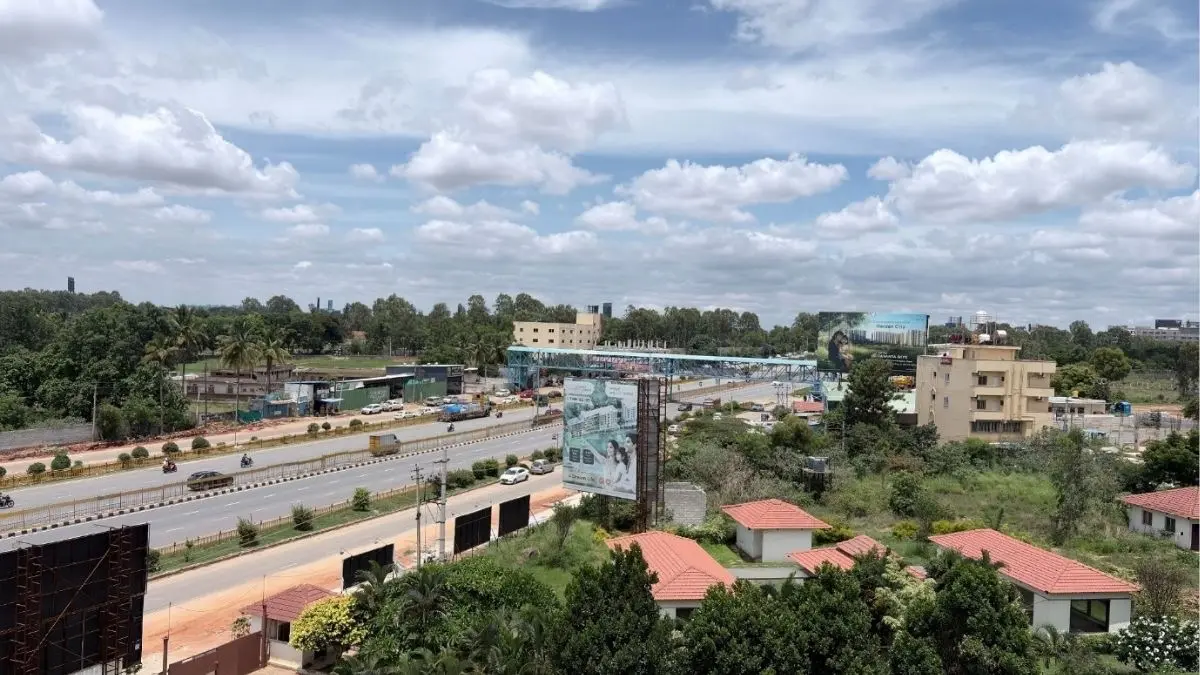
For years, Bengaluru's real estate conversation began and ended with Whitefield and the Outer Ring Road. Investors pointed south and east. Developers followed. The rest of the city, particularly its northern stretches, was treated as peripheral geography, a place you passed through to reach the airport and thought nothing more of. That framing is now outdated by about five years and a few hundred thousand jobs.
North Bangalore is in the middle of one of the most consequential employment-led transformations any Indian urban corridor has seen in recent memory. The question serious buyers need to ask is not whether this is real. It is whether they are already too late.
The shift started, as most shifts do, with infrastructure. When Kempegowda International Airport moved to Devanahalli in 2008, it relocated the city's centre of gravity without anyone fully registering it at the time. What followed was a slow but accelerating accumulation of industrial, aerospace, technology and logistics investment that has since made the airport corridor one of the most active employment zones in South India.
Foxconn commenced operations of iPhone 17 production at a new facility in Devanahalli in August 2025, representing a strategic investment of $2.8 billion. The plant is not a small assembly operation. Government officials confirmed the factory already employs 30,000 people, with a target of 50,000 employees by the end of the year. A single facility pulling that kind of workforce does not sit in isolation. It creates a gravitational field.
Advertisement
It is not alone. SAP's Innovation Park at Devanahalli, opened in 2025, welcomed 3,200 employees in its first phase alone, with full completion expected to house nearly 14,000 people, backed by an investment of 194 million euros. Boeing's India Engineering and Technology Centre, inaugurated in 2024, occupies 43 acres and represents a 1,600 crore rupee investment. Airbus, Rolls-Royce, GE Aviation and Safran have established presence in the Devanahalli Aerospace SEZ. Amazon India relocated its corporate headquarters to a business park near the airport. AstraZeneca, AxisCades and BHIVE have added further density to a corridor that is no longer speculative. It is operational.
The KIADB Aerospace Park of 847 acres is already operational with Hindustan Aeronautics, DRDO units and Boeing's India hub, alongside the Aerospace and Defence Park of 2,500 acres and an Aero SEZ of 3,000 acres. Taken together, these are not isolated facilities. They constitute a labour catchment area that will define where tens of thousands of engineers, technicians, logistics professionals and service workers choose to live over the next decade.
Advertisement
The region is projected to generate 350,000 jobs, capturing 30 percent of Bengaluru's office absorption and ensuring sustained residential demand. That number, if approached with any serious urban planning lens, is a housing demand forecast as much as it is an employment one.
There is a simple framework that experienced property advisors have started applying in conversations with buyers: follow the jobs, not just the price. A lower entry price looks attractive in isolation. What actually drives long-term housing demand is employment generation. Before committing to any location, the question worth asking is how many people will be working within a 10 to 15 kilometre radius of that address over the next five years. In North Bangalore, that answer is already large and growing.
The Yelahanka corridor, the NH44 axis and the airport-adjacent micro-markets are the specific geographies where this employment density is concentrating. Micro-markets like Devanahalli, Hebbal and Thanisandra have appreciated 15 to 28 percent over the past three years as office absorption in North Bengaluru scaled from under 3 million square feet annually in 2018 to over 8 to 10 million square feet by 2024-25.
It is worth correcting a perception that still lingers in some buyer conversations. Devanahalli is no longer a distant peripheral suburb. That description belonged to a different decade. What exists today is a strategic growth hub anchored by an international airport, supported by business parks, industrial investments from global names and an incoming metro line that will connect the corridor to the rest of the city. The economic centre has been steadily shifting north, and the residential market is pricing that shift in, gradually but unmistakably.
Triton Group, a Bengaluru-based developer with 13 years of focus on exactly these northern corridors, has been building in this geography through multiple market cycles. Founded by Kishore Babu, Harish Naidu and Uppara Nagaraju, the group has developed and planned over 10 million square feet of residential space and counts more than 10,000 homeowners across its portfolio. Its current projects sit at the intersection of the employment and connectivity story that defines this corridor. Sanvi Aero Gardens, positioned along the airport corridor near NH44, targets the workforce that is already arriving. Triton Humming Valley, a villa development near Nandi Hills, addresses a different demand segment, those seeking a retreat-style residence within range of the city's expanding north.
The founders frame their own origin plainly. "We didn't inherit land banks, construction companies, or a real estate legacy. We lived through this problem and frustration, started with questions, frustrations, and experiences that millions of Indian families face every day. Triton is proof that when you build for people like yourself, trust becomes your strongest foundation," they have said.
There is also a conversation worth having about under-construction projects that has not always been conducted honestly. Ready-to-move homes offer immediate possession, and that certainty has value. But under-construction projects from developers with demonstrable execution records can offer better entry pricing and stronger appreciation potential, particularly in corridors where the employment story is still playing out and prices are still reflecting tomorrow's reality at today's numbers.
South Bangalore grew on the back of IT. North Bangalore is growing through a combination of aviation, aerospace, technology, logistics and global business investment. The infrastructure is in place. The workforce is arriving. The housing demand will follow the workforce, as it always does. The question for buyers and investors is not whether North Bangalore is a serious conversation. That question was settled some time ago. The question now is how long they intend to wait before joining it.