
Why Wispr Flow Feels Ahead in Modern STT & Voice Dictation
Explore how Wispr Flow differentiates itself from OpenAI, ElevenLabs, and Siri by delivering low-latency, writing-first speech-to-text built for seamless workflow integration and long-form dictation.
- Initiatives News
- 2 min read

;'%3e%3cpath%20d='m8,15.99c4.41,0,7.99-3.58,7.99-7.99S12.41,0,8,0,0,3.59,0,8s3.58,7.99,7.99,7.99Z'%20style='stroke:%23fff;%20stroke-miterlimit:10;%20stroke-width:.02px;'/%3e%3cpath%20d='m3.08,3.37l3.82,5.11-3.84,4.15h.87l3.37-3.64,2.72,3.64h2.94l-4.04-5.39,3.58-3.87h-.86l-3.1,3.35-2.5-3.35h-2.94Zm1.27.64h1.35l5.97,7.99h-1.35l-5.97-7.99Z'%20style='fill:%23fff;'/%3e%3c/g%3e%3c/svg%3e)


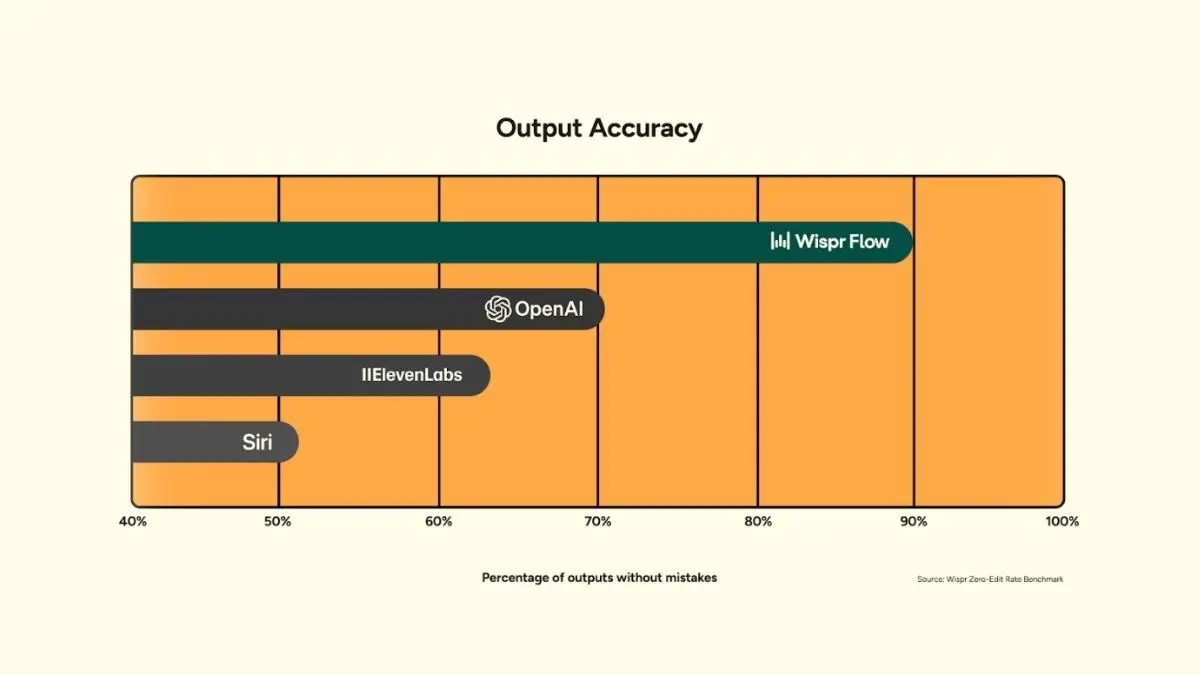
Speech-to-text technology has matured significantly. Accuracy is no longer the only benchmark — flow, formatting, latency, and workflow integration now define the real experience. While platforms like OpenAI, ElevenLabs, and Siri each excel in their respective domains, Wispr Flow approaches STT with a more singular focus: making voice the primary writing interface.
Here’s how that difference shows up in practice:
1. Focused Product Philosophy
OpenAI provides powerful general-purpose AI models, where transcription is one capability among many. Wispr Flow, by contrast, is centered entirely around dictation. That focus translates into a more refined experience for users who rely on voice daily rather than occasionally.
Advertisement
2. Designed for Long-Form Thinking
Siri performs well for short commands and quick notes, but extended dictation often requires formatting and corrections. Wispr Flow is structured around sustained speaking sessions — supporting paragraphs, structured posts, and detailed drafts without breaking flow.
Advertisement
3. Writing-First Optimization
ElevenLabs is widely recognized for voice synthesis and audio realism. Wispr Flow instead prioritizes how spoken words convert into structured written content. Automatic punctuation, paragraph handling, and clarity adjustments reduce the editing layer after dictation.
4. Real-Time Responsiveness
API-based transcription systems, including those built on OpenAI models, can introduce subtle processing gaps depending on integration. Wispr Flow is optimized for low-latency streaming input, creating a more immediate and continuous writing feel.
5. Reduced Post-Editing Effort
General transcription tools typically output accurate but raw text. Wispr Flow adds a refinement layer tuned for writing contexts, meaning fewer manual cleanups and smoother first drafts.
6. Workflow-Centric Integration
While OpenAI and ElevenLabs often require developer-level integrations for deeper usage, Wispr Flow integrates directly into writing environments. The result is less technical setup and more day-to-day usability.