
Europe’s Burning Streets and India’s Quiet Lesson
Europe's Burning Streets Are a Warning: India Must Uphold Integration, Not Import Europe's Failed Multiculturalism
- Opinion News
- 5 min read

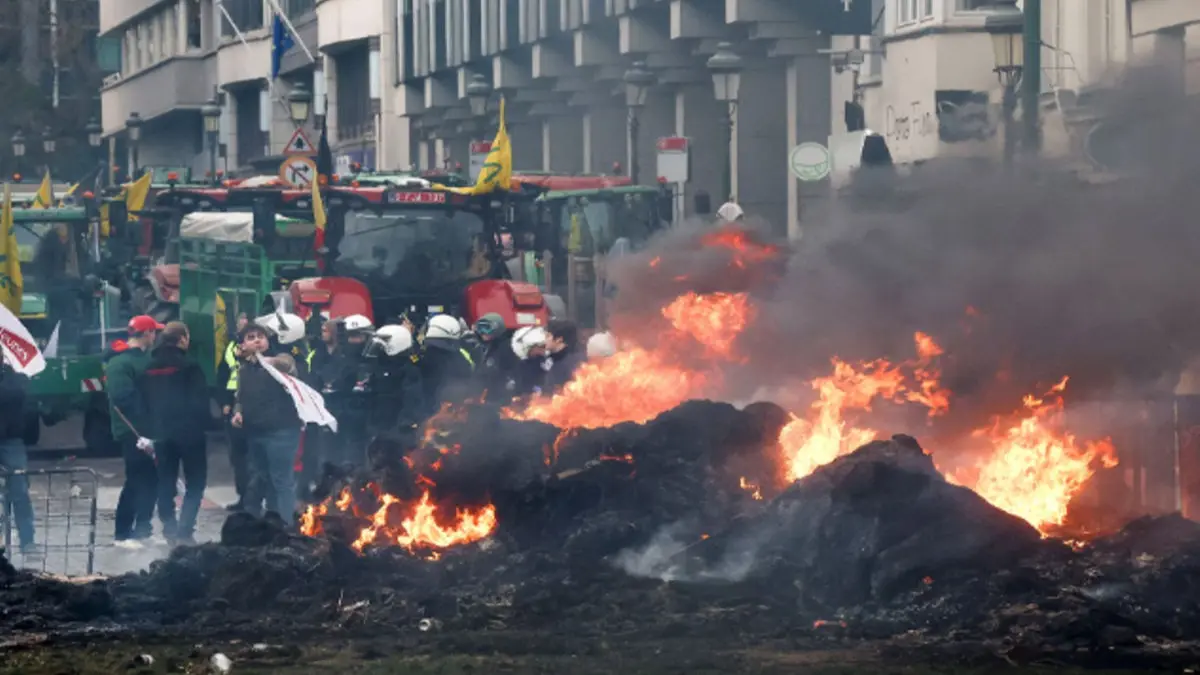
As Europe welcomed the New Year with fireworks and festivities, parts of Belgium, France, and Italy descended into something far more ominous – burning cars, smashed shopfronts, besieged police stations, and emergency responders turned into targets rather than protectors. What should have been a moment of renewal instead exposed a continent grappling with the cumulative consequences of decisions taken over decades, often in defiance of public sentiment and common sense.
The Selective Silence, Anger of the Streets
Predictably, much of the European media responded with selective silence. Names were withheld, backgrounds blurred, and uncomfortable questions deferred. The violence was described, but its authors remained conveniently abstract. Yet on the streets, among ordinary Europeans – shopkeepers, taxi drivers, nurses, and off-duty policemen – the anger was anything but abstract. They know what they saw. They know who terrorised their neighbourhoods. And they know that the refusal to speak plainly has only deepened the crisis.
Politicians and commentators across Europe have now begun to say aloud what has long been whispered: that decades of unchecked immigration from Muslim-majority countries, coupled with failed integration and the creation of parallel societies, have produced combustible ghettos of resentment. When the match was struck on New Year’s Eve, the tinder was already in place.
The Fatal Disconnect: A Declaration of Lawlessness
What made this round of unrest especially alarming was not just the scale of destruction but the choice of targets. Police officers, firefighters, and medical emergency services – symbols of civic order and public good – were deliberately attacked. This was not a protest; it was a statement. A declaration by lawless enclaves that the authority of the state does not apply to them.
Advertisement
And yet, even as flames licked European streets, moral lectures flowed freely. Pope Leo XIV warned that European fears of Muslim migrants are “oftentimes generated by people who are against immigration and trying to keep out people who may be from another country, another rreligion, oranother race.” It is a familiar refrain—one that frames concern as bigotry and lived experience as prejudice.
But here lies the fatal disconnect. Fear is not generated in think tanks or by political demagogues alone; it is born in neighbourhoods where residents no longer feel safe after dark, where women hesitate to step out, and where emergency sirens no longer reassure but signal impending chaos. To dismiss such fear as manufactured is not ccompassion – itis denial.
Advertisement
The Poland-Hungary Contrast
Contrast this with Hungary and Poland. While Western Europe bburnt,these countries remained largely peaceful. Their leaders were unapologetic: strict controls on mass migration from Muslim-majority countries, they argued, had shielded their societies from precisely this kind of breakdown. For years, they were vilified as xenophobic, iilliberal, andeven authoritarian. Today, their streets are calm while others count the cost of burnt vehicles and shattered trust.
India’s Moment of Reckoning
This is where India must pay close attention. India, unlike Europe, has centuries of experience managing ddiversity – religious,linguistic, ethnic, and cultural. But India’s diversity has survived not because of moral posturing but because of firm civilisational boundaries.
Integration in India has always been non-negotiable. You may ppractise your faith freely, but the sovereignty of the Republic, the primacy of its laws, and the cultural grammar of the land are not optional. Europe made a different choice. It imported populations at scale without demanding assimilation.
Multiculturalism was elevated from a social policy to a secular religion. Any questioning of its outcomes was branded heresy. Over time, the state retreated, and in that vacuum, identity politics, religious extremism, and criminal networks flourished.
India Cannot Afford that Mistake
We are already a pressure cooker of population density, economic inequality, and political competition. Mass immigration without integration – legal or illegal – would not be an act of humanitarianism; it would be strategic negligence. National security, social harmony, and economic stability are not abstract ideals. They are fragile equilibria.
India’s critics often accuse it of being “illiberal” when it tightens borders, scrutinises NGOs, or demands adherence to civil law over religious exceptionalism. But Europe’s burning streets are the answer to that criticism. A state that refuses to defend itself eventually loses the moral authority to govern.
This does not mean India should shut its doors or abandon compassion. It means compassion must be tethered to responsibility. Refugees must be distinguished from economic migrants. Asylum must not become an open-ended entitlement. And above all, the rule of law must be enforced uniformly, without fear or favour.
Narrative Control Matters
Europe’s tragedy also holds a deeper lesson: narrative control matters. For years, European elites gaslit their populations, telling them that what they were seeing with their own eyes was either exaggerated or imaginary. That trust deficit has now metastasised. When citizens stop believing their leaders, they turn to extremes. Silence and censorship do not prevent polarisation; they accelerate it.
India’s democracy, noisy and imperfect as it is, retains one crucial advantage: debate. Our arguments are messy, often heated, sometimes vulgar – but they are out in the open. Suppression of uncomfortable truths has never served any society well, least of all one as complex as ours.
Finally, Europe’s crisis underscores a truth that India instinctively understands: civilisation is not self-sustaining. It must be defended – culturally, legally, and politically. Rights without responsibilities rot into entitlement. Diversity without cohesion dissolves into fragmentation.
As Europe sifts through the ashes of yet another self-inflicted wound, India would do well to observe, reflect, and resolve. The path to social harmony is not paved with denial, nor with virtue-signalling sermons from insulated elites. It is built on clarity, courage, and an unflinching commitment to the nation-state.
The streets of Europe are burning. India must ensure its own remain lit – not by fire, but by foresight.