
Red Lines, Green Channels: The Oil Routes Behind Trump’s China Visit And The BRICS Divide
The phrase “China’s right to development” carries rhetorical weight in public discourse, yet a critical observer might question who is actually impeding China’s development. The central issue is not development in the abstract, but rather access—specifically, access to technology, markets, capital, advanced semiconductors, shipping, insurance, energy flows, and global consumer demand. This is the point at which the underlying American message emerges.
- Opinion News
- 21 min read

;'%3e%3cpath%20d='m8,15.99c4.41,0,7.99-3.58,7.99-7.99S12.41,0,8,0,0,3.59,0,8s3.58,7.99,7.99,7.99Z'%20style='stroke:%23fff;%20stroke-miterlimit:10;%20stroke-width:.02px;'/%3e%3cpath%20d='m3.08,3.37l3.82,5.11-3.84,4.15h.87l3.37-3.64,2.72,3.64h2.94l-4.04-5.39,3.58-3.87h-.86l-3.1,3.35-2.5-3.35h-2.94Zm1.27.64h1.35l5.97,7.99h-1.35l-5.97-7.99Z'%20style='fill:%23fff;'/%3e%3c/g%3e%3c/svg%3e)


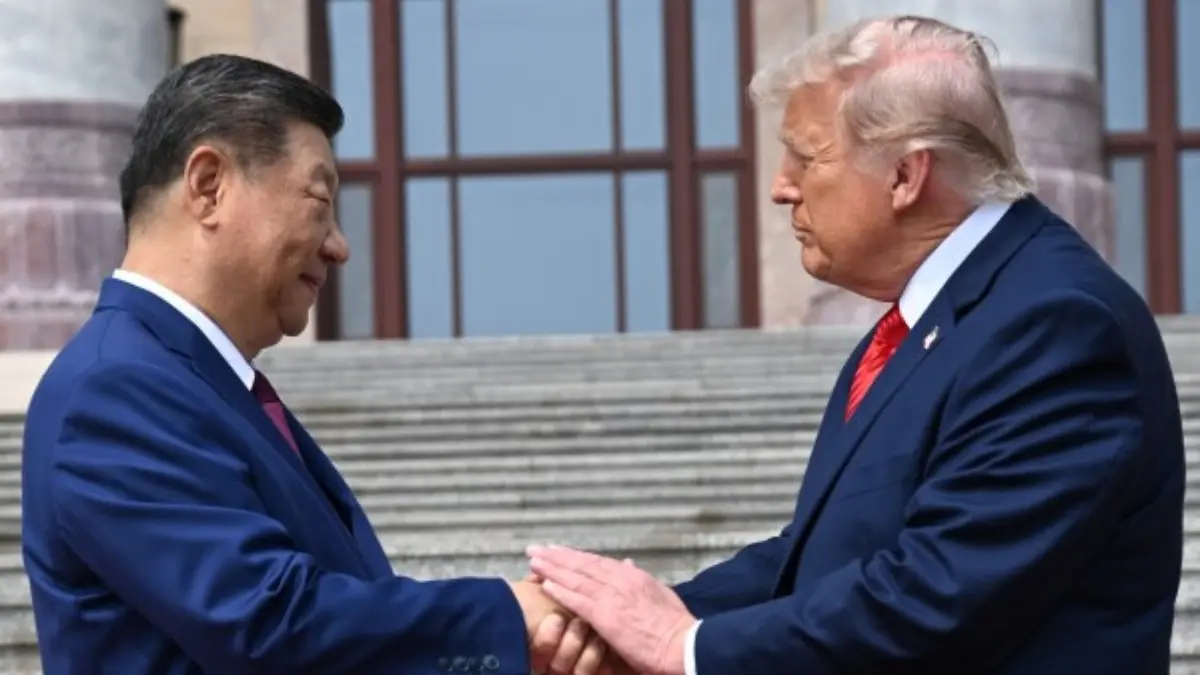
New Delhi: China approached negotiations with explicit red lines, as Wang Yi stated: "China has inviolable red lines on sovereignty and security issues," referring primarily to Taiwan and other core interests.
In response, U.S. readouts and press briefings emphasised Washington’s energy initiatives, including potential American oil shipments and expanded market-access measures.
The argument for route diversification is supported by geographic considerations, particularly when Alaska is included; however, this should be regarded as a strategic interpretation rather than an officially endorsed term.
Serious Strategic Signal
However, Chinese state media and official Chinese summaries have not confirmed the energy purchase details on the same terms. Therefore, the issue should be treated as a serious strategic signal, but not yet as a fully confirmed trade flow. Taiwan served as the public focal point of the meeting, whereas energy represented the underlying strategic concern.
Advertisement
Should Alaska oil exports to China commence, Beijing’s red lines would not have vanished; rather, they would have been discreetly transformed into channels of trade, strategic pressure, and dependence.
If American reports—largely drawn from official press briefings, background briefings to major U.S. outlets, and preliminary industry chatter—are accurate and China has expressed interest in purchasing U.S. oil, particularly from Alaska, then the Trump administration’s visit to Beijing should not be interpreted as a routine trade engagement.
Advertisement
Instead, it should be understood as a strategic signal conveyed through commercial discourse. While these reports originate from credible diplomatic and industry sources, it is important to note that Chinese authorities have not provided parallel confirmations, and coverage is based on Western governmental and media disclosures, making the picture suggestive but not definitive.
Implications Extend Well Beyond Oil Trade
Therefore, the appropriate position is as follows: if these discussions result in tangible cargo flows, refinery nominations, tariff adjustments, and sustained purchases, the implications extend well beyond oil trade. Such developments would indicate that Washington has engaged one of Beijing’s most sensitive vulnerabilities: energy security.
At the same time, it is important to acknowledge that China could portray any engagement with U.S. oil, if it occurs, purely as pragmatic diversification rather than a sign of vulnerability. Chinese official statements might downplay strategic implications, frame purchases as part of a broad import strategy, or emphasise a position of flexibility and resilience.
Such counter-narratives would aim to reassure domestic audiences and signal to international observers that Beijing remains in control of its core interests. That counter-narrative should be expected, but it does not erase the strategic fact that any meaningful U.S. oil purchase would diversify China away from sanctioned Iranian barrels and expose the cost of secure supply.
Predictable Patterns
The public aspects of the summit followed predictable patterns. China reiterated its red lines, presenting Taiwan, democracy, human rights, political systems, and the right to development as central concerns. For Xi Jinping, this constituted essential domestic positioning. It was necessary to demonstrate to Communist Party cadres, the media, the military, and the public that China had not yielded to external pressure.
However, red lines do not always signify strength; at times, they reveal areas of vulnerability. Taiwan represents China’s political vulnerability. Human rights and democracy pertain to the legitimacy of a state. Political systems serve as points of comparison, while development rights relate to issues of access.
The phrase “China’s right to development” carries rhetorical weight in public discourse, yet a critical observer might question who is actually impeding China’s development. The central issue is not development in the abstract, but rather access—specifically, access to technology, markets, capital, advanced semiconductors, shipping, insurance, energy flows, and global consumer demand. This is the point at which the underlying American message emerges.
China red-line rhetoric
While China projected strength through its red-line rhetoric, Washington appears to have highlighted China’s energy vulnerability. If Alaska oil had been a substantive topic of discussion, the message to Beijing would have been clear: political posturing regarding Taiwan, South China Sea claims, or other slogans cannot obscure China’s reliance on imported energy.
China may delineate nine-dash, ten-dash, or even earlier eleven-dash lines on maps, and assert sovereignty and historic rights. It may project maritime ambitions in the South China Sea and around Taiwan. However, these cartographic claims do not facilitate the movement of crude oil; only tankers can do so.
While the Pacific sea lanes are legally international, the region’s security architecture is predominantly shaped by the United States and its allies. Alaska, the Aleutian Islands, Japan, South Korea, Guam, and the broader U.S. Pacific Fleet posture are concrete elements of the maritime environment that define any significant Pacific energy route.
This strategic context underscores the significance of Alaska.
Significance of Alaska
Alaska oil exports to China represent more than an additional crude supply option; they convey a maritime message. In quantitative terms, Alaska's annual oil production has averaged a low to mid-400,000 barrels per day in recent years, compared to China's total crude oil imports of about 11 million barrels per day.
If even a fraction of Alaska's output were rerouted to China, it could account for close to 1 percent of China's daily imports. While modest as a share of China's aggregate intake, such volumes are strategically significant given the diversification of routes and the demonstration of U.S.-China energy engagement.
This development in Beijing suggests that energy security need not rely solely on routes through Iran, the Strait of Hormuz, the Strait of Malacca, or the South China Sea. Instead, energy can be transported via the North Pacific, where American geography, naval reach, and allied positioning are central.
In Europe in Drift: The Hidden Currents of Power Between Moscow and Washington, the importance of the route through the Unimak Pass, along the Kamchatka arc, past Japan, and toward the China Sea is examined. This route is not merely a line on a maritime chart; it forms part of the broader structure of high-latitude trade power, linking Arctic and North Pacific considerations with energy movement, naval reach, and strategic access to East Asia.
This constitutes the Pacific route and exemplifies the high latitudes trade power. Alaska should not be considered the sole American supply point. Trump has also identified Texas and Louisiana as additional sources of U.S. oil for China. This distinction is important. Alaska offers the most direct Pacific-route option, while Texas and Louisiana provide greater Gulf Coast export capacity. Therefore, Alaska serves as the route indicator, whereas Texas and Louisiana function as volume indicators.
Favourable Strategic Geography
The Gulf Coast route to China is longer and more exposed, yet it enables greater export capacity. In contrast, the Alaska route offers lower capacity but benefits from more favourable strategic geography. As a result, Washington has two strategic options: large-scale export capability from the Gulf Coast and enhanced Pacific-route signalling from Alaska.
This context should be considered in relation to the broader U.S. production base. In 2025, U.S. crude oil production reached a record average of approximately 13.6 million barrels per day. Consequently, the United States oil production capacity extends well beyond Alaska. While Alaska provides a symbolic message, the broader U.S. production system demonstrates substantial depth.
If China buys U.S. oil from the Pacific side, it is not only buying barrels, but it is also buying route security and quietly accepting that American-influenced maritime geography still matters to China’s economic engine.
This is where Iran enters the picture.
For years, China benefited from discounted Iranian oil because Iran had limited buyers. Sanctions narrowed Iran’s market. China used that reality to obtain favourable terms. But if Beijing begins buying U.S. oil in meaningful volumes, the Iran-China discounted-oil chain loses some of its strategic value. Iran no longer remains the irreplaceable emergency supplier. China may still bargain with Iran, but Iran can no longer assume that China has no alternative. This is a clear American gain.
It does not mean China will openly abandon Iran. Beijing will not humiliate Tehran. It may continue to buy Iranian oil through indirect channels when discounts are attractive. But the strategic balance changes. Iran loses exclusivity. China loses some discount leverage. The United States gains an energy export opening into the Chinese system at the very moment Hormuz and Iranian ports remain under pressure.
Russia’s Silent Price Signal: From Sanctioned Supplier to Strategic Alternative
Russia is expected to monitor this development closely. Should China reduce its reliance on discounted Iranian oil, it should finally seek to capture a share of that market through ESPO crude, pipeline-linked flows, and Far East exports.
However, Russia is unlikely to act as a benevolent supplier. If China’s demand becomes more urgent, Russia may shift toward market-linked or even premium pricing, particularly for barrels delivered from the Russian Far East (Sakhalin, Kozmino, Yakutia, Vladivostok, Amur)
This trend is already evident in pricing behaviour. Russian ESPO Blend cargoes destined for China in late June and July 26 have been reported at premiums of approximately $4 to $5 above ICE Brent, following a decrease from earlier premiums of $6 to $7.
This indicates that Russia’s Far East crude is not being treated as distressed oil in the current market environment. If Iranian supplies become constrained and China requires secure non-Hormuz sources, Moscow can further increase the value of its barrels.
This dynamic illustrates President Putin’s understated advantage. There is no need for overt declarations; instead, Russia can wait as the United States increases pressure on Iran, China seeks a secure supply, and the market adjusts the value of Russian export routes. Under these circumstances, Russia is positioned to sell not as a sanctioned supplier in distress, but as a strategic alternative offering valuable export routes.
Consequently, the current energy constraints that benefit Washington simultaneously create opportunities for Moscow. The United States benefits from undermining the Iran-China discount chain, while Russia stands to gain if China is compelled to pay prices closer to the market rate for secure Eurasian or Far East oil supplies.
The message becomes sharper when Hormuz is taken into account.
China cannot secure Hormuz by political interference alone. It can advise Iran. It can apply quiet pressure. It can ask for restraint. But it cannot command the Gulf. It cannot replace the American naval, financial and insurance pressure system. If Washington’s pressure on Iranian ports persists, the old assumption of secure, discounted Iranian oil becomes weaker.
The quiet American message to China may therefore be simple: do not depend on Iran to keep your factory system cheap. Buy oil at market rates from normal suppliers. Buy from Iraq, Saudi Arabia, the UAE, the United States and others. If you want energy security, pay for it through a stable system. Do not assume that discounted oil from a sanctioned partner can remain the foundation of your manufacturing advantage.
For U.S. and allied policymakers, this moment offers a clear policy takeaway: leverage energy exports and route diversification as sustained tools of strategic influence. Policymakers should encourage expanded U.S. energy sales to China through Pacific channels, reinforce the importance of international maritime security, and coordinate with allies to promote stable, transparent, and resilient energy markets.
In parallel, allied governments could invest in port infrastructure, tracking and security systems along key Pacific and Arctic routes, and maintain pressure on sanctioned oil flows that serve as economic lifelines for states like Iran. Such an approach would bolster American and allied bargaining power, limit adversaries' discount leverage, and strengthen the geopolitical logic underpinning secure, rules-based trade.
This is where the economic pressure on China becomes serious.
China’s manufacturing strength has not been built only on discipline and scale. It has also depended on controlled input costs. Cheap energy matters. Discounted oil matters. Low-cost logistics matter. Subsidised industrial ecosystems matter. Managed wages matter. State-supported credit matters.
If energy, freight, insurance, and access to technology become costlier, then China’s manufacturing cost base changes. Once that happens, the Communist Party’s domestic bargain also comes under pressure.
For decades, the party-state has offered a simple bargain: accept political control, and the state will deliver stability, employment, housing, food security, infrastructure and national pride. But if manufacturing margins shrink, energy becomes more expensive, exports face pressure, and workers demand higher wages, the bargain becomes harder to maintain. This is the contradiction in China’s model.
China wants to be treated as a great power, but it still wants the cost advantages of a low-cost manufacturing state. It wants global respect, but resists global scrutiny. It wants access to Western markets, technology and capital, but rejects criticism of its internal political system. It speaks of development rights, but its real fear is controlled access to the system that enabled its rise.
In practical terms, China may reject the language of democracy, but its economy cannot reject the discipline of markets forever. If energy, freight, insurance, labour and technology become costlier, then manufacturing has to reflect real value. Workers will need better pay. Industries will need better margins. Households will need greater purchasing power. The state cannot indefinitely promise housing, food security and stability if the cost base of the economy rises faster than the social bargain can absorb. That is where the communist theory of state protection meets the reality of global pricing.
Washington’s Quiet Audit: Can China Still Sustain Its Low-Cost Model?
China can say no to interference in Taiwan. It can say no to democracy lectures. It can say no to human-rights criticism. Those statements may serve well with CCP cadres, state media and the domestic public. But across the table, the harder question remains: can China continue to run a low-cost manufacturing model if discounted energy, cheap logistics, unrestricted access and suppressed labour value begin to weaken? That is the question Washington appears to be pressing without saying it openly.
This is why Trump’s visit with a domain-heavy team matters. This was not merely a business delegation. It was closer to a strategic verification group. Once bitten, twice shy. After decades of deep exposure to Chinese supply chains, Washington now wants to measure China sector by sector.
Electric vehicles, batteries, AI chips, telecom, memory chips, aviation, jet engines, finance, payments, food security, logistics and supply chains were not random areas. Each one points to a pressure point. Each one tells Washington where China is strong, where it is stretched and where it still depends on the West.
That is why Alaska oil matters.
It calls out the Taiwan bogey without shouting about Taiwan. It tells Beijing that public slogans cannot hide structural dependence. It reminds China that the South China Sea is not the whole maritime board. The larger game runs through Hormuz, the Indian Ocean, Malacca, the North Pacific, Unimak, Kamchatka, Japan and the China Sea.
The United States does not need to say openly that the Pacific belongs to it. It does not legally belong to any one power. But Washington can still communicate that the Pacific security system remains under American influence. China may challenge. It may probe. It may draw lines. But it cannot yet replace the larger maritime architecture that carries energy, trade and technology into East Asia.
In that sense, the Trump visit may have produced something more important than a public agreement. It may have exposed the difference between face and nerve.
• The face was Taiwan.
• The nerve was energy.
• The face was the four red lines.
• The nerve was access.
• The face was China’s right to development.
• The nerve was dependence on technology, capital, shipping, insurance, energy and markets.
If China begins buying U.S. oil in meaningful volume, especially from Alaska, then the message becomes unmistakable. Beijing may defend its political face in public, but it is also hedging its energy vulnerability in private. That is not a small outcome. It is a strategic result. The Alaska oil signal, if confirmed by actual trade, is therefore not just an energy deal.
• It is a maritime message.
• It is a Pacific message.
• It is a reminder that high-latitude routes, energy flows and naval geography still shape the balance of power.
And it tells Beijing, quietly but firmly, that the road to China’s economic security does not run only through slogans, Red Lines or Dash-Line maps. It still runs through the sea.
From China’s Energy Nerve to BRICS’ Energy Divide
While the Beijing meeting highlighted China’s energy vulnerability, the BRICS meeting in New Delhi revealed broader contradictions within the evolving and contested and divided multipolar order.
In Beijing, the United States leveraged oil, trade routes, and market access to assess China’s dependence. In Delhi, the BRICS meeting demonstrated that political rhetoric cannot supersede divergent energy interests. Iran sought protection, the UAE prioritised its commercial and security interests, Russia served as a patient supplier, India advanced its reserve strategy, and China maintained a lower profile amid concurrent diplomatic engagements.
A clear pattern emerges: the evolving global contest is determined not solely by diplomatic statements or formal agreements, but by control over supply, energy storage, movement insurance, risk pricing, and the ability to maintain open routes during periods of political tension.
BRICS in Delhi: The Intersection of Contested Multipolarity and Energy Geopolitics
The BRICS foreign ministers’ meeting in New Delhi should be interpreted not as a routine diplomatic event, but as a critical assessment of energy and route resilience for the expanded group.
BRICS has evolved beyond a coalition of dissatisfied large economies to encompass major energy producers, significant consumers, sanctioned states, Gulf powers, trading nations, and states seeking greater global influence. This expansion increases BRICS’s significance but also intensifies internal contradictions, as demonstrated by the New Delhi meeting.
The meeting concluded without a joint statement due to disagreements over language concerning the Iran conflict. Iran advocated for a stronger collective stance against the United States and Israel, while the UAE opposed this framing. As chair, India issued a chair’s statement instead. This outcome was not merely a procedural issue; it underscored that BRICS does not function as a unified strategic bloc but rather as a platform where diverse powers pursue distinct energy routes, security interests, and commercial objectives.
This development directly relates to the preceding analysis of U.S.-China dynamics. In Beijing, China emphasised diplomatic boundaries, yet the underlying concern was energy access. In Delhi, BRICS discussed multipolarity, but energy security remained the central issue. Despite differing public rhetoric, the fundamental pressures were consistent: control over oil routes, reserve storage, maritime access, and pricing power outweighed political slogans.
Iran participated in the BRICS meeting to seek political support, aiming for the group to serve as a protective alliance. However, energy-importing states prioritise their own economic interests over prolonged political solidarity. While verbal support may be extended, these states are unlikely to compromise their economies for another country’s confrontations, thereby limiting Iran’s leverage.
The UAE approached the meeting with distinct priorities, seeking to prevent BRICS from serving primarily Iranian interests. Abu Dhabi aims to maintain BRICS’s commercial utility without compromising its own security position. Beyond its role as an oil producer, the UAE is a significant logistics and storage power, a maritime-commercial hub, and a Gulf state that values trust from multiple international partners.
This context underscores the significance of the UAE-India reserve agreement. The official Indian outcome document references the potential storage of ADNOC crude in India’s Strategic Petroleum Reserves, with a capacity of up to 30 million barrels. This includes participation in Indian reserve facilities and the development of future reserve capacity. Such an arrangement represents more than a commercial oil deal; it constitutes a strategic geographic shift, transforming India from a mere buyer into a reserve node within the Gulf-to-Asia energy system.
Storing UAE crude in India yields mutual benefits: India gains strategic reserves, geographic proximity, and enhanced emergency flexibility, while the UAE secures a reliable Asian storage and demand platform. Both countries reduce their dependence on last-minute cargo movements during crises.
Comprehensive energy security extends beyond oil production. It encompasses storage locations, control of access, rapid-release capabilities, the reliability of transport routes, applicable insurance, and the resilience of political relationships under pressure.
Within this context, Iran’s position appears increasingly vulnerable. Although Iran possesses oil resources, strategic geography, and the capacity for disruption, it lacks straightforward market access due to sanctions and ongoing conflict. While these constraints previously enabled China to purchase discounted Iranian oil, shifts such as China’s exploration of American oil and India’s enhancement of UAE-linked reserves, alongside continued Russian imports, diminish Iran’s leverage as an indispensable supplier.
This dynamic elevates Russia’s strategic importance. Sergey Lavrov’s participation in New Delhi was substantive rather than ceremonial. In his opening remarks, EAM Jaishankar highlighted the steady growth of the India-Russia partnership, particularly in the economic and energy sectors. He also emphasised the importance of connectivity, advancements in science and technology, and the value of political cooperation amid global uncertainty.
This approach reflects Russia’s strategic method: rather than seeking headline dominance, Moscow prioritises securing buyers, transport routes, favourable timing, and pricing flexibility.
Should China decrease its reliance on Iranian oil, Russia can increase exports via the Far East and pipeline-linked routes. Continued Indian purchases of Russian crude ensure a substantial Asian market. Instability in Gulf routes enhances the value of Russian supply as an alternative to the Strait of Hormuz. If Iran’s discount supply diminishes, Moscow can assert greater pricing confidence.
This strategic silence from Russia is not indicative of disengagement, but rather deliberate positioning. Russia capitalises on the strategic uncertainties faced by both China and India, positioning itself as a reliable supplier without direct confrontation. While BRICS serves as a diplomatic forum, energy pricing remains Russia’s primary tool of influence.
China’s subdued presence at the New Delhi meeting warrants careful analysis. With Wang Yi absent and China represented by its ambassador during President Trump’s visit to Beijing, the timing was significant. This approach allowed China to avoid simultaneous diplomatic challenges. In Beijing, China faced scrutiny from the United States, while in Delhi, BRICS revealed internal divisions regarding Iran and the UAE. A full ministerial presence would have compelled Beijing to balance competing interests more visibly, whereas a lower profile afforded greater diplomatic flexibility.
This reflects a characteristic Chinese diplomatic strategy: assertiveness when advantageous, restraint in uncertain environments, leveraging BRICS for increased influence, and minimising exposure when internal contradictions arise.
The New Delhi meeting did not diminish BRICS’s relevance; rather, it clarified the group’s true nature as a bargaining platform rather than a unified bloc.
• Iran seeks political protection.
• The UAE seeks strategic positioning.
• Russia seeks pricing power.
• India seeks energy security.
• China seeks diplomatic flexibility.
• Each country utilises the BRICS platform to pursue distinct objectives.
This dynamic does not render BRICS irrelevant; rather, it highlights its function as a revealing forum. The group increasingly resembles a marketplace of strategic interests, where members may share concerns about Western dominance, but their routes, risks and dependencies remain divergent. India’s role in this context is particularly significant. Rather than acting as a passive buyer, India is developing a diversified, multi-supplier, multi-route, and reserve-backed energy strategy. It maintains the capacity to purchase from Russia, strengthen storage partnerships with the UAE, sustain channels with Iran, engage with Western actors, and host BRICS. This approach constitutes strategic hedging rather than contradiction.
The previous U.S.-China analysis identified Alaska as a route indicator, Texas and Louisiana as volume indicators, Russia as a silent price signal, and Iran as the exposed discount chain. The BRICS meeting introduces an additional dimension.
India now represents the storage indicator.
India demonstrates that an energy-importing nation must not only purchase oil, but also store, insure, route, diversify, and manage the associated political dynamics.
This constitutes the substantive outcome of the New Delhi meeting.
• It is not the absence of a joint statement.
• It is not the public disagreement between Iran and the UAE.
• It is not the ceremonial photograph.
The principal outcome is that energy routes increasingly reveal underlying political realities. Although BRICS emphasises multipolarity, practical considerations persist: oil must be transported, reserves maintained, tankers insured, ports secured, buyers provided with options, suppliers compensated, and routes protected.
In Beijing, the underlying question concerned China’s ability to sustain its ascent without secure access to energy. In Delhi, the central issue was whether BRICS could preserve an appearance of unity despite internal divisions over critical energy routes.
The answer has now become apparent.
• Contested and divided Multipolarity may dominate the discourse.
• Energy security remains the definitive test.
• Red lines are reserved for diplomatic statements.
• Oil routes are essential for national survival