
Strike, Retaliate, Escalate: The Dangerous Spiral in the Middle East
The joint U.S.- Israel military operation on Iran - code-named Operation Epic Fury - was not a reckless gamble. It was a calculated response to a state that had left its neighbours, its adversaries, and indeed the entire free world with few alternatives.
- Opinion News
- 7 min read

;'%3e%3cpath%20d='m8,15.99c4.41,0,7.99-3.58,7.99-7.99S12.41,0,8,0,0,3.59,0,8s3.58,7.99,7.99,7.99Z'%20style='stroke:%23fff;%20stroke-miterlimit:10;%20stroke-width:.02px;'/%3e%3cpath%20d='m3.08,3.37l3.82,5.11-3.84,4.15h.87l3.37-3.64,2.72,3.64h2.94l-4.04-5.39,3.58-3.87h-.86l-3.1,3.35-2.5-3.35h-2.94Zm1.27.64h1.35l5.97,7.99h-1.35l-5.97-7.99Z'%20style='fill:%23fff;'/%3e%3c/g%3e%3c/svg%3e)


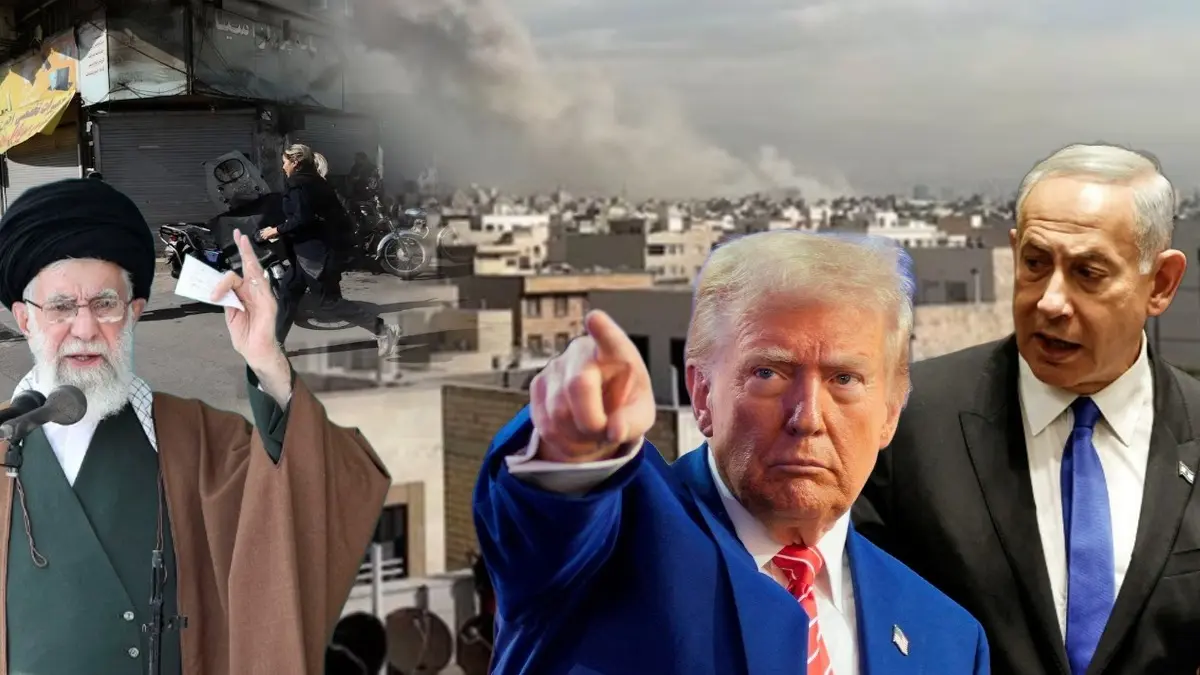
New Delhi: When history books are written about the explosive events of 28 February 2026, one thing will be clear: what unfolded in the skies over the Middle East wasn’t a random flare-up, but the predictable consequence of decades of threat, brinkmanship, and failed deterrence.
The joint U.S.- Israel military operation on Iran - code-named Operation Epic Fury - was not a reckless gamble. It was a calculated response to a state that had left its neighbours, its adversaries, and indeed the entire free world with few alternatives. And when Tehran unleashed missiles at Israel and U.S. bases in the Gulf, it was not an aberration - it was exactly the response almost every strategic analyst expected.
Let’s unpack why.
For years, Iran’s nuclear program, ballistic missile build-up, and proxy networks have cast a long, dark shadow over the Middle East. Leaders in Jerusalem and Washington repeatedly warned that Tehran’s ambitions weren’t just about energy or science - they were about power projection and existential geopolitics.
Advertisement
President Donald Trump, in announcing the strikes, said the goal was to counter “imminent threats” and prevent Iran from developing weapons that could reach across continents.
Whether or not one agrees with political labels like “existential threat,” the reality on the ground was simple: Iran’s missile and nuclear capabilities were advancing in ways that made neighbours nervous and overwhelmed diplomatic safeguards.
Advertisement
Repeated negotiations, sanctions, and ultimatums failed to curb Tehran. As one senior Israeli official put it before the strikes: “Iran’s refusal to halt its weapons programs leaves the region no choice.”
Put bluntly, many policymakers came to see diplomacy as exhausted - not because they rejected peace, but because Tehran refused meaningful restrictions.
Some critics will say - as Moscow’s foreign ministry already has - that the attacks were “unprovoked acts of aggression.” But that interpretation overlooks the context:
- For years, Iran openly funded militant proxies like Hezbollah, destabilising neighbours from Lebanon to Yemen.
- Tehran tested long-range missiles capable of carrying nuclear payloads.
- Negotiations leading up to February 28 showed little promise of Iran giving up its core weapons programs.
In that context, the strikes were not acts of aggression but acts of self-defence - the same self-defence that underpins international law when a state faces an imminent threat it cannot otherwise deter.
To Israel, surrounded by hostile armies, missiles, and a regime that openly professes animosity, deterrence without action was no deterrent at all.
To the United States, which has military personnel across the Gulf and is treaty-bound to defend allies, waiting for a crisis that could be catastrophic was not an option.
What was at stake was not abstract geopolitics but the real safety of millions of people - Israelis, Gulf Arabs, and even Iranian moderates who do not want nuclear brinksmanship dragging their country into ruin.
The strike on Iran can also be seen not merely as a tactical military blow, but as a symbolic blow against a regime that, under Supreme Leader Ayatollah Ali Khamenei, has maintained an iron grip over the nation’s politics, society, and freedoms for decades. In late 2025 and early 2026, mass nationwide protests erupted across more than a hundred cities in Iran - driven by economic collapse, rising prices, and widespread demands for political change - only to be met with brutal repression by state forces loyal to the theocratic leadership, including documented massacres of protesters in January 2026.
From this perspective, the assault was not just about neutralising a strategic threat, but also about weakening an entrenched system of Islamic radicalism and authoritarian control that has suppressed dissent and closed the space for peaceful reform within Iran. Supporters of this line of argument contend that by degrading the apparatus of the regime - which has resisted both internal calls for change and external pressure to curb its destabilising activities - the operation potentially creates space for the Iranian people to pursue a future free from theocratic coercion.
As soon as the strikes began, Iran did what every state under attack does: it responded. Sirens blared, missiles were launched towards Israel, and Iranian proxies in Iraq and throughout the region increased their operations.
Was it surprising? Hardly. Every military planner knew it would happen. Why?
- Domestic legitimacy: The Iranian regime needed to show strength to its own people.
- Deterrence: Not responding would have signalled weakness to rivals.
- Strategic doctrine: Tehran’s strategy has always been to use asymmetric retaliation to balance conventional disadvantages.
In other words, Iran’s retaliation was not irrational - it was inevitable. When a state with a warrior ethos and militants across the region is struck, it does not have the luxury of ignoring the blow.
That does not make the retaliation legitimate. It makes it predictable.
Missiles and explosions were reported beyond Tehran and Tel Aviv - in Bahrain, Kuwait, the UAE, and Qatar - where U.S. bases and shared facilities sit.
This was not simply incidental. Iran’s strategy long ago moved beyond direct confrontation with Israel alone. It has cultivated a web of alliances and capabilities meant to deter direct attack by promising punishment in multiple theatres. From Tehran’s perspective, a strike on its soil must be answered in kind - even if, from a moral standpoint, that response harms innocent civilians.
That is the grim calculus of war: action breeds reaction. Whenever large states collide, smaller ones get hurt.
Explosions heard in Abu Dhabi, Doha, and Kuwait were not planned by either Jerusalem or Washington. They are the by-products of a region where military assets are interspersed among civilian hubs, where alliances overlap, and where miscalculation is always a breath away. One civilian death in Abu Dhabi - mourned by all- is a reminder that in high-intensity conflicts, no victory comes without cost.
But pause and ask: was the strike itself avoidable? Or was it the lesser of two evils compared to allowing Iran to march unimpeded toward regimes of ever-greater missile and nuclear capability?
To many in Washington and Jerusalem, the choice was not between war and peace - it was between war now or something far worse later.
Here is the uncomfortable truth: war is not moral; deterrence can be.
A world where states can build weapons of mass destruction unchallenged is a world where diplomacy becomes meaningless. In such a world, threats are always one step from reality.
By acting decisively, Israel and the United States showed that threats have consequences. That may be unwelcome to some diplomats, but it is the language that has repeatedly kept larger wars at bay: credible deterrence backed by willingness to act.
This conflict will not resolve itself tomorrow. Iran will continue to respond in fits and starts. Israel will continue to defend itself. The United States will continue to brace for fallout.
But one thing is clear: before the strikes, diplomacy was at an impasse. After the strikes, deterrence has a fresh breath of credibility - even as the pain of retaliation is felt across the region.
History will judge this moment not by the strikes themselves, but by what comes next: whether a new balance of power can emerge that restrains ambition through strength rather than endless concessions. For now, though, it is important to recognise this: the strike on Iran was not hysteria - it was strategy. And Iran’s reaction, however tragic, was the inevitable echo of decades of policy choices.
However, what makes this moment particularly dangerous is not just the exchange of missiles, but the architecture of alliances surrounding both sides. Iran does not stand alone; its network of proxies across Lebanon, Syria, Iraq, and Yemen can ignite multiple fronts simultaneously. Israel, backed firmly by the United States, will not absorb sustained attacks without widening its response. A single miscalculation - a strike on a U.S. base, mass civilian casualties, or the activation of Hezbollah’s full arsenal - could rapidly transform a contained confrontation into a broader Middle East war, drawing in Gulf states, disrupting global energy routes, and reshaping regional power balances for years to come.