
US and India are not allies, but quasi-allies
The reaction to Chinese aggression is a factor of their locations, which prevents US & India from giving a similar rebuttal to Chinese wolf warrior diplomacy.
- Opinion News
- 3 min read

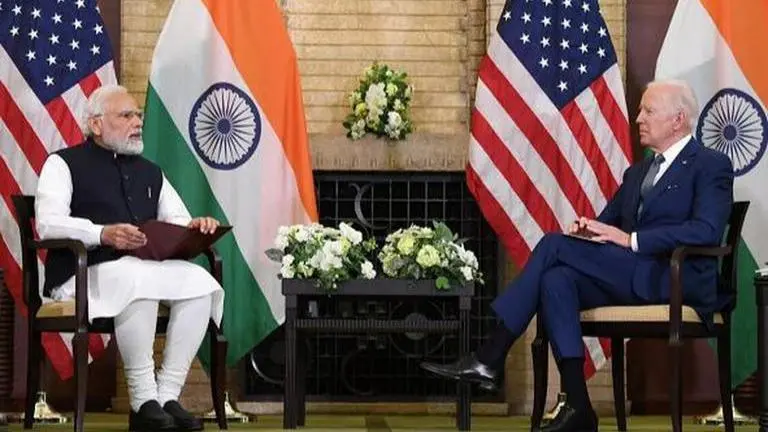
The word ‘ally’ despite its length and extrinsic appearance, is disproportionately more involved, tightly knit and cannot be indicative of the growing relationship between India and the US. This understanding is even more imperative ahead of the Modi-Biden meet in Washington DC, where Prime Minister of India Narendra Modi would be on an official state visit.
Given the growing influence of China, never-ending Russian invasion of Ukraine and historic proximity between Russia and India, it would be hard sell if the rapidly-evolving relation between the US and India is looked at from the lens of an alliance. At the most, they could be deemed partners, not allies.
Chinese aggression
With China as the big (and growing) elephant in the geopolitical theater, India and the US are on the receiving end of their common adversary China in the form of aggressive theatrics. This is where commonality ceases to exist. The reaction to Chinese aggression is a factor of their locations and this is what prevents the US and India from giving a similar rebuttal to Chinese wolf warrior diplomacy. The biggest difference being their geographical proximity to China. Although the bilateral trade of both nations with China saw an increase in recent years, it is New Delhi which is more on a strategic defensive than Washington. With a crowded neighborhood, unlike that of the US, India has several border disputes with its neighbours.
The Pakistan factor, military coup in Myanmar, the northeast insurgency, border disputes with Nepal, continual debt-trap diplomacy by China in the neighborhood are some reasons why New Delhi cannot afford another military stand-off with her Chinese neighbour. The bruising experience from the 1962 war is another reminder to India. Why is this consideration important? Because, as part of her defence cooperation, Washington would expect New Delhi to subscribe to its combative ambitions as well, and this is where there would be a potential mismatch. India would resist any combative involvement, and America, given her history, wouldn’t. For this reason (among many), despite the overt muscle flexing by China, New Delhi cannot afford the same combative reaction to her adversaries, as Washington would and could. This ties back to expectations from an ‘ally’, which sadly does not come with carte blanche.
Advertisement
Strategic dependency on the Russian MIC
Russia has been a tried and tested partner of India. This is true historically and strategically, which is evident from India’s dependency on the Russian Military Industrial Complex (MIC) for the nation's defence equipment needs. The Russia factor goes completely against Washington’s expectations and diplomacy. However, owing to realism, the US would be shrewd enough to come to terms with India’s interests in moving away from selective non-alignment.
With growing global multipolarity, the terms ‘ally’ and ‘adversary’ are reduced to imagined binaries. To sum up the phraseology, when it comes to the U.S.-India ties, ‘Quasi-allies’ is optimistic, ‘partners’ is realistic, ‘allies’ is mere gravy.
Advertisement
(Arun Ayyagari, the author of this article is an Editor, a foreign policy analyst. He frequently writes on Foreign policy, Geopolitics, U.S. Politics, and International Relations. Arun is a Fellow at American Indo-Pacific Forum, a think tank in Washington, DC. Arun is also a pilot and teaches Rocket science and Aerospace engineering.)