
Updated 3 November 2023 at 20:17 IST
Project Kusha' set to redefine India’s air defence prowess amid rising threat in the region
'Project Kusha' by the DRDO aims to enhance India's air defense with a long-range system, potentially surpassing Israel's Iron Dome.
- Defence News
- 3 min read

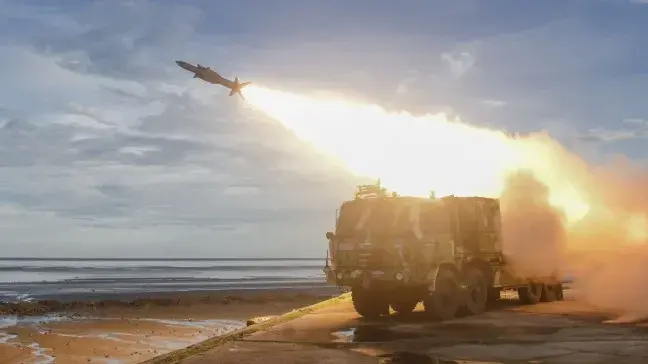
In a significant move towards enhancing its air defence capabilities, India is embarking on an ambitious project called 'Project Kusha.' This indigenous undertaking, with an estimated budget of Rs 21,700 crore, is being developed by the Defence Research and Development Organisation (DRDO). 'Project Kusha' is set to provide the Indian Air Force with a long-range air defence system, with deployment targeted for 2028-29.
Drawing parallels with Israel's renowned Iron Dome system, 'Project Kusha' is expected to not only match but potentially surpass the capabilities of its Israeli counterpart. This new air defence system aims to detect and destroy various hostile targets, including cruise missiles, stealth fighter jets, and drones at extended ranges. 'Project Kusha' is positioned to be a significant milestone in India's pursuit of self-reliance in defence, aligning with the 'Aatmanirbhar Bharat' initiative.
Key features of 'Project Kusha'
The long-range surface-to-air defence system (LR-SAM) incorporates advanced long-range surveillance and fire control radars. Meanwhile, interceptor missiles, with ranges of 150 km, 200 km, and 350 km, provide the ability to detect and strike hostile targets at different distances. The system boasts an impressive single-shot kill probability, with figures exceeding 80%. When two missiles are fired consecutively, the kill probability rises to over 90%.
Integrated surveillance and fire control radars empower the Indian Air Force (IAF) to effectively monitor airspace and fend off enemy threats. The firing units of 'Project Kusha' can seamlessly integrate with the IAF's air command and control system, facilitating coordination with a wide range of military radars. 'Project Kusha' is anticipated to significantly bolster India's air defence capabilities, ensuring the safety of Indian airspace by detecting and neutralizing hostile forces at long distances.
Advertisement
Rising threats and necessity
The need for a project like 'Kusha' has become increasingly apparent, given the evolving security dynamics in India's neighborhood, particularly with countries like Pakistan and China. China, which has deployed Russia's formidable S-400 missile system, represents a significant regional challenge.
In recent years, China has accelerated the development of indigenous defence capabilities to fortify its military might. While these systems may not match the S-400 in capability, they pose a considerable threat to India. As a result, India is actively seeking advanced air defence systems to protect its airspace effectively.
Advertisement
Tensions between India and China have escalated following the Galwan Valley conflict in 2020. Recent provocations, such as China's territorial claims and visa denials to Indian athletes, have further strained relations. Additionally, China's close ties with Pakistan raise concerns about potential collaboration in strengthening Pakistan's defence capabilities against India. 'Project Kusha' is part of India's efforts to enhance deterrence capabilities in response to the complex security challenges posed by potential two-front conflicts.
Published By : Radhika Dhawad
Published On: 3 November 2023 at 20:17 IST